

Best Coffee Scale for Precision Brewing
Table of Contents
- Why Precision Matters in Coffee Brewing
- How Scales Improve Brewing Consistency
- Best Coffee Scale for Pour Over
- Best Espresso Scale for Dosing and Yield
- Coffee Scale with Timer: Combining Measurement and Brew Time
- How to Use a Coffee Scale for Repeatable Results
- Key Features to Evaluate: Accuracy, Durability, and Usability
- Common Mistakes When Choosing and Using a Coffee Scale
- Frequently Asked Questions
Last Updated: October 12, 2026
Why Precision Matters in Coffee Brewing
Getting your coffee right starts with measurement. Most home brewers eyeball their beans and water, then wonder why their cup tastes inconsistent. A best coffee scale removes that guesswork and makes brewing repeatable.
Precision affects extraction, which determines flavor. Measuring accurately lets you control the coffee-to-water ratio, the foundation of every good cup. Without a scale, you're brewing blind, and the difference between an exceptional cup and a mediocre one often comes down to weighing versus estimating.
How Scales Improve Brewing Consistency
A coffee scale delivers consistency nothing else can. Measuring by weight eliminates the variables of volume measurements: a scoop of finely ground espresso weighs more than a scoop of coarse grounds, and a scale just measures mass.
Extraction depends on the coffee-to-water ratio. Get it wrong and you either under-extract (weak, sour) or over-extract (bitter, harsh). A scale lets you dial in the exact ratio for your beans, grinder, and method, then repeat it every time.
The real benefit emerges over months. Brewing consistently reveals subtle flavors you'd miss if every cup tasted slightly different, and you begin to understand how your beans taste when brewed correctly. That's when coffee becomes something you genuinely enjoy.
Best Coffee Scale for Pour Over
Pour-over demands precision because you manually control water flow and brew time. A coffee scale for pour over should measure coffee and water accurately, ideally with a timer.
For pour-over work, look for a scale with these characteristics:
- Resolution of at least 0.1 grams, Pour-over recipes often call for precise amounts, and finer resolution helps you dial in the exact dose
- Capacity between 500-2000 grams, Enough to hold your dripper, filter, and coffee without exceeding the maximum weight limit
- A tare function, Essential for measuring just the coffee or just the water without removing the dripper from the scale
- Response time under 2 seconds, You want the reading to stabilize quickly as you pour water
Many pour-over enthusiasts use a basic digital scale with a timer, which tracks brew time without checking your phone and keeps your focus on pouring technique. The scale needn't be fancy, just accurate and durable enough for daily use on a wet counter.
Water resistance matters more here than with other methods, since pour-over involves active pouring and splashing. Look for a scale rated for kitchen use.
Best Espresso Scale for Dosing and Yield
Espresso demands the most precision of any brewing method. A best espresso scale must measure both input (dose) and output (yield), often in real time while you pull a shot.
Espresso scales typically need:
- Resolution of 0.1 grams or finer, Espresso doses are small (usually 18-22 grams), so you need precision to hit your target
- A maximum capacity of at least 500 grams, You need room for the portafilter, basket, and espresso cup
- Fast response time, ideally under 1 second, Espresso shots pull quickly, and you may want to monitor weight changes as the shot extracts
- Calibration capability, Espresso scales often need periodic calibration to maintain accuracy over time
The difference between a pour-over and espresso scale is responsiveness and precision. Espresso scales track weight changes in real time, helping you understand extraction; some enthusiasts monitor shot weight as it extracts, adjusting pressure or grind if the flow seems off.
Accuracy matters more than budget here. A scale off by 0.5 grams might be fine for a liter of pour-over, but it's a problem when your entire espresso dose is 20 grams. Invest in an espresso-specific scale if that's your primary method.
Coffee Scale with Timer: Combining Measurement and Brew Time
A coffee scale with timer solves a real problem: you need to measure weight and track time at once, but most kitchen scales lack a timer. Some coffee scales integrate both, so you're not juggling two devices.
The timer serves several purposes:
- Brew time tracking, Tells you how long your water has been in contact with coffee, which affects extraction
- Pre-infusion monitoring, For espresso, lets you time the bloom phase before full pressure
- Consistency checking, If your brew time varies wildly, it signals a problem with grind size or pouring technique
Not every coffee scale includes a timer, and many brewers just use their phone. If you prefer a dedicated device, look for scales that combine both functions clearly, with a timer that's easy to start and stop without resetting your weight reading.
The trade-off is price: scales with integrated timers cost more than basic digital scales. If you brew pour-over every morning and want to track consistency, the convenience may be worth it; if you brew occasionally, a separate timer works fine.
How to Use a Coffee Scale for Repeatable Results
Measuring Coffee and Water
Place your brewing device on the scale and tare it to zero, so the scale measures only what you add next, not the dripper or cup underneath.
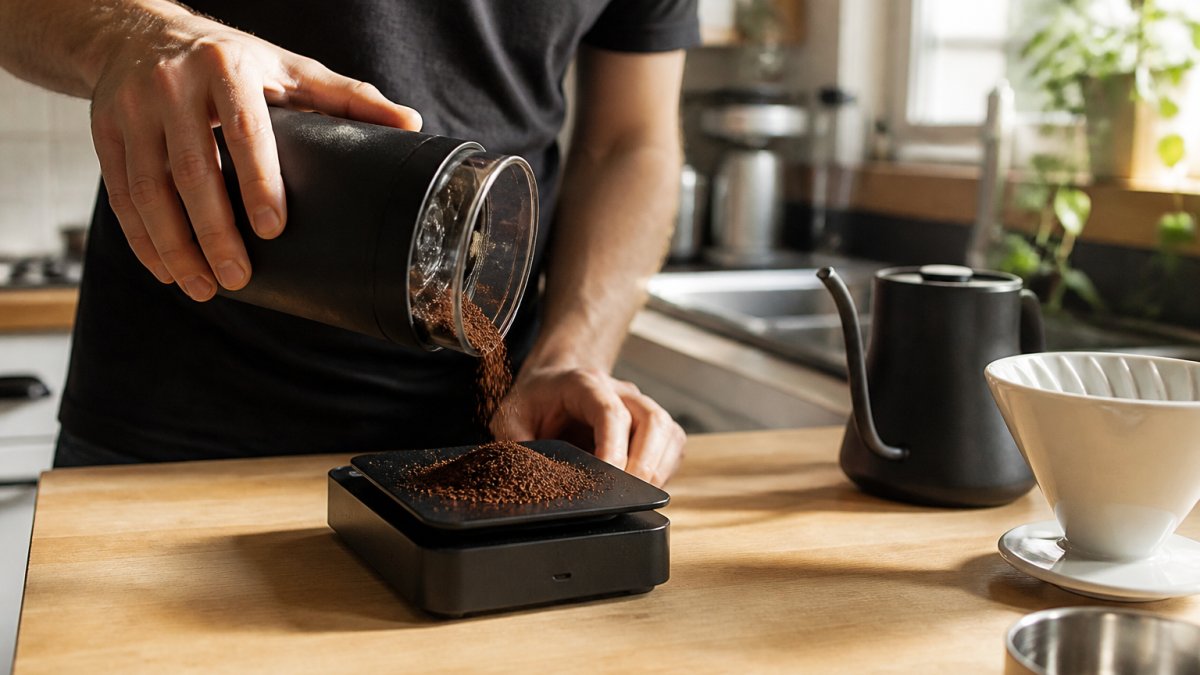
Add your ground coffee. Pour-over doses typically range from 15-30 grams depending on vessel and preferred strength; espresso doses usually fall between 18-22 grams. Write down the weight you choose as your baseline.
Tare again to zero out the coffee weight, then pour water until you reach your target weight. Most recipes use 1 part coffee to 16-18 parts water by weight, though some prefer stronger (1:15) or weaker (1:20) brews.
The scale should display both measurements clearly. If the numbers are hard to read quickly, consider a larger display, since you'll be reading it while actively brewing.
Coffee-to-Water Ratios
The coffee-to-water ratio is the most important variable you control, directly determining strength and extraction.
Common ratios by brewing method:
- Pour-over: 1:16 to 1:18 (one part coffee to 16-18 parts water)
- French press: 1:15 to 1:17 (slightly stronger, since immersion brewing is less efficient)
- Espresso: 1:2 to 1:3 (dose to yield, if you use 20 grams of coffee, you want 40-60 grams of espresso out)
- Immersion cold brew: 1:4 to 1:8 (very strong concentrate, then diluted)
Start with 1:16 for pour-over. If your coffee tastes weak or sour, move toward 1:15; if bitter or harsh, move toward 1:17 or 1:18. The scale lets you adjust precisely instead of guessing.
Once you find a ratio that works, write it down. Next time you'll know exactly how much coffee and water to use, turning a recipe into a repeatable formula.
Calibration and Accuracy
Most digital scales need occasional calibration. Check your manual, since instructions vary by model: some calibrate automatically, while others require placing a known weight on them and confirming the reading.
Calibration matters most if your scale is off by 0.5 grams or more. Small errors won't ruin casual brewing, but when dialing in espresso or matching a specific recipe, even 0.5 grams shifts results noticeably.
Test accuracy by weighing the same object multiple times. Readings should be identical each time; if they vary, the scale may need calibration or replacement.
Store your scale on a level surface, away from moisture. A scale exposed to water or dropped repeatedly loses accuracy over time, so treat it like the precision tool it is.
Key Features to Evaluate: Accuracy, Durability, and Usability
Scale Accuracy and Resolution
Accuracy has two parts: resolution (the smallest increment the scale measures) and repeatability (whether it gives the same reading each time).
Resolution matters most for espresso and other small-dose brewing. A 0.1-gram resolution is standard for coffee work, and 0.01-gram resolution is genuinely useful for dialing in espresso recipes precisely. For pour-over and immersion, 0.1 grams is sufficient. Consistent measurements provide the foundation for brewing better coffee, ensuring that each variable remains controlled as you refine your extraction technique.
Repeatability is equally important: a scale can have fine resolution but give slightly different readings each time you weigh the same object. Test this before buying by weighing something several times; consistent readings signal a reliable scale.
Temperature can affect accuracy, since some scales drift as they warm up. If you brew at the same time each morning, this shouldn't matter, but if conditions vary, a scale with good temperature stability is worth the extra cost.
Minimum Weight and Maximum Capacity
Minimum weight is the smallest amount the scale measures accurately. Most coffee scales have a 2-5 gram minimum, which is fine; a 10-gram minimum makes small espresso doses difficult.
Maximum capacity determines what you can weigh. A 500-gram maximum won't hold a full French press but is fine for espresso, while a 2000-gram (2-kilogram) maximum handles almost any home setup. Choose based on what you brew.
Some brewers use a small, precise scale for espresso and a larger one for pour-over. It isn't necessary, but it's an option if you want specialized tools.
Water Resistance and Long-Term Reliability
Kitchen scales get wet, since brewing involves steam, splashing, and humidity. A scale rated for kitchen use has some water resistance, but ratings vary.
Look for sealed buttons and a water-resistant display, with a solid, stable base rather than flimsy plastic. If you'll set a wet dripper on it or pour water nearby, durability matters.
Battery life is worth considering. Some scales use easy-to-replace AA or AAA batteries; others are rechargeable, which is convenient until the battery stops holding a charge. Check how long a charge lasts and whether replacements are easy to find.
A scale that lasts five years beats one that fails after eighteen months, even if the cheaper one costs less upfront. For a daily tool, durability is an investment.
Common Mistakes When Choosing and Using a Coffee Scale
The biggest mistake is buying a scale too imprecise for your needs. A bathroom scale typically has 100-gram increments, useless for coffee, and even basic kitchen scales sometimes have resolution coarser than 0.1 grams.
Another common error is not taring properly. Forget to tare after placing your dripper and your measurements are off by the dripper's weight. Make taring routine: place the device, tare, add coffee, tare again, add water.
Many brewers measure their coffee but eyeball the water, which defeats the purpose. If you use a scale, measure both components; consistency comes from measuring everything.
An uneven surface causes readings to drift, and your counter might slope slightly even if it looks level. Place the scale on a flat, stable surface and don't move it while measuring.
Ignoring calibration is a mistake if your scale is old or readings drift.
Finally, don't assume that a more expensive scale is always better. A mid-range scale that's durable and accurate will outperform an expensive one with poor build quality.
Precision in coffee brewing doesn't require expensive equipment or complicated techniques. Pair our carefully sourced, freshly roasted coffee with a quality scale and you'll taste the difference immediately. The Specialty Coffee Association provides brewing guidelines for different methods if you want to dial in your ratios further.
Frequently Asked Questions
Do you need a special scale for brewing coffee?
A dedicated coffee scale is worth the investment if you want repeatable, flavorful brews. While a kitchen scale can technically weigh coffee beans and water, a coffee scale offers faster response times, better resolution (often 0.1g increments), and features like automatic timers and tare functions that streamline your workflow. For precision brewing, the speed and accuracy differences add up across hundreds of brews.
How accurate should a coffee scale be?
Look for a scale with 0.1g resolution and ±0.5g accuracy for pour-over and immersion brewing. Espresso requires tighter tolerances: 0.01g resolution is ideal for dialing in dose and yield. Accuracy matters because a 1-gram error in a 20-gram dose changes your coffee-to-water ratio by 5%, noticeably affecting extraction and flavor. Calibration capability ensures long-term reliability.
Is a coffee scale with a timer worth it?
Yes, if you brew pour-over or immersion methods regularly. An integrated timer eliminates the need for a separate device and keeps your hands free to pour. You can monitor brew time without looking at your phone, improving consistency and letting you adjust pour rate or water temperature mid-brew. For espresso, timers are less critical since shots finish in 25-30 seconds, but they still help track flow rate.
What is the best coffee-to-water ratio?
A 1:16 ratio (1g coffee to 16g water) is a reliable starting point for most brewing methods. Pour-over typically ranges 1:15 to 1:17, while espresso uses 1:2 to 1:2.5 (e.g., 20g in, 40-50g out). Precision scales let you dial in your exact preference: if you prefer stronger coffee, try 1:14; for lighter, try 1:18. Weighing both coffee and water removes guesswork and lets you replicate your best brews.