

Best Dark Roast Coffee for Espresso: Top Picks 2026
Table of Contents
- What Makes the Best Dark Roast Coffee for Espresso
- Quick Comparison: Top Dark Roast Espresso Beans
- 1. Eager Beaver Roasters: Roasted to Order for Maximum Freshness
- 2. Lavazza Super Crema: Italian Tradition Meets Reliable Crema
- 3. Peet's Major Dickason's Blend: Full-Bodied Complexity for Serious Espresso Lovers
- 4. Death Wish Coffee: Maximum Intensity and Organic Certification
- 5. Kicking Horse Cliff Hanger: Ethically Sourced with Fruity Complexity
- 6. Stumptown Founders Blend: Direct Trade Dark Roast Simplicity
Last Updated: July 22, 2026
Finding the best dark roast coffee for espresso requires understanding how roast level, bean density, and crema production work together. At Eager Beaver Roasters, we've spent years sourcing and roasting beans specifically for espresso machines. Below, we'll walk you through what separates truly great espresso dark roasts from the rest, and show you six options that deliver on that promise.
What Makes the Best Dark Roast Coffee for Espresso
Dark roast espresso beans are roasted longer than light or medium roasts, deepening caramelization and bringing out bold, rich flavors. The real skill is finding a dark roast that balances body, crema production, and smoothness without tipping into bitterness.
The best dark roast coffee for espresso achieves three things simultaneously: it produces thick, consistent crema, that golden-brown layer carrying flavor compounds; it has enough density and oil content to resist channeling (uneven water flow); and it delivers complex flavor notes rather than just tasting burnt.
Crema, Body, and Flavor Balance
Crema forms when hot water forces CO2 and oils from coffee grounds into an emulsion. Dark roasts produce more crema naturally because extended roasting breaks down cell walls and releases more oils. The sweet spot for espresso dark roasts is medium-dark roasting, where you get strong crema without excessive greasiness. According to the Specialty Coffee Association's espresso standards, proper crema should be 1/4 to 1/3 of the total shot volume and should persist for at least 30 seconds.
Body refers to the weight and texture of the espresso on your palate. A full-bodied dark roast feels heavier and richer than a light roast, coming from dissolved solids and oils that survive brewing. There's a point of diminishing returns where you're tasting char instead of coffee.
Oiliness and Bean Freshness Indicators
Visible oiliness on whole beans signals a dark roast, but freshly roasted dark beans may appear dry for the first 3-5 days after roasting because CO2 is still escaping. Once degassing stabilizes (around day 7-10), oils migrate to the surface, ideal for espresso.
Look for a matte finish with a light sheen. Beans that are shiny and clumped together have likely been sitting for weeks or months and may have gone stale. The roast date is your most reliable indicator of freshness. Beans roasted within the last 7-14 days are ideal for espresso. Eager Beaver Roasters roasts to order, which means your beans arrive at their peak.
Quick Comparison: Top Dark Roast Espresso Beans
| Coffee | Roast Profile | Best For | Key Characteristic |
|---|---|---|---|
| Eager Beaver Roasters | Dark, roasted to order | Maximum freshness | Customizable roast date |
| Lavazza Super Crema | Dark blend (60% Arabica, 40% Robusta) | Milk-based drinks | Thick, reliable crema |
| Peet's Major Dickason's | Full dark roast | Complex flavor | Earth and spice notes |
| Death Wish Coffee | Dark, organic blend | High caffeine | Bold, smooth finish |
| Kicking Horse Cliff Hanger | Medium-dark | Fruity complexity | Organic and Fair Trade |
| Stumptown Founders Blend | Dark roast | Straightforward boldness | Direct Trade certified |
1. Eager Beaver Roasters: Roasted to Order for Maximum Freshness
Nothing beats freshly roasted beans. Eager Beaver Roasters roasts to order, meaning your beans are roasted specifically for you and shipped immediately. This eliminates the biggest problem with buying dark roast espresso online: stale beans that have lost their crema potential and flavor complexity.
Dark beans are more porous and degrade faster than light roasts. By the time a dark roast has sat in a warehouse for two months, the flavor has flattened and crema production drops noticeably. With Eager Beaver Roasters, you're guaranteed beans that are 3-7 days old when they arrive, the sweet spot for espresso.
Eager Beaver Roasters sources beans from trusted farms worldwide and offers light, medium, and dark roast options. For espresso specifically, their dark roasts are engineered to produce full body and rich crema while avoiding the ashy, over-roasted taste that plagues many mass-market dark roasts. The beans arrive whole, so you can grind them fresh for each shot, a critical step that makes a measurable difference in extraction and flavor.
2. Lavazza Super Crema: Italian Tradition Meets Reliable Crema
Lavazza Super Crema is one of the world's most popular espresso blends. This blend combines 60% Arabica and 40% Robusta beans from 15 different coffee-growing countries, creating a consistent, foolproof espresso that works in nearly any machine. The Robusta component is key, Robusta beans are naturally higher in caffeine and produce more crema than Arabica.

The flavor profile leans toward sweetness with notes of hazelnut, brown sugar, and honey. This makes Lavazza Super Crema exceptional in milk-based drinks like cappuccinos and lattes. The crema is thick and compact, persisting longer than most blends. If you prefer straight espresso shots without milk, you might find this blend too sweet and lacking complexity.
Pricing falls in the mid-range for quality espresso, and the beans are widely available in grocery stores. Check the roast date before buying, aiming for bags roasted within the last 60 days.
What works: The Robusta blend ensures consistent crema production. The flavor is smooth and approachable for people new to espresso.
What doesn't: The sweetness can become cloying with multiple shots. Shelf availability means fresher alternatives exist if you order online.
3. Peet's Major Dickason's Blend: Full-Bodied Complexity for Serious Espresso Lovers
Peet's Major Dickason's Blend is a 100% Arabica dark roast that delivers serious complexity without sacrificing smoothness. This blend of premier origin coffees from Latin America and the Indo-Pacific delivers deep notes of earth, spice, dark chocolate, and subtle fruit undertones.
The roast is darker than Lavazza but not so dark that it tastes burnt. Peet's has been roasting coffee since 1966, and their expertise shows in the balance they've achieved. The beans are dense and dark with visible but not excessive oiliness. Crema production is strong, though not quite as thick as the Lavazza blend, the tradeoff for using 100% Arabica instead of a Robusta blend.
Major Dickason's works exceptionally well as a straight shot, where the complexity shines. It's also solid in milk-based drinks, though the earthiness is more pronounced than sweetness.
4. Death Wish Coffee: Maximum Intensity and Organic Certification
Death Wish Coffee has built a brand around "the world's strongest coffee," and they deliver on that claim. This dark roast blend combines USDA Organic and Fair Trade Certified Arabica and Robusta beans, creating an extremely high-caffeine coffee with bold, smooth flavor.

The flavor profile emphasizes dark chocolate and black cherry notes, with naturally low acidity that prevents the bitterness you'd expect from such a dark roast. The air-roasting process minimizes the ashy taste that plagues many high-caffeine dark roasts. The result is a smooth, drinkable espresso that packs significantly more punch than standard blends.
The Robusta component drives the caffeine content and crema production, making this blend excellent for espresso machines. However, if you're sensitive to caffeine or prefer lighter, more nuanced flavors, Death Wish is overkill. Pricing is higher than mainstream options, but reasonable for an organic, certified blend.
What works: Exceptional crema production, smooth despite high intensity, certified organic and Fair Trade.
What doesn't: The intensity is unnecessary for most espresso drinkers. The price premium is significant.
5. Kicking Horse Cliff Hanger: Ethically Sourced with Fruity Complexity
Kicking Horse Coffee Cliff Hanger Espresso is an organic, Fair Trade, medium-dark roast that breaks the mold of traditional dark roast espresso. Instead of earthy, chocolatey profiles, Cliff Hanger delivers tasting notes of wild berry syrup, blackcurrant, and milk chocolate with a smooth cocoa finish.
The beans come from Indonesia, Central America, and South America, sourced directly from farms that meet strict ethical standards. The medium-dark roast preserves more origin characteristics than a full dark roast, which is why you get fruity notes instead of just chocolate and char. The crema is solid but not as thick as some competitors, the tradeoff for a lighter roast that emphasizes flavor over body.
Cliff Hanger works well as a straight shot if you appreciate fruity, complex espresso. In milk-based drinks, the fruit notes become more subtle, and the cocoa finish takes center stage. Pricing is higher than mainstream options, reflecting the organic certification and direct trade sourcing.
6. Stumptown Founders Blend: Direct Trade Dark Roast Simplicity
Stumptown Coffee Roasters Founders Blend is a straightforward dark roast that delivers a bold, full-bodied espresso without complexity or pretension. This 100% Arabica coffee sourced through Direct Trade partnerships is roasted dark enough to produce thick crema and rich body without tasting ashy.

The flavor profile emphasizes dark chocolate and strong character. There are no surprising fruit notes or delicate undertones, just a clean, strong espresso that works beautifully in milk-based drinks and stands up well as a straight shot. Stumptown has been roasting coffee since 1999 and has built a reputation for quality and consistency. Their Direct Trade sourcing means beans are sourced directly from farms, ensuring better prices for producers.
Pricing is competitive with other specialty roasters. If you want a no-compromise dark roast espresso without paying premium prices for organic certification or exotic sourcing stories, Stumptown Founders Blend delivers.
What works: Bold, straightforward flavor profile. Direct Trade sourcing. Consistent roasting quality.
What doesn't: Lacks the complexity or unique characteristics of other options. Not ideal if you prefer subtle, nuanced flavors.
Espresso Grind Size for Dark Roast: Getting It Right
Grinding dark roast espresso beans requires a finer setting than you might use for light roasts, but not as fine as you'd think. Dark roast beans are more porous and less dense, making them easier to extract. If you grind them too fine, you risk over-extraction, which produces bitter, ashy shots. The ideal grind for dark roast espresso is slightly coarser than for medium roasts, think fine sand, not powder.
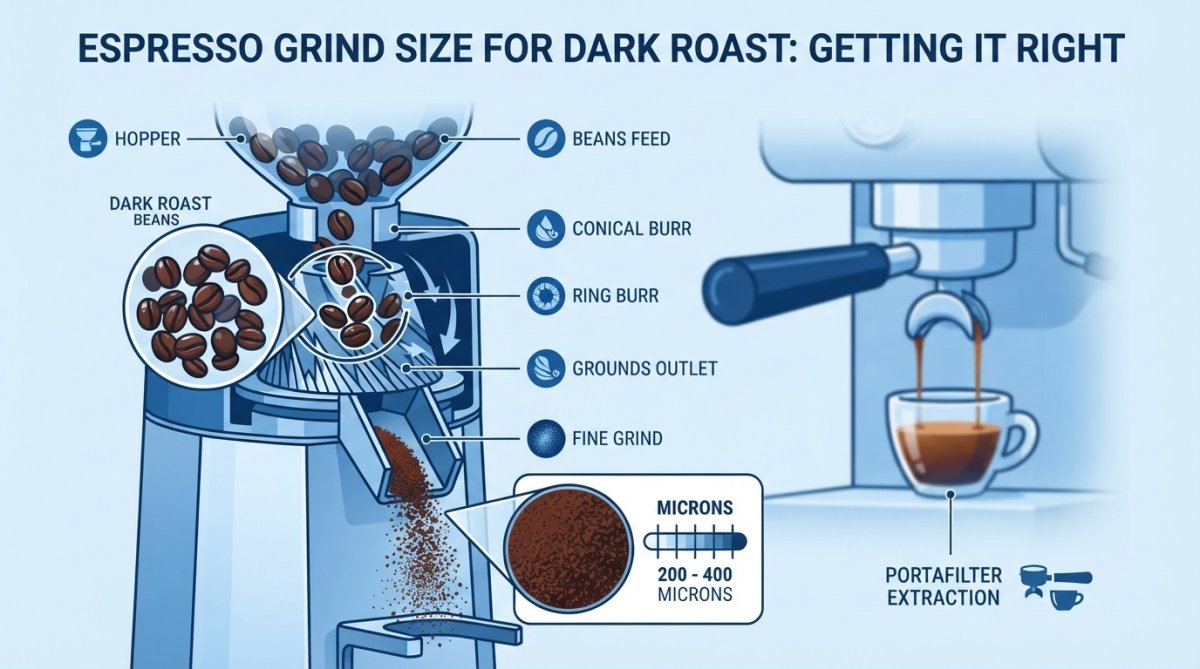
Aim for a 25-30 second pull. If the shot pulls too quickly (under 20 seconds), grind finer. If it pulls too slowly (over 35 seconds), grind coarser. Burr grinders (either conical or flat burrs) are essential for espresso. Blade grinders produce inconsistent particle sizes, causing uneven extraction and weak shots.
Dark Roast Espresso in Milk-Based Drinks vs. Straight Shots
Dark roast espresso behaves differently depending on how you drink it. As a straight shot, dark roasts shine when they have complexity and balance. In milk-based drinks, dark roasts excel because their boldness cuts through the milk and prevents the espresso from disappearing.
For milk drinks like cappuccinos and lattes, you actually want a darker, bolder roast than you would for straight shots. The milk dampens subtle flavors, so a light or medium roast espresso can become insipid when combined with milk. Dark roasts maintain their character and presence even when diluted with steamed milk and foam.
If you're primarily drinking straight espresso shots, choose a dark roast with complexity and balance, like Peet's Major Dickason's or Kicking Horse Cliff Hanger. If you're primarily making lattes and cappuccinos, a darker, bolder roast like Lavazza Super Crema or Death Wish Coffee will give you better results. Eager Beaver Roasters allows you to customize your roast based on how you actually drink your espresso.
How to Choose the Best Dark Roast Beans for Your Machine
Choosing the best dark roast coffee for espresso comes down to three factors: your machine, your taste preferences, and your commitment to freshness. If you have a high-end espresso machine with precise temperature and pressure controls, you can get away with lighter, more complex roasts. If you have a basic machine or a Moka pot, you'll have better results with a darker, more forgiving roast like Lavazza Super Crema.
Your taste preferences matter more than any expert recommendation. If you love bold, intense flavors, Death Wish or Stumptown will satisfy you. If you prefer balanced, complex espresso, Peet's or Kicking Horse are better choices. If you want maximum freshness and customization, Eager Beaver Roasters roasts to order and lets you specify your preferred roast profile.
Freshness is non-negotiable. Beans older than 30 days lose their crema potential and flavor complexity. Always check the roast date before buying. Start with a 1/2 lb or 1 lb bag to test before committing to larger quantities.
Tasting Notes and Flavor Profiles: What to Expect
Dark roast espresso delivers a range of flavor notes depending on the origin and roasting profile.
Chocolate and Cocoa: The most common dark roast note, resulting from caramelized sugars during roasting. Quality chocolate notes are rich and smooth; poor roasting produces ashy, burnt chocolate.
Nuts (hazelnut, almond, walnut): Common in blends that include Robusta beans. Nutty notes add sweetness and body without bitterness.
Spice (cinnamon, clove, black pepper): Develops during the roasting process as sugars break down. Spice notes add complexity and prevent dark roasts from tasting one-dimensional.
Caramel and Brown Sugar: Signs of proper caramelization during roasting. These notes add sweetness and body, making espresso smoother.
Earth and Tobacco: More subtle notes found in single-origin dark roasts. These notes indicate terroir and add complexity.
Fruit (berry, cherry, citrus): Surprising in dark roasts, but medium-dark roasts can preserve these notes. Fruit notes add brightness and prevent espresso from feeling heavy.
When tasting espresso, notice the notes that appear at different stages. The first sip might emphasize chocolate, the middle might highlight spice, and the finish might reveal caramel or fruit. This evolution indicates quality roasting and proper extraction.
The Role of Crema in Espresso Quality
Crema is often mistaken as the most important indicator of espresso quality, but it's actually just one of several factors. Crema is the emulsion of oils, gases, and water that forms when hot water forces through finely ground coffee under pressure. It carries flavor compounds and adds texture, but it's not a substitute for proper extraction and bean quality.
Thick, persistent crema is a sign that the beans are fresh and the extraction is on point. However, some excellent espressos produce less crema than others. Single-origin Arabica coffees often produce thinner crema than Robusta blends, but that doesn't make them inferior. The ideal crema should be 1/4 to 1/3 of the total shot volume and should last at least 30 seconds. A shot with thin crema and exceptional flavor is better than a shot with thick crema that tastes ashy.
Roast Levels Explained: From Medium-Dark to Super Dark
Understanding roast levels helps you choose beans that match your preferences.
Medium-Dark Roast: Roasted until the second crack begins. The surface shows visible oils, and the color is dark brown. Medium-dark roasts preserve more origin characteristics while still producing good crema. Ideal for espresso if you prefer balanced flavor with some complexity.
Dark Roast: Roasted through the second crack, producing a dark brown to nearly black color with visible oiliness. The roasting process dominates the flavor profile, creating bold chocolate, caramel, and spice notes. This is the standard for espresso in most cafes.
French Roast / Super Dark: Roasted well past the second crack, producing an almost black color and maximum oiliness. The flavor is bold and intense, with minimal origin characteristics. French roasts are more prone to bitterness but work well in milk-based drinks.
Italian Roast: Similar to French roast but sometimes roasted slightly lighter. Always check the roast date and appearance rather than relying on the name alone.
The Agtron scale provides objective measurement: lower numbers indicate darker roasts. Most espresso roasts fall between 25-35 on the Agtron scale. Anything darker than 20 approaches French roast territory and may taste ashy.
Choosing the best dark roast coffee for espresso comes down to prioritizing freshness, understanding your machine's capabilities, and matching the roast profile to your taste preferences. Eager Beaver Roasters stands out because they roast to order, eliminating the staleness problem that plagues most online coffee retailers. With customizable roast profiles and beans roasted within days of shipping, you'll get the crema production and flavor complexity that makes espresso worth the effort. Find your perfect roast at Eager Beaver Roasters and taste the difference that freshness actually makes.
Frequently Asked Questions
What makes a dark roast coffee good for espresso?
The best dark roast coffee for espresso produces thick, stable crema, has a full-bodied mouthfeel, and balances bitterness with caramelized sweetness. Look for beans with visible oiliness (indicating proper caramelization), low acidity for smooth extraction, and a roast profile that highlights chocolate, nutty, or smoky notes rather than sour or grassy flavors. Espresso roast blends are specifically formulated for espresso machines and typically perform better than single-origin light or medium roasts.
What's the ideal espresso grind size for dark roast beans?
Dark roast beans are softer and more porous than lighter roasts, so they require a slightly coarser grind than you might use for medium roasts. Target a fine but not powder-like consistency, think fine sand rather than flour. Start at a medium-fine setting on your grinder and adjust based on shot time: if extraction is too fast (under 25 seconds), go finer; if too slow (over 35 seconds), go coarser. Equipment-specific adjustments matter: espresso machines with higher pressure may need slightly coarser grinds.
Can I use any dark roast coffee for espresso, or do I need espresso-specific beans?
While you can technically use any dark roast whole bean for espresso, beans labeled as 'espresso roast' or 'espresso blend' are optimized for espresso machines. These blends are formulated to produce excellent crema, balanced sweetness, and full body under espresso pressure and temperature. Single-origin dark roasts can work, but espresso blends, typically combining Arabica and Robusta varieties, are more forgiving and deliver more consistent results, especially for home baristas.
What flavor notes should I expect from dark roast espresso?
Quality dark roast espresso typically features chocolate notes, nutty flavors (hazelnut, almond), caramelized sweetness, and earthy undertones. Avoid beans that taste burnt, ashy, or excessively bitter, this indicates over-roasting. Some dark roasts include subtle fruit notes (cherry, berry) or spice complexity. Tasting notes vary by origin blend: Latin American beans often emphasize chocolate and nuts, while Indonesian coffees add earthy, herbal characteristics. Check the roaster's tasting notes and look for descriptions mentioning 'smooth,' 'balanced,' or 'sweet' rather than just 'bold' or 'strong.'
Are dark roast espresso beans lower in acid than lighter roasts?
Yes, dark roast coffee generally has lower acidity than light or medium roasts because the extended roasting process breaks down chlorogenic acids. This makes low acid dark roast coffee a better choice for people with sensitive stomachs or acid reflux. During espresso brewing, proper extraction technique, avoiding over-extraction, further reduces perceived acidity. Brands like Death Wish Coffee specifically market naturally low acidity, and Kicking Horse emphasizes a smooth finish, both appealing to those seeking gentler espresso.
This article was written using GrandRanker