

Best Way to Store Roasted Coffee Beans
Table of Contents
- Understanding the Enemies of Coffee Freshness
- The Best Way to Store Roasted Coffee Beans at Home
- Best Coffee Storage Containers for Maximum Freshness
- How Long Do Coffee Beans Last in Storage
- Freezing Coffee Beans: Pros, Cons, and Best Practices
- Maintaining Coffee Freshness: Environmental Factors and Storage Conditions
- Quick Storage Guide: Best Practices for Different Roast Profiles
- Conclusion: Keeping Your Roasted Beans at Peak Flavor
Last Updated: July 30, 2026
Finding the best way to store roasted coffee beans comes down to understanding what degrades them and building a storage strategy that fights back. The enemies are simple: oxygen, light, heat, and moisture. Master these variables, and your coffee stays exceptional.
This guide walks you through every storage method that actually works, from the original bag to vacuum-sealed containers to freezing, and shows you exactly how to match your approach to your roast profile and consumption pace.
Understanding the Enemies of Coffee Freshness
Coffee staling is chemistry. The moment beans are roasted, they begin losing volatile compounds that create aroma and flavor. Your job is to slow that process.
How Oxidation and Air Exposure Degrade Your Beans
Oxidation is the primary culprit in coffee degradation. When oxygen contacts roasted beans, it triggers chemical reactions that break down the compounds responsible for taste and aroma. A freshly roasted bean exposed to air degrades noticeably within 24 hours and significantly within a week.
Freshly roasted coffee also needs to degas. During the first 24-72 hours after roasting, beans release carbon dioxide (CO2) built up during roasting. The solution is a one-way valve, it lets CO2 escape while blocking oxygen from entering. This is why quality roasters include a one-way valve in the original bag.
After the degassing window closes (usually by day 4), your priority shifts to blocking oxygen completely. An airtight seal without a valve becomes your best friend.
Why Light, Heat, and Moisture Matter
Light, particularly UV light, accelerates the breakdown of coffee compounds. A bean stored in a clear jar on a sunny kitchen counter will noticeably decline in flavor within 3-4 days compared to the same bean in an opaque container.
Heat speeds up every degradation process. Every 10-degree increase in temperature roughly doubles the rate of staling. This is why pantry storage beats countertop storage, and why freezing works, cold dramatically slows chemical reactions.
Moisture is equally important. Humid environments cause beans to absorb water, promoting mold growth and diluting flavors. The ideal humidity range is 50-65%.
The Best Way to Store Roasted Coffee Beans at Home
Storing roasted coffee beans effectively depends on understanding your consumption pace and roast profile.
The Role of One-Way Valves in Fresh Coffee Storage
A one-way valve allows CO2 to escape while preventing oxygen from entering. For the first 24-72 hours after roasting, this valve is invaluable. However, the valve becomes a problem after degassing completes. An open valve allows ambient oxygen to gradually seep in over time.
Once beans have finished degassing, typically by day 4 after roasting, transferring to a fully airtight container (without a valve) is recommended. The valve is essential during the fresh roast window. It's a liability during storage.
Storing Coffee in the Original Bag vs. Transfer
The original bag from a quality roaster is engineered for the first week of storage. It typically includes a one-way valve, an opaque exterior, and a resealable zipper. For beans you'll consume within 7-10 days, the original bag is your best option.
Beyond day 10, transferring to a dedicated storage container makes sense. The original bag wasn't designed for long-term storage. Once you transfer, you're moving to a different storage paradigm.
| Storage Method | Best For | Duration | Oxygen Protection |
|---|---|---|---|
| Original bag with valve | First 7-10 days | Immediate consumption | Good |
| Airtight canister | Weeks 2-4 | Regular use | Excellent |
| Vacuum-sealed container | Weeks 2-6 | Moderate use | Excellent |
| Freezer storage | Weeks 4-12 | Infrequent use | Excellent |
Best Coffee Storage Containers for Maximum Freshness
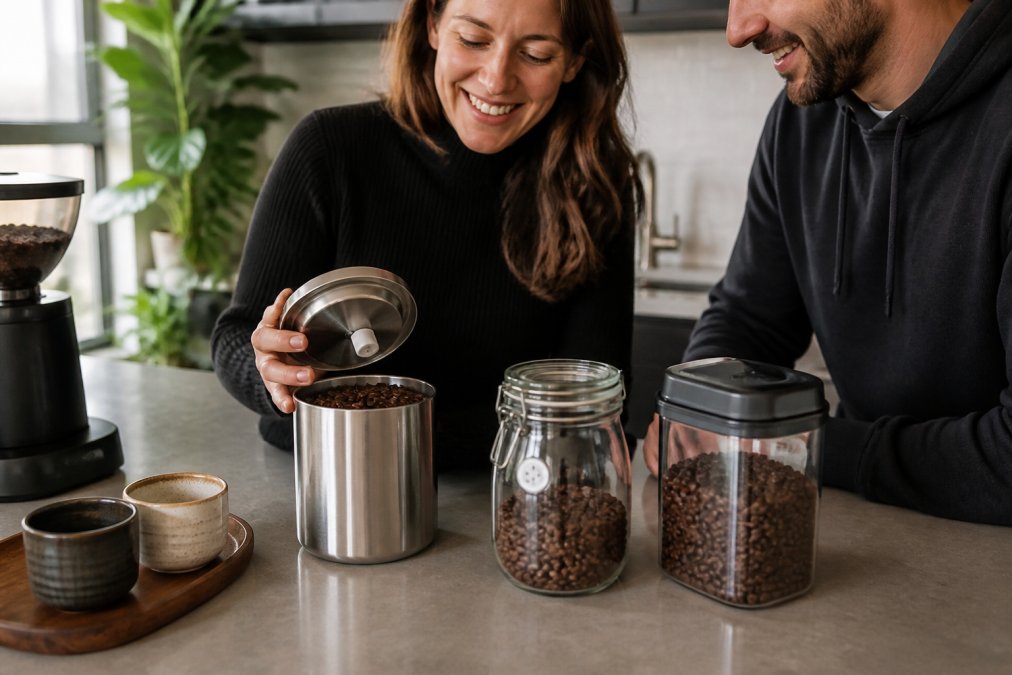
The right container makes the difference between coffee that stays vibrant for three weeks and coffee that tastes flat by week two.
Vacuum Sealing vs. Nitrogen Flushing: Which Works Better
Vacuum sealing removes air from the container before sealing it, creating a near-oxygen-free environment. This is highly effective for storage periods of 2-6 weeks. Nitrogen flushing is a commercial technique where nitrogen gas replaces oxygen before sealing, slightly more effective than vacuum sealing but requiring commercial equipment.
For home use, vacuum sealing wins on practicality. The Fellow Atmos Vacuum Canister ($39.95-$85.00) uses an integrated pump to remove air and seal tight, extending freshness up to 50% longer than standard airtight containers. The Tightpac Coffeevac ($12.99-$19.00) uses a patented vacuum closure system that's simpler and cheaper but still effective.
Container Material Comparison: Glass, Stainless Steel, and Plastic
Stainless Steel: Blocks light completely and maintains a consistent internal environment. The Planetary Design Airscape Coffee Canister ($35.00-$49.00) uses restaurant-grade stainless steel with a patented plunger lid that actively forces air out as you close it. Stainless steel is the most durable long-term option.
Opaque Glass: Blocks light and allows you to see your bean level. Glass is chemically inert and doesn't impart taste or odor. The downside is fragility and poor insulation against temperature fluctuations.
BPA-Free Plastic: Lightweight and affordable, but degrades over time and can leach compounds if exposed to heat or light. For short-term storage (under 4 weeks), plastic works fine. Beyond that, metal or glass is safer.
For maximum freshness and durability, stainless steel beats glass and plastic. The Friis Coffee Vault ($38.90-$44.90) uses stainless steel with a patented freshness valve and includes a year's supply of replacement valves.
How Long Do Coffee Beans Last in Storage
Freshness isn't binary. Beans degrade on a curve. Understanding where your beans are on that curve helps you adjust brewing or decide when to move to freezer storage.
Shelf Life by Roast Level: Light, Medium, and Dark
Light roasts contain delicate, volatile compounds that degrade faster than those in dark roasts. A light roast peaks at day 5-7 after roasting and noticeably declines by week 3.
Medium roasts offer a middle ground. They peak around day 7-10 and maintain good quality through week 4.
Dark roasts are the most stable. A dark roast can maintain acceptable quality through week 6 or longer, though peak flavor is still earlier (days 10-14).
This is why consumption pace matters. If you drink a pound of light roast per week, buy weekly. If you drink a pound of dark roast every two weeks, buying in larger quantities makes sense.
Signs Your Coffee Has Gone Stale
Aroma loss is the first sign. Fresh beans smell vibrant and complex when you open the bag. Stale beans smell flat and muted.
Flat, muted flavor in the cup is the most obvious sign. The brightness and complexity fade.
Loss of crema (the tan foam on espresso) indicates staling. Fresh beans produce thick, persistent crema. Stale beans produce thin or no crema.
By week 3-4 of storage (depending on roast level and conditions), most beans show noticeable decline. By week 6, decline is significant.
Freezing Coffee Beans: Pros, Cons, and Best Practices
Freezing is a powerful tool for extending freshness, but it requires care. Done right, it preserves beans remarkably well.
When Freezing Makes Sense for Your Routine
Freezing makes sense when you buy beans faster than you can consume them, or when you want to preserve a limited-edition roast. It also makes sense if you drink coffee sporadically, buying a month's supply and freezing most of it.
Freezing does NOT make sense if you're going to thaw and refreeze repeatedly. Each cycle exposes beans to temperature fluctuation and potential condensation.
Frozen beans last 3-4 months with minimal quality loss. Room-temperature beans last 3-4 weeks before significant decline. If your consumption pace is slower than 3-4 weeks per pound, freezing wins.
How to Freeze Beans Without Freezer Burn
Freezer burn happens when moisture on the bean surface freezes and sublimates, creating a dry, damaged surface. Prevent it by ensuring beans are completely dry before freezing and by packaging them to minimize air exposure.
Step 1: Transfer beans to an airtight container or vacuum-sealed bag. Remove as much air as possible.
Step 2: Place the airtight container inside a freezer bag for extra protection.
Step 3: Label with the roast date.
Step 4: When ready to use, let the sealed container sit at room temperature for 1-2 hours before opening. This prevents condensation from forming as beans warm.
Step 5: Use within 2-3 days of thawing.
Maintaining Coffee Freshness: Environmental Factors and Storage Conditions
Where you store your beans matters as much as how you store them.
Humidity, Altitude, and Temperature Fluctuation Impact
Humidity: High humidity (above 70%) promotes mold growth and causes beans to absorb moisture, diluting flavors. Low humidity (below 40%) can leach moisture from beans. The sweet spot is 50-65% relative humidity.
If you live in a humid climate, store beans in a cool, dry location like a pantry or basement rather than near a sink. If you live in a dry climate, a sealed container is even more important.
Temperature fluctuation is more damaging than a consistently cool temperature. Consistent cool temperature (60-70°F) beats variable temperature. A pantry or basement with stable temperature is ideal. Avoid storing beans above appliances where temperature varies.
The coolest practical location without freezing is ideal. Room temperature (68-72°F) is acceptable. Warm kitchens (75°F+) accelerate staling.
Common Myths About Coffee Storage Debunked
Myth: Beans should be stored in the freezer immediately after roasting. Reality: Beans need to degas first. Freezing them immediately traps CO2 and creates off-flavors. Wait 3-4 days, then freeze if needed.
Myth: A sealed container stops all staling. Reality: A sealed container slows staling but doesn't stop it. Even in a perfect seal, beans decline over time.
Myth: Grinding beans before freezing extends freshness. Reality: Grinding before freezing is counterproductive. Ground coffee has exponentially more surface area exposed to oxygen. Freeze whole beans, grind after thawing.
Myth: Storing beans in the refrigerator is better than room temperature. Reality: Refrigerators are humid and subject to temperature fluctuation. Room-temperature pantry storage beats refrigerator storage. Freezer beats both for long-term storage.
Myth: All airtight containers are equally good. Reality: Container material, seal quality, and valve design all matter. A vacuum-sealed stainless steel container outperforms a basic plastic container.
Quick Storage Guide: Best Practices for Different Roast Profiles
Light Roast (consume within 2-3 weeks):
- Store in original bag for first 7 days
- Transfer to airtight stainless steel canister by day 4
- Keep in cool, dark pantry
- Grind immediately before brewing
Medium Roast (consume within 3-4 weeks):
- Original bag works for first 10 days
- Transfer to vacuum-sealed container for weeks 2-4
- Room temperature storage is acceptable
- Maintains quality longer than light roast
Dark Roast (consume within 4-6 weeks):
- Original bag works for first 10-14 days
- Transfer to airtight container for longer storage
- Can tolerate slightly warmer storage without major quality loss
- Freezing unnecessary unless storing beyond 6 weeks
The best way to store roasted coffee beans requires intention. You're fighting four enemies, oxygen, light, heat, and moisture, with simple tools: airtight containers, cool dark locations, and understanding your consumption pace.
Eager Beaver Roasters roasts to order so your beans arrive at peak degassing point. From there, the storage strategy depends on your roast level and how quickly you drink coffee. A light roast consumed within two weeks needs minimal intervention. A dark roast consumed over six weeks benefits from freezer storage or a vacuum-sealed container.
The investment in a quality container, like the Planetary Design Airscape or Fellow Atmos, pays for itself in preserved flavor. So does buying the roast profile that matches your consumption pace. Start there, store smart, and your morning cup will taste noticeably better.
Find Your Perfect Roast at Eager Beaver Roasters and lock in freshness from day one.
Frequently Asked Questions
What are the main enemies of roasted coffee bean freshness?
The four primary enemies are air (oxygen exposure), light (UV rays), heat, and moisture. Oxygen causes oxidation and rancidity; UV light degrades volatile compounds and flavor profile; heat accelerates staling; and moisture promotes mold and off-flavors. Protecting your beans from all four is essential to maintaining the best way to store roasted coffee beans and preserving the aroma and cup quality that freshly roasted beans deliver.
How long do roasted coffee beans stay fresh?
Whole bean coffee typically peaks in flavor 3-10 days after roasting (when degassing completes) and remains fresh for 2-4 weeks in an airtight container. Light roasts degrade faster than dark roasts due to lower density and higher porosity. Freezing can extend shelf life to 3-6 months, though some argue it risks freezer burn and volatile compound loss. Always check the roast date on your bag, freshly roasted beans from craft roasters like Eager Beaver Roasters arrive with transparency on roast-to-ship timelines.
Is freezing coffee beans a good storage method?
Freezing can work if done correctly, but it's not ideal for regular use. Pros: extends shelf life significantly and protects beans from air and light. Cons: temperature fluctuations during repeated thawing cause condensation and freezer burn, damaging cell structure and volatile compounds. Best practice: freeze only if you won't open the bag frequently, use airtight, vacuum-sealed containers, and thaw completely before opening to avoid moisture absorption. For weekly coffee drinkers, pantry storage in a proper airtight container with a one-way valve is superior.
What type of coffee storage container works best?
Look for containers with three key features: an airtight seal, opacity (to block UV light), and ideally a one-way degassing valve. Stainless steel and opaque glass canisters excel at blocking light; vacuum-seal containers (like Fellow Atmos or Tightpac Coffeevac) actively remove oxygen; and containers with one-way valves (like Coffee Gator or Friis Coffee Vault) allow CO2 to escape while preventing oxygen entry. Material matters too, stainless steel is durable and blocks light, while glass lets you see contents but requires an opaque exterior. Avoid clear plastic and original bags without one-way valves.
This article was written using GrandRanker