

Burr Grinder Settings: The Real Impact on Espresso Extraction
Table of Contents
- Why Burr Grinder Settings Decide Your Espresso Shot
- Grind Size and Surface Area: The Physics of Espresso Extraction
- How to Dial In Espresso with a Repeatable Workflow
- Espresso Grind Adjustment for Sour Shots
- Espresso Grind Adjustment for Bitter Shots
- Espresso Extraction Time: Reading Shot Time and Flow
- Grinder Calibration, Burr Alignment, and Channeling
- Frequently Asked Questions
Last Updated: October 20, 2026
Why Burr Grinder Settings Decide Your Espresso Shot
Burr grinder settings control how fast water moves through your coffee, and that single variable decides whether your shot tastes sweet or sour.
Here is the core idea. Espresso is a balance between grind fineness, dose, and time. Change one and the others shift.
Most home baristas chase pressure and temperature first. That is backwards. The grind sets the resistance, and resistance sets the shot.
Grind Size and Surface Area: The Physics of Espresso Extraction
Grind size determines how much surface area the water can reach. Finer coffee grounds expose more surface, so water pulls flavor out faster.
Think of it as contact time. The Specialty Coffee Association's brewing guidance frames extraction as a balance of grind, time, and ratio.
Espresso extraction is the process of dissolving flavor compounds from coffee grounds into water under pressure.
A few things shift when you change grind size:
- Water flow speeds up with coarser grounds and slows with finer ones.
- Contact time between water and coffee changes with flow.
- Flavor balance tips sour when under-extracted and bitter when over-extracted.
How to Dial In Espresso with a Repeatable Workflow
Dialing in means adjusting the grind until the shot tastes balanced and hits a target time for your recipe. The goal is not a magic number on the dial. The goal is a repeatable process where you change one variable, measure the result, and decide the next move from evidence rather than guesswork.
Step 1: Lock the recipe before you touch the grind
Write down three numbers before your first shot:
- Dose: the dry coffee weight in the basket, in grams. A common starting point for a double basket is 18 grams, but use whatever your basket is rated for.
- Yield: the beverage weight in the cup, in grams. A common starting ratio is 1:2, so an 18-gram dose targets about 36 grams out.
- Target time: the window from pump start to the end of the shot. Many practitioners aim for roughly 25 to 30 seconds for a 1:2 shot, but treat this as a starting window, not a law.
Keep dose and yield fixed for the entire session. If you change them mid-dial-in, you lose the ability to attribute a flavor change to the grind.
Step 2: Pull a baseline shot and record four data points
Set the grinder to a medium-fine setting, prepare the puck the same way every time, and pull one shot. Record:
- Dose in grams
- Yield in grams
- Shot time in seconds
- Taste in plain words (sour, bitter, thin, dry, balanced)
This baseline is your reference. Every later shot is compared against it, not against a number from someone else's grinder.
Step 3: Apply a decision rule, not a guess
Use the shot time and taste together to choose the next adjustment:
- Shot runs faster than target and tastes sour or thin: grind finer.
- Shot runs slower than target and tastes bitter or dry: grind coarser.
- Shot time is on target but taste is flat or hollow: check bean freshness and puck preparation before changing the grind again.
Step 4: Make a small, measurable grind change
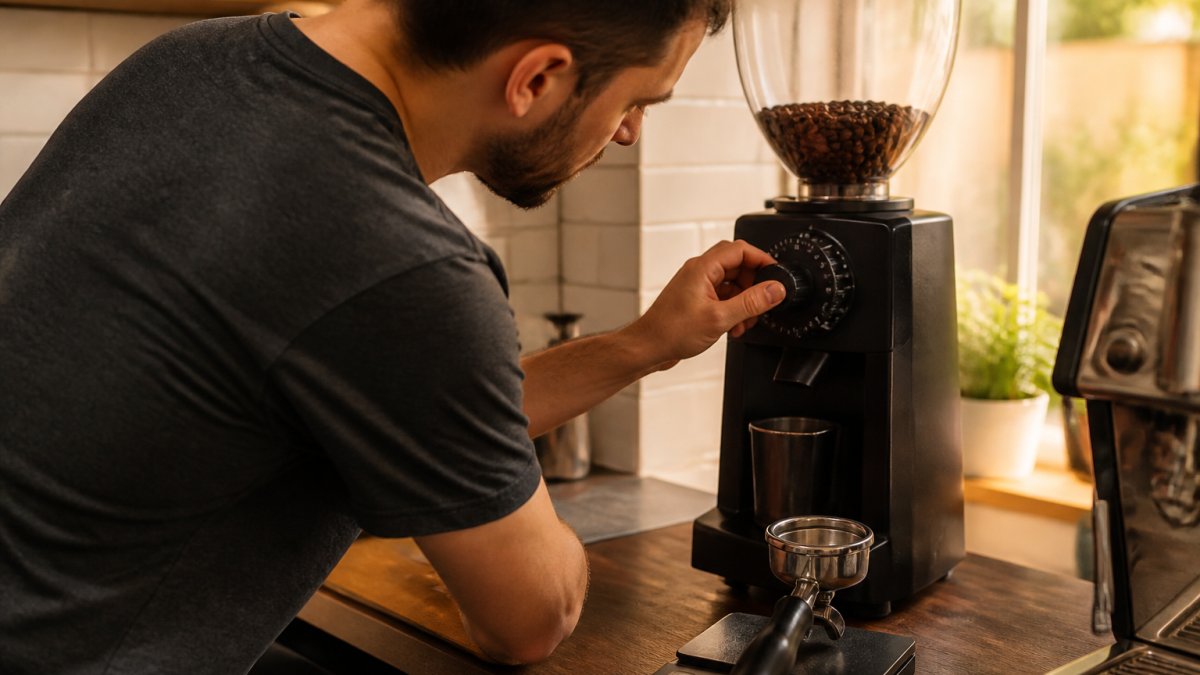
Numbered settings are not standardized between grinders, so do not copy another grinder's number. Instead, move in the smallest increment your grinder allows, often one click or one marked step, and pull another shot.
A useful rule of thumb: a small grind change should shift shot time by a few seconds, not by ten. If one step swings the shot wildly, your grinder has coarse adjustment sensitivity and you should compensate with dose or puck preparation rather than chasing the dial.
Worked example
Suppose your baseline is 18 grams in, 36 grams out, 22 seconds, and the shot tastes sharp and thin. That is fast and under-extracted, so you grind finer by one step. The next shot runs 27 seconds and tastes sweeter with more body.
Now suppose the confirming shot at 27 seconds tastes bitter and dry. You went too far. Coarsen by one step and re-test.
Step 5: Confirm with a second shot before you commit
A single good shot can be luck. Pull a second shot at the same setting and confirm that dose, yield, time, and taste repeat. Only then write the setting down as your recipe for that coffee.
Espresso Grind Adjustment for Sour Shots
A sour or weak shot usually means the grind is too coarse. Water runs through too fast, so it never pulls out the sweeter compounds.
Sour flavor sits at the front of your tongue and feels thin. That is under-extraction. Grind finer, then pull again.
Watch for these signs of under-extraction:
- Shot finishes faster than your target time
- Thin body and sharp acidity
- Pale crema that fades quickly
If the grind is already fine and the shot still tastes sour, check your dose and water temperature before grinding finer again.
Espresso Grind Adjustment for Bitter Shots
Bitter or dry shots point to over-extraction, which means the grind is too fine. Water stays in contact with the coffee too long and pulls out harsh compounds. Coarsen the grind a notch and pull another shot.
Bitter flavor lingers at the back of the tongue and leaves a dry finish. That is your signal to back off the grind.
Signs of over-extraction:
- Shot runs long and drips slowly
- Harsh, ashy, or rubbery notes
- Dark, thin crema
Espresso Extraction Time: Reading Shot Time and Flow
Shot time is your fastest feedback signal. A typical espresso shot runs roughly 25 to 30 seconds, though the right number depends on your dose and yield.
Watch the flow, too. A healthy shot starts slow, turns into a steady stream, and finishes with a light blonding.
The National Coffee Association's brewing resources note that grind, time, and ratio work together, so read them as a set.
| Symptom | Likely Cause | Grind Fix |
|---|---|---|
| Sour, weak, fast shot | Under-extraction | Grind finer |
| Bitter, dry, slow shot | Over-extraction | Grind coarser |
| Uneven flow, spritzing | Channeling | Improve distribution |
| Good time, flat taste | Grind or freshness | Check beans and burrs |
Grinder Calibration, Burr Alignment, and Channeling
Two grinders set to the same number can behave differently, and the reason goes beyond fine versus coarse. Burr geometry, burr alignment, and grinder tolerance all change what a setting actually produces, which is why you dial in by taste and time rather than by the number on the dial.
Why the same setting produces different results
A burr grinder does not make one uniform particle size. It makes a distribution: a cluster of target-size particles, a tail of fines, and a tail of boulders. The shape of that distribution depends on the burr type and condition.
- Conical burrs typically produce a wider distribution with more fines, which can add body but also increase the risk of channeling if the fines migrate.
- Flat burrs typically produce a narrower, more uniform distribution, which can improve clarity and consistency but demands better puck preparation to avoid uneven flow.
- Burr alignment determines whether the gap between burrs is even. A misaligned burr set produces inconsistent particle sizes even at a fixed setting, so the same dial position yields different results shot to shot.
This is why a setting that works on one grinder may over-extract or under-extract on another. The number is a label, not a measurement.
Channeling: why a shot can taste sour and bitter at once
Channeling is when water finds a weak path through the coffee bed instead of flowing evenly. The water takes the path of least resistance, so part of the puck is over-extracted and part is under-extracted.
Grind distribution feeds channeling. A wide distribution with many fines can clog part of the puck, pushing flow into channels. A narrow distribution reduces that risk but does not eliminate it if the puck is poorly prepared.
Signs of channeling:
- Spritzing or uneven flow from the bottomless portafilter
- Holes, craters, or a lopsided puck after the shot
- A shot that tastes sharp and harsh at the same time
Separating grind effects from other variables
Before you change the grind again, rule out the other variables that mimic grind problems. Use this troubleshooting matrix.
| Symptom | Check first | Grind may be the cause if |
|---|---|---|
| Sour, fast shot | Dose too low, water temperature too low, stale beans | The same recipe with fresh beans and correct dose still runs fast |
| Bitter, slow shot | Dose too high, water temperature too high, overfilled basket | The same recipe with correct dose still runs slow |
| Uneven flow, spritzing | Distribution, tamp level, basket cleanliness | The puck is evenly prepared and flow is still uneven |
| Good time, flat taste | Bean freshness, water quality, burr wear | Fresh beans and clean burrs still produce flat shots |
| Sour and bitter together | Channeling, puck preparation | Distribution and tamp are consistent and the problem persists |
A few habits reduce channeling and make grind changes readable:
- Distribute grounds evenly before tamping, using a leveling tool or a gentle shake
- Tamp level with steady pressure; the exact pressure matters less than consistency
- Keep the basket clean and dry between shots
Fresh beans matter more than most people think. At Eager Beaver Roasters, we roast to order so your coffee arrives fresh, which keeps extraction predictable. Our African Espresso and 6 Bean Blend both pull well as espresso and give you a stable base to dial in against.


Frequently Asked Questions
How does grind size affect espresso extraction?
Grind size controls how fast water moves through the coffee bed. A finer grind creates more surface area and slows water flow, which raises extraction and can push a shot toward bitter. A coarser grind speeds flow and lowers extraction, which can leave a shot sour and weak. On a burr grinder, small setting changes shift both shot time and flavor balance, so grind size is the first variable to adjust when dialing in.
How much should I change my burr grinder setting at a time?
Make one small step at a time, then pull a shot and taste. On most espresso grinders, a single click or a small fraction of a dial turn is enough to change shot time by several seconds. Change the grind, keep dose and yield the same, and record the result. If you jump too far, you lose track of which change fixed the shot. Adjust the grind, retest, and repeat until flavor balance lands where you want it.
Can a burr grinder produce a fine enough grind for espresso?
An espresso-specific burr grinder can. Flat or conical burrs crush beans into consistent particle sizes, and espresso grinders offer fine adjustment ranges tight enough to dial in a shot. Blade grinders and most general-purpose grinders produce uneven particle-size distribution, so fines and chunks extract at different rates, causing channeling and inconsistent shots. Check that your grinder is rated for espresso before chasing grind settings.
How do I fix espresso that tastes sour or bitter?
Sour, weak flavor usually means under-extraction, so grind finer in small steps and watch shot time lengthen. Bitter, dry finish points to over-extraction, so grind coarser and shorten contact time. Keep dose, brew ratio, and water temperature fixed while you change one variable. If flavor still swings after several grind adjustments, check for channeling, stale beans, or burr alignment before changing anything else.
Dialing in espresso takes patience, but the payoff is a shot you can repeat every morning. The grind is the lever that moves everything else, and fresh coffee makes that lever predictable. Eager Beaver Roasters roasts to order with carefully sourced beans and no fillers, so every bag gives you a clean starting point. Start with our light, medium, or dark roast options and dial in from there. Find your perfect roast and pull a better shot tomorrow.