

Fair Trade Organic Coffee Roasts Explained
Table of Contents
- What Fair Trade Coffee Means
- How Fair Trade Certification Works
- Understanding Organic Coffee and Certification
- Fair Trade vs. Organic Coffee: Key Differences
- Fair Trade vs. Direct Trade Coffee: Which Offers Better Support
- How Roast Level Shapes Flavor and Freshness
- Reading Coffee Labels and Verifying Claims
- Choosing Your Fair Trade Organic Roast
- Frequently Asked Questions
Last Updated: October 10, 2026
What Fair Trade Coffee Means
Fair trade coffee is a certification system designed to ensure that coffee farmers receive equitable compensation for their beans and work under humane conditions. Rather than selling to middlemen at commodity prices, fair trade farmers access direct buyer relationships and guaranteed minimum prices that protect them from market volatility.
Fair trade addresses a fundamental problem: coffee farmers in developing regions sell to local brokers who take substantial cuts before beans reach exporters, importers, and roasters. Fair trade eliminates intermediaries and establishes transparent pricing agreements upfront.
When you buy fair trade certified coffee, your purchase directly supports farming communities. The system enforces social standards, fair wages, safe conditions, reasonable hours, and requires environmental stewardship that protects soil health and biodiversity.
Fair trade requires producers to invest premiums into community development, schools, healthcare, water systems, or equipment, creating long-term economic stability beyond individual harvests.
How Fair Trade Certification Works
Independent auditors verify that producers meet strict standards before using the fair trade label. Fair Trade USA conducts on-site inspections to confirm compliance with pricing, labor, and environmental requirements.
Auditors evaluate operations across multiple categories: minimum price floors, social standards (wages, hours, child labor prohibitions), environmental practices, and community investment. Certification is valid for three years, then recertification audits occur.
Smaller cooperatives pay proportionally lower fees, ensuring affordability. Once certified, producers sell to roasters paying fair trade premiums, typically 10-20% above commodity prices.
Each certified batch includes documentation tracking the farm, harvest date, processing method, and certifier's seal. This transparency allows roasters and consumers to verify genuine fair trade coffee.
Understanding Organic Coffee and Certification
Organic coffee is grown without synthetic pesticides, herbicides, or chemical fertilizers. Instead, organic farmers rely on natural pest management, composting, crop rotation, and other ecological practices to maintain soil fertility and control pests.
The USDA regulates organic certification. Farms must transition to organic practices over three years before claiming organic status. During transition, farmers follow protocols but cannot use the label, a significant financial burden for small farms.
Organic certification requires detailed record-keeping and proof that no prohibited synthetic chemicals were applied. Certifiers conduct unannounced inspections and soil testing, with annual surveillance after certification.
Organic coffee farming often uses shade-growing under native trees rather than sun-exposed monocultures, preserving habitat and suppressing pests naturally. The trade-off is lower yield per acre, which is why organic coffee costs more.
Organic practices build soil carbon, reduce water contamination, and support biodiversity. However, organic certification alone doesn't guarantee fair pricing or community investment, that's where fair trade becomes complementary.
Fair Trade vs. Organic Coffee: Key Differences
Fair trade focuses on economic justice and social standards: guaranteed minimum prices, transparent supply chains, and community investment. A fair trade farm may still use synthetic pesticides; the priority is protecting farmers' livelihoods and working conditions.
Organic certification focuses on environmental practices and prohibits synthetic inputs, but doesn't guarantee fair pricing or community benefits. An organic farm could theoretically exploit workers while meeting organic standards.
Fair trade supports farmer income and community development but may use conventional chemicals. Organic protects the environment and your health but doesn't guarantee fair compensation. Many roasters seek both certifications to address both concerns.
Fair trade premiums compensate for social and economic standards; organic premiums compensate for higher labor costs and lower yields. Dual certification commands both premiums.
Fair Trade vs. Direct Trade Coffee: Which Offers Better Support
Direct trade is an alternative sourcing model that some specialty roasters use instead of fair trade certification. Understanding the distinction helps you evaluate which approach genuinely supports farmers.
Direct trade establishes direct relationships between roasters and farms. Roasters visit regions, negotiate prices directly, and commit to multi-year agreements, theoretically increasing revenue reaching farmers.
Fair trade uses standardized minimum prices and third-party auditing to ensure farmer welfare. Any roaster can purchase fair trade beans; any certified farm can sell to any buyer willing to pay the floor price.
Fair trade is independently verified by third parties. Direct trade depends on roaster integrity with no external auditor confirming promised prices or working conditions. Some roasters practice direct trade ethically; others use it as marketing.
Direct trade can offer higher prices than fair trade minimums, but farmers lack contractual protection if a roaster reduces purchases. Fair trade provides stability through guaranteed minimums.
Fair trade offers verifiable assurance of fair compensation; direct trade requires trusting roaster claims. Many roasters combine both approaches.
How Roast Level Shapes Flavor and Freshness
Roasting transforms green beans through heat-triggered chemical reactions that develop flavor, acidity, and aromatic oils. Longer roasting shifts flavor characteristics distinctly.
Lighter roasts preserve volatile compounds that degrade faster; darker roasts develop stable flavors lasting longer. Light roasts require faster consumption; dark roasts have a longer optimal window.
Light Roast Organic Coffee: Bright Acidity and Origin Flavors
Light roasts are removed from heat early in the roasting process, typically when the beans reach a light brown color and just begin their first crack, an audible popping sound indicating expanding internal pressure.
Light roasts preserve origin character and terroir. A light roast Tanzania showcases floral and fruity notes; a light roast Guatemala highlights bright fruit and chocolate. These notes are lost in darker roasts where roasting heat dominates.

Light roast acidity is bright and crisp, pleasant tartness that brings flavor into focus. Light roasts pair well with pour-over and drip methods that extract slowly.
Light roasts stale faster as volatile compounds degrade quickly. Roasting to order ensures fresher coffee than pre-roasted options.
Medium Roast: Balance and Versatility
Medium roasts balance origin character with developed roasted flavors, making them the most versatile roast level.
Medium roasts preserve origin flavor while adding roasted notes, caramel, chocolate, spice. A medium roast Colombia showcases dried orange and berry with chocolate; a medium roast Peru displays salted caramel and citrus.
Medium roast acidity is moderate; body is fuller with more mouthfeel and sweetness. This balance works well with drip, pour-over, French press, and espresso.
Medium roasts maintain quality longer than light roasts while preserving origin characteristics. For uncertain brewers, medium roast is the safest choice, forgiving across methods.
Dark Roast Organic Coffee: Bold Body and Roasted Notes
Dark roasts are roasted longer, typically into the second crack or just beyond. Beans are dark brown to nearly black, and roasting flavors dominate the cup.
Dark roasts develop bold, heavy body with low acidity. You taste roasted chocolate, molasses, and sometimes smoky or spicy notes. Origin character becomes subtle, a dark roast bean from any region tastes more like "dark roast" than like its specific origin. For coffee drinkers who find acidity unpleasant or prefer bold, straightforward flavors, dark roast is ideal.
Dark roasts are excellent for espresso and milk-based drinks. The bold flavors cut through milk and sweeteners without disappearing. The lower acidity is gentler on sensitive stomachs. Dark roasts also have the longest shelf life, roasted flavors are stable and don't degrade as quickly as lighter roasts.
The Bali Blue from Eager Beaver Roasters is a medium-dark roast showcasing dark chocolate, molasses, and brown sugar notes. It's forgiving across brewing methods and maintains quality well over time.
Reading Coffee Labels and Verifying Claims
A coffee bag label contains crucial information that helps you verify freshness, confirm certifications, and understand what you're purchasing.
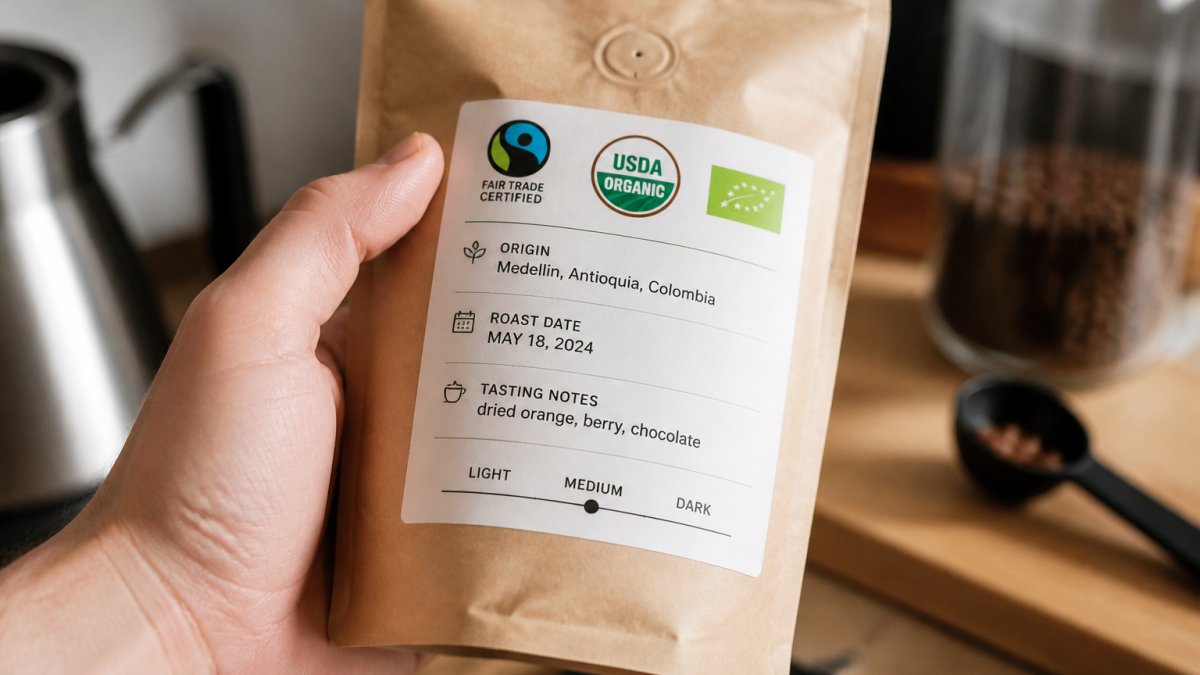
The roast date is the most important information on any label. This tells you exactly when the beans were roasted. Fresh coffee peaks in flavor 5-14 days after roasting, depending on roast level.
Certification logos appear prominently on ethical coffee labels. Look for the Fair Trade USA seal (a black and white yin-yang symbol), the USDA organic seal, or both. These seals are standardized and easily recognizable.
Origin information should specify the country, region, and ideally the farm or cooperative name. "Colombia" alone is vague, Colombia produces coffee across multiple regions with different flavor profiles.
Tasting notes describe the flavor profile you should expect. If a light roast lists "dark chocolate and molasses," that's a red flag suggesting the roast level description is inaccurate.

Processing method affects flavor and should appear on the label. "Fully washed" or "wet-hulled" or "natural" processing methods each produce distinct flavor profiles.
Choosing Your Fair Trade Organic Roast
Selecting the right fair trade organic coffee comes down to matching roast level to your brewing method and flavor preferences, then verifying certifications before purchasing.
Start by considering your brewing method. If you're uncertain about your method, medium roast is the safest starting point.

Next, think about flavor preference. Do you enjoy bright, acidic, fruity coffees? Choose light roast. Prefer balanced sweetness with moderate acidity? Medium roast.
Check for dual certification. Fair trade and organic logos should both appear on the label.
Verify the roast date. Coffee roasted within the last two weeks is ideal. Anything older than 30 days has noticeably declined in quality.
Read the origin and processing information. Single-origin coffees from specific regions or cooperatives offer traceability and distinct flavor profiles.
Consider your consumption pace. Light roasts are best consumed within 14-21 days of roasting. If you drink slowly, medium or dark roast maintains quality longer.
Finally, start with one bag and take notes on what you enjoy. Does the acidity feel bright or harsh? Is the body full or thin?
Choosing fair trade organic coffee means supporting farming communities while protecting your health and the environment. Explore our single-origin offerings, each one tells the story of the farmers and regions that produced it. Find Your Perfect Roast and taste the difference that ethical sourcing and fresh roasting make.
Frequently Asked Questions
What does fair trade mean for coffee?
Fair trade certification ensures coffee farmers receive a minimum price for their beans, regardless of market fluctuations. This protects farmer income and supports sustainable farming practices. Fair trade standards also require social and environmental protections, including safe working conditions and restrictions on harmful pesticides. The certification creates transparency in the supply chain, so you know your purchase directly supports farming communities.
Is fair trade coffee always organic?
No. Fair trade and organic are separate certifications. Fair trade focuses on pricing and working conditions; organic focuses on how beans are grown without synthetic pesticides or fertilizers. A coffee can be fair trade but not organic, or organic but not fair trade. Many premium coffees carry both certifications, but you should check the label to confirm which standards apply to your specific beans.
What is the difference between fair trade and direct trade coffee?
Fair trade uses a certification system with minimum prices set by third-party organizations. Direct trade involves roasters buying directly from farmers at prices negotiated between them, often higher than fair trade minimums but without formal certification. Direct trade offers greater transparency and relationship-building but lacks third-party verification. Both support farmers better than commodity-market coffee, but fair trade provides standardized protections across all producers.
How do I know which roast level is best for fair trade organic coffee?
Light roasts preserve origin flavors and acidity, ideal for single-origin beans you want to taste fully. Medium roasts balance origin character with roasted notes, working well for most brewing methods. Dark roasts emphasize bold, roasted flavors like chocolate and molasses. Choose based on your brewing method (pour-over favors light roasts, French press suits medium to dark) and your taste preference for brightness versus body.
Does roast level affect the health benefits of organic coffee?
Roast level does not significantly change whether coffee is organic or not. The organic certification applies to how beans were grown, regardless of how they're roasted afterward. However, roasting does affect the coffee's acidity and compounds like chlorogenic acid. Light roasts retain more chlorogenic acid, while dark roasts have less due to heat exposure. Both remain organic; the difference is in flavor profile and how your body processes the coffee.
How can I tell whether coffee is genuinely fair trade and organic?
Look for certification logos on the bag from organizations like Fair Trade USA or Rainforest Alliance for fair trade, and USDA Organic for organic certification. Check the roast date to ensure freshness; beans should be used within 2-4 weeks of roasting. Reputable roasters list the farm or region, altitude, processing method, and tasting profile. If the label lacks these details or uses vague language like 'ethically sourced,' the certifications may not be verified.
Why does fair trade organic coffee cost more than grocery store coffee?
Fair trade minimum prices and organic farming practices both increase production costs. Fair trade ensures farmers earn sustainable income; organic eliminates synthetic pesticides and fertilizers, requiring more labor-intensive farming. Additionally, specialty roasters like Eager Beaver Roasters roast to order for maximum freshness, which costs more than mass-produced coffee. The price reflects genuine quality, transparency, and and ethical sourcing rather than commodity-grade beans.