

Why Grocery Store Coffee Tastes Bitter: 6 Reasons & Fixes
Table of Contents
- Why Grocery Store Coffee Tastes Bitter: The Core Problem
- 1. Stale Coffee Beans and Oxidation
- 2. Over-Extraction and Grind Size for Less Bitterness
- 3. Coffee Water Temperature and Brewing Time
- 4. Water Quality and Mineral Content Impact
- 5. Dirty Equipment and Coffee Oil Buildup
- 6. Dark Roasts, Burnt Beans, and Roast Profile Mismatch
- How to Fix Bitter Coffee at Home: The Brewing Ratio Solution
Last Updated: July 28, 2026
Why Grocery Store Coffee Tastes Bitter: The Core Problem
Grocery store coffee tastes bitter because of a cascade of chemical degradation that begins the moment beans are roasted. Most people blame roast level or brewing method, but the real culprit is storage: grocery store coffee sits in permeable bags under fluorescent lights for weeks or months. During that time, volatile aromatic compounds evaporate, fats oxidize and turn rancid, and bitter compounds concentrate, producing harsh, ashy, flat coffee.
Below are the six primary reasons grocery store coffee develops that characteristic bitter flavor, and how to fix it with simple adjustments to your brewing technique and bean selection.
1. Stale Coffee Beans and Oxidation
Freshness is the foundation of good coffee flavor. Once roasted, coffee beans begin losing quality immediately through oxidation, where oxygen reacts with the beans' organic compounds and breaks them down into less desirable molecules.
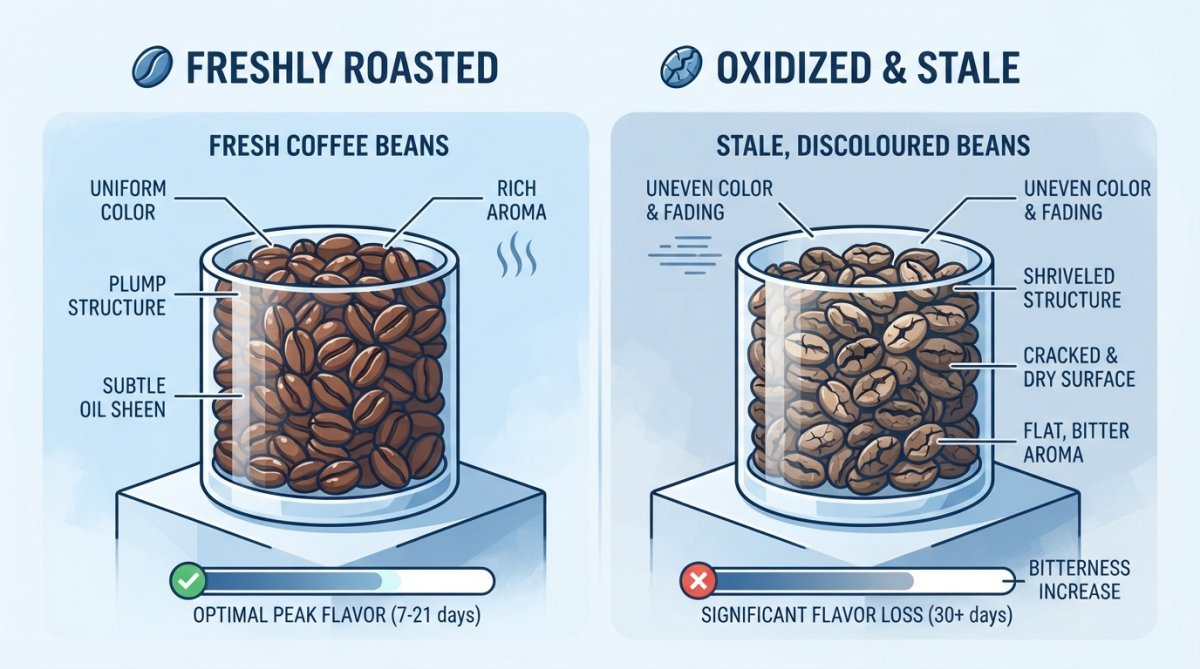
How Oxidation Breaks Down Flavor Compounds
When coffee is freshly roasted, it contains volatile aromatic oils and complex organic compounds that create nuanced flavors. These compounds are unstable. Exposure to oxygen, light, and heat breaks them down into simpler, less pleasant molecules. Over time, fruity, floral, or chocolatey notes fade, leaving behind bitter tannins and harsh phenolic compounds.
Grocery store coffee typically sits 4-12 weeks between roasting and purchase, then another 2-4 weeks on your shelf before brewing. By that point, the majority of volatile compounds have evaporated or oxidized into bitter-tasting compounds. This is why the first cup from a fresh bag tastes noticeably different from the last cup.
Storage Science for Pre-Ground Coffee
Pre-ground coffee is particularly vulnerable to oxidation because grinding exponentially increases surface area exposed to oxygen. A single coffee bean has roughly 2-3 square inches of surface area. When ground, that same bean's surface area expands to 400+ square inches, meaning oxidation happens roughly 200 times faster in ground coffee than in whole beans.
Pre-ground coffee from a grocery store has typically been ground 3-8 weeks before purchase, then sits in your pantry another 1-3 weeks. By brewing time, the coffee has oxidized so thoroughly that bitter compounds dominate every sip.
The solution is straightforward: buy whole beans and grind immediately before brewing. If you must buy pre-ground, consume it within 3-5 days of opening. Better yet, switch to freshly roasted beans shipped directly to your door, like those from Eager Beaver Roasters, which arrive within days of roasting before oxidation degrades flavor compounds significantly.
2. Over-Extraction and Grind Size for Less Bitterness
Over-extraction pulls too many dissolved solids from the grounds during brewing. You extract not only desirable flavors but also harsh bitter compounds that dissolve last, creating acrid, burnt, astringent coffee.
Why Over-Extraction Creates Harsh Flavors
Coffee extraction works on a timeline. The first compounds to dissolve are sweet, acidic, fruity notes, the "good" flavors. As water continues contacting grounds, it pulls out increasingly bitter compounds, including tannins and chlorogenic acid lactones. Brewing too long, using water that's too hot, or grinding too fine extracts these bitter compounds in high concentration.
Grocery store coffee is often roasted very dark to mask staleness. Dark roasts naturally contain more bitter compounds than light or medium roasts. Combined with stale coffee and over-extraction, bitterness becomes overwhelming.
The fix involves two adjustments: use a coarser grind and reduce brewing time. A coarser grind presents less surface area to water, slowing extraction. Shorter brewing time means less time pulling out bitter compounds. For drip coffee makers, switch from medium to medium-coarse grind and reduce brewing time by 15-20 seconds. For French press, use coarse grind and steep 3-4 minutes instead of 4-5 minutes.
3. Coffee Water Temperature and Brewing Time
Water temperature and brewing time control how fast flavor compounds dissolve from grounds. Too hot or too long extracts bitterness. Too cool or too short under-extracts and misses good flavors.
The ideal water temperature for brewing coffee is 195-205 degrees Fahrenheit. Many grocery store coffee drinkers use water straight from a boiling kettle (212°F), which is too hot and accelerates extraction, pulling bitter compounds faster and in higher concentration.
Brewing time varies by method: drip coffee makers need 4-6 minutes total contact, French press 3-4 minutes, pour-over 2.5-4 minutes. Grocery store coffee often sits on warming plates for 15-30 minutes after brewing, over-extracting further and creating burnt, bitter taste.
The solution is simple: brew at 200°F, not 212°F, and remove coffee from heat immediately after brewing. If you use an automatic drip machine, transfer brewed coffee to a thermal carafe instead of leaving it on the heating plate. This single change eliminates the burnt, over-extracted bitterness plaguing most grocery store coffee drinkers.
4. Water Quality and Mineral Content Impact
Water makes up 98% of brewed coffee, yet most people never consider water quality when complaining about bitter coffee. Minerals in your water, calcium, magnesium, and other dissolved solids, directly affect how efficiently coffee compounds dissolve and how the final cup tastes.
Water that's too soft (low mineral content) under-extracts, producing sour, thin coffee. Water that's too hard (high mineral content) over-extracts, producing bitter, harsh coffee. Ideal water has 50-200 parts per million mineral content with balanced calcium and magnesium.
Many grocery store coffee drinkers use untested tap water. If your tap water is very hard, common in areas with limestone or chalk bedrock, excess minerals accelerate extraction and pull out bitter compounds aggressively. Conversely, distilled water lacks minerals, causing under-extraction and sour coffee.
Test your water hardness using an inexpensive test kit from a hardware store. If above 200 ppm, use filtered water. If below 50 ppm, add mineral water or use a filter that adds trace minerals. This adjustment alone can reduce perceived bitterness by 20-30%, even without changing beans.
5. Dirty Equipment and Coffee Oil Buildup
Coffee oils accumulate on brewing equipment surfaces over time. These oils oxidize and turn rancid, creating stale, bitter taste that transfers to every cup. Most grocery store coffee drinkers never clean equipment properly, so rancid oil layers thicken with each brew.
The problem is especially severe in automatic drip machines, where water filters through the same internal passages daily without thorough cleaning. The heating element, water reservoir, and spray head accumulate oxidized coffee oils that impart burnt, bitter flavor to fresh water before it contacts grounds.
French press pots are equally problematic. The mesh filter traps fine particles and oils that oxidize between uses. Without disassembly and thorough cleaning after each use, you're brewing fresh coffee through rancid oil residue.
The solution requires two steps. First, deep clean equipment monthly using specialized coffee equipment cleaner like Cafiza or equal parts white vinegar and water. For automatic drip machines, run vinegar solution through the brew cycle twice, then plain water twice more. For French press, disassemble completely and soak the mesh in hot vinegar solution for 15 minutes, scrub with a soft brush, and rinse thoroughly.
Second, rinse equipment with hot water immediately after each use and wipe visible oils with a dry cloth. This prevents oil oxidation and accumulation between deep cleans.
6. Dark Roasts, Burnt Beans, and Roast Profile Mismatch
Darker roasted beans naturally develop more bitter compounds. Grocery stores use dark roasts to hide staleness: when beans are old and oxidized, their original flavor notes have faded. A light or medium roast would taste flat and stale. A dark roast masks this by introducing charred, smoky, ashy notes from the roasting process itself rather than the bean's origin.
The problem is that dark roasts inherently contain more bitter compounds. Combined with stale beans and over-extraction, bitterness becomes unbearable. Many grocery store coffee drinkers assume they simply don't like coffee, when they're drinking a product engineered to be unpleasant when old.
Additionally, many grocery store brands roast unevenly, resulting in some charred beans and others under-roasted, creating jagged, unpleasant flavor profiles with sharp bitter notes.
The solution is switching to light or medium roast from a specialty roaster that roasts to order. Light roasts preserve the bean's origin characteristics, terroir, processing method, varietal's natural flavors. Medium roasts like Eager Beaver Roasters' House Blend offer smooth, balanced profiles showcasing the bean's qualities without relying on roast-induced bitterness to mask staleness. When you brew fresh, properly roasted medium roast, the difference is immediate.
How to Fix Bitter Coffee at Home: The Brewing Ratio Solution
The brewing ratio, the proportion of coffee to water, is the most underrated lever for controlling bitterness. Most people use too much coffee relative to water, concentrating bitter compounds and creating astringent cups.
The standard brewing ratio is 1:16, meaning 1 gram of coffee to 16 grams of water. For a typical 8-ounce cup (237 ml), this means roughly 15 grams of ground coffee. Many grocery store coffee drinkers use 20-25 grams, which is why their coffee tastes so bitter.
Step-by-Step: Adjusting Your Brewing Ratio
Step 1: Measure your current coffee amount. Use a kitchen scale to weigh the ground coffee you currently use for one cup.
Step 2: Calculate your target amount. Multiply your cup size in milliliters by 0.06. For an 8-ounce cup (237 ml), the target is 14-15 grams.
Step 3: Reduce your coffee amount gradually. Don't cut it by half overnight. Reduce by 1-2 grams every 2-3 days until reaching your target, allowing your palate to adjust.
Step 4: Adjust water temperature and brewing time. Brew at 200°F for the standard time for your method (4-6 minutes for drip, 3-4 minutes for French press).
Step 5: Fine-tune grind size. If coffee tastes sour, your grind is too coarse and you're under-extracting, go one notch finer. If still bitter, go one notch coarser.
| Adjustment | Effect on Bitterness | Difficulty | Time to Result |
|---|---|---|---|
| Reduce coffee amount (1:16 ratio) | Reduces 30-40% | Easy | 1 cup |
| Lower water temperature (200°F vs 212°F) | Reduces 20-25% | Easy | 1 cup |
| Shorten brewing time by 30 seconds | Reduces 15-20% | Easy | 1 cup |
| Switch to coarser grind | Reduces 25-35% | Medium | 2-3 cups |
| Clean equipment with vinegar | Reduces 40-60% | Medium | 1 cup |
| Buy fresh, medium roast beans | Reduces 70%+ | Hard (requires purchase) | 1 cup |
Most grocery store coffee drinkers report noticeable improvement within the first cup after adjusting the brewing ratio. The combination of less coffee, lower water temperature, and shorter brewing time eliminates most harsh bitterness without equipment investment.
Grocery store coffee doesn't have to taste bitter. The staleness, over-extraction, and equipment buildup plaguing mass-market coffee are all fixable with simple adjustments to your brewing method and bean selection. If you've tried these fixes and still experience bitterness, the issue is likely the beans themselves. Switching to fresh, medium-roast coffee from a specialty roaster like Eager Beaver Roasters eliminates the oxidation and staleness that no brewing technique can fully overcome. Our beans are roasted to order and arrive within days, preserving the aromatic compounds and flavor complexity that make coffee worth drinking. Try our House Blend medium roast or Gourmet Donut Shop light-medium blend and experience the difference fresh, properly roasted coffee makes in your cup.
Frequently Asked Questions
What makes grocery store coffee taste bitter?
Grocery store coffee tastes bitter due to multiple factors: stale beans that have oxidized, over-extraction from improper grind size and brewing time, water temperature that is too hot, and accumulated coffee oils on brewing equipment. Pre-ground coffee degrades faster than whole beans, and mass-market roasters often use darker roast profiles that mask inferior bean quality. The combination of these factors creates harsh, unpleasant flavors that mask the natural sweetness of quality beans.
How does stale coffee beans affect the taste of my brew?
Stale coffee beans lose their aromatic compounds and organic compounds through oxidation, which occurs when beans are exposed to air and light. As freshness date passes, chlorogenic acid lactones and other flavor-producing molecules break down, leaving behind bitter tannins and phenylindanes that create a harsh aftertaste. Pre-ground coffee stales much faster than whole beans because grinding increases surface area. This is why roasted-to-order coffee from sources like Eager Beaver Roasters delivers noticeably better flavor, the beans are fresh when they reach your door.
What coffee to water ratio should I use to reduce bitterness?
A standard brewing ratio of 1:16 (1 part coffee to 16 parts water by weight) is a good starting point, but reducing bitterness often means using slightly less coffee or more water, try 1:17 or 1:18. This lower ratio reduces extraction yield and limits the dissolution of bitter compounds. However, the ratio alone won't fix stale beans or over-extraction from incorrect grind size and brewing time. Combine a proper ratio with medium-fine grind, water temperature between 195-205°F, and a burr grinder for consistent results.
Does grind size really affect how bitter my coffee tastes?
Yes, grind size directly controls extraction. Too-fine grounds increase surface area and contact time with hot water, leading to over-extraction and bitter compounds leaching into your cup. Too-coarse grounds under-extract, creating a sour, acidic taste. For less bitterness, use a medium-fine grind and adjust brewing time: shorter brew time for finer grinds, longer for coarser. A burr grinder gives you consistency that blade grinders cannot. If you're using pre-ground coffee from the grocery store, you're fighting an uphill battle, whole beans ground fresh always outperform pre-ground.
This article was written using GrandRanker