

How to Choose Your Coffee Roast Profile: A Pro-Sumer Guide
Table of Contents
- What Is a Coffee Roast Profile and Why It Matters
- Coffee Roast Levels Explained: Light, Medium, and Dark
- Light Roast vs. Dark Roast Flavor: Key Differences and Science
- Best Coffee Roast for Espresso: Matching Profile to Brewing Method
- How to Choose Your Roast Profile Based on Personal Taste
- Coffee Roasting at Home Tips: Building Your Roast Library
- Common Mistakes When Selecting a Roast Profile
- Finding Your Perfect Roast: A Decision Framework
How to Choose Your Coffee Roast Profile: A Pro-Sumer Guide
Last Updated: July 24, 2026
Understanding roast profiles separates casual coffee drinkers from those who care about what's in their cup. At Eager Beaver Roasters, we've spent years helping coffee enthusiasts dial in their preferences. Roast profiles aren't just about light, medium, or dark, they're about intentional heat application, timing, and the specific chemical transformations that happen inside each bean.
What Is a Coffee Roast Profile and Why It Matters
A roast profile is the precise sequence of temperature changes applied to green coffee beans during roasting. It's not the same as roast level, a common point of confusion. The roast profile describes the journey: how fast temperature rises, when you apply heat through conduction versus convection, how long you hold at certain temperatures, and when you pull the beans relative to first crack and second crack.
Two roasters can both produce a "medium roast," but their roast profiles might be completely different. One might charge beans at 350°F and ramp heat aggressively, hitting first crack in 8 minutes. Another might charge at 300°F and climb slowly over 12 minutes. Same roast level, different flavor outcome.
The roast profile controls sugar development, acidity levels, body, and the specific flavor notes you'll taste.
Roast Profile vs. Roast Level: Understanding the Difference
Roast level is the endpoint: light, medium, dark. Roast profile is the path you took to get there. You can reach a medium roast through dozens of different profiles.
Two coffees at the same roast level can taste completely different depending on the profile used. A medium roast pulled at second crack tastes heavier and more bitter than one pulled just before second crack. Professional roasters obsess over roast profiles because they're reproducible, once you document charge temperature, heat application method, bean temperature at first crack, and development time, you can replicate it on your next batch.
Coffee Roast Levels Explained: Light, Medium, and Dark
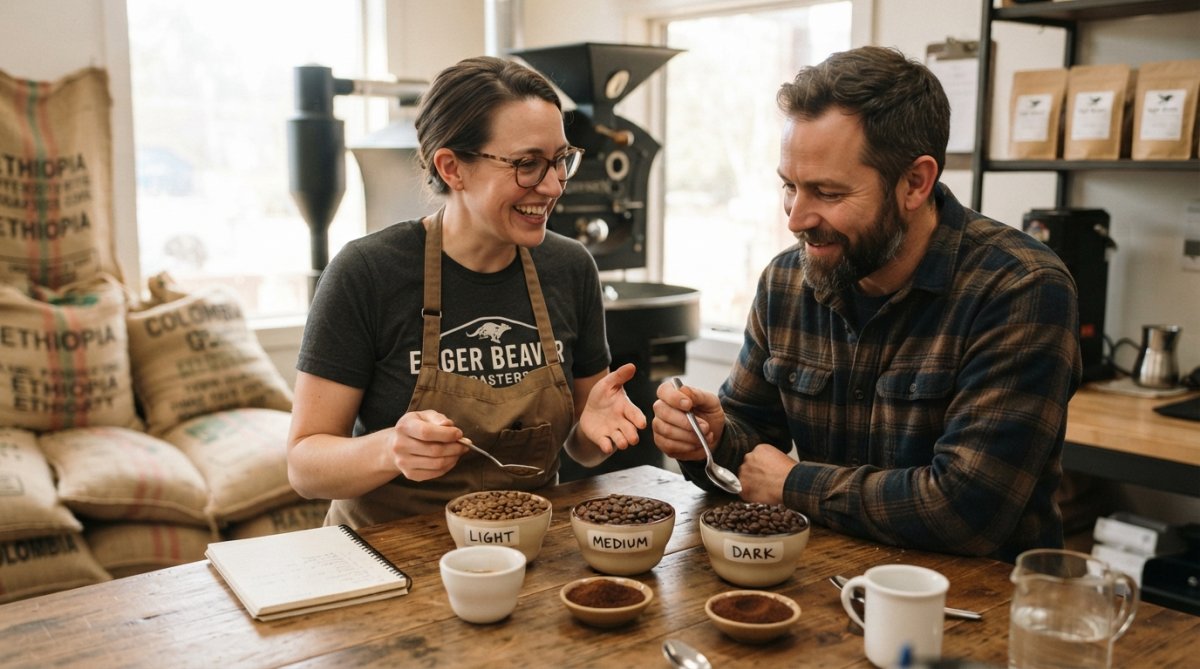
The three main roast levels exist on a spectrum defined by visual color and internal bean temperature.
Light Roasts: First Crack and Origin Flavor
Light roasts are pulled shortly after first crack, when trapped moisture inside the bean turns to steam and forces expansion with an audible pop. The bean's surface temperature is typically between 350-400°F.
Light roasts preserve the most origin flavor, characteristics from where the beans grew. A light roast Ethiopian coffee tastes bright and fruity because you're tasting the bean's natural acidity before the roasting process breaks it down. The tradeoff: light roasts have higher acidity and less body. For filter brewing, pour-over, French press, and drip, light roasts shine because the brewing method extracts delicate origin flavors without muddying them.
Medium Roasts: Balance and Complexity
Medium roasts hit the sweet spot between origin flavor and roast character. They're pulled between first crack and second crack, or just as second crack begins. Bean temperature usually sits between 400-420°F.
The Maillard reaction, the chemical process creating new flavor compounds, has progressed far enough to add sweetness, caramel, and chocolate notes. But origin flavor hasn't been completely buried. Medium roasts work across brewing methods and are forgiving in espresso because they have enough body to create crema and enough flavor complexity to taste interesting.
Dark Roasts: Body and Smoky Notes
Dark roasts are pulled during or after second crack, when the bean's surface temperature exceeds 420°F. The beans have expanded significantly and developed visible oils on the surface.
Dark roasts taste smoky, bold, and full-bodied. The roasting process has caramelized sugars heavily and created new bitter and roasted notes. Origin flavor is almost completely masked. Dark roasts are traditional for espresso because the heavy body cuts through milk and the bold flavor stands up to extraction intensity.
Light Roast vs. Dark Roast Flavor: Key Differences and Science
Acidity, Sweetness, and Maillard Reaction
Light roasts taste more acidic because less of the bean's chlorogenic acid, responsible for sourness, has been broken down by heat. This isn't "sour" in a bad way; it's brightness. Many describe light roast acidity as "crisp" or "clean."
Dark roasts taste less acidic because heat has decomposed chlorogenic acid. In its place, you taste sweetness from caramelized sugars and roasted, bitter notes.
The Maillard reaction, between amino acids and sugars, begins around 300°F and accelerates as temperature rises. It creates hundreds of new flavor compounds: nutty, caramel, chocolate, and bread notes. Light roasts stop this reaction early. Dark roasts let it run longer, creating deeper roasted flavors.
Sugar Development and Caramelization During Roasting
Sugars in coffee beans start to caramelize around 350°F and intensify dramatically after first crack.
A slow rate of rise (RoR) in early stages gives sugars more time to develop sweetness before first crack. A fast RoR compresses that development window, resulting in less perceived sweetness but more origin flavor preservation. After first crack, caramelization accelerates and sugars break down into simpler, sweeter compounds. By second crack, sugars are breaking down into bitter compounds. Pulling just after first crack tastes sweeter than pulling after second crack.
Best Coffee Roast for Espresso: Matching Profile to Brewing Method
Espresso requires different roast profiles than filter coffee because the brewing method is fundamentally different. Espresso forces hot water through densely packed finely ground coffee in 25-30 seconds. Filter coffee steeps grounds for 3-5 minutes.
Filter Roasts vs. Espresso Profiles
Filter roasts are typically lighter and emphasize origin flavor and brightness. Espresso roasts are typically medium to dark and emphasize body and sweetness. Espresso's short contact time extracts primarily sweet compounds and oils; it doesn't extract much acidity or delicate origin flavor. A light roast in espresso tastes thin and sour. A medium roast tastes balanced, sweet, and full-bodied.
Espresso roasts also account for thermal mass. The coffee needs enough body and oil content to create crema, the tan foam on top of an espresso shot. Lighter roasts don't have enough oils.
How Bean Origin Influences Roast Selection
Origin flavor is the starting point for choosing a roast profile.
Ethiopian coffees are naturally fruity and floral. A light roast will taste like blueberry, jasmine, or bergamot. A dark roast will bury those notes under smoke. If you're buying Ethiopian coffee, a light or light-medium roast makes sense.
Colombian coffees are naturally balanced with chocolate, hazelnut, and caramel notes. They work across roast levels. Brazilian coffees are naturally sweet and nutty with low acidity. They benefit from medium to dark roasting because additional heat amplifies sweetness and creates body.
How to Choose Your Roast Profile Based on Personal Taste
The best roast profile for you depends on three things: your brewing method, your taste preferences, and your tolerance for acidity.
Start by identifying what you like in coffee. Do you prefer bright, crisp coffee with citrus and floral notes? Light roast. Do you like smooth, balanced coffee with chocolate and caramel? Medium roast. Do you like bold, heavy coffee with smoky, roasted character? Dark roast.
Next, match that preference to your brewing method. For espresso, start with a medium roast. For pour-over, light to medium roast highlights origin flavor. For French press, medium roast works well because immersion brewing extracts body and sweetness effectively.
Visual Indicators: Using the Agtron Scale and Color Assessment
The Agtron scale is a standardized system for measuring coffee roast color, ranging from 95 (lightest) to 25 (darkest).
Light roasts fall in the 75-85 Agtron range and are tan to light brown with no visible oils. Medium roasts are 55-70 Agtron and medium brown, sometimes with a slight sheen of oil. Dark roasts are 25-40 Agtron and dark brown to nearly black with visible oils. If you're buying whole beans, look at the color to verify that what the roaster labeled actually is.
Rate of Rise, Development Time, and Roast Curve Fundamentals
For home roasters, three metrics matter: rate of rise (RoR), development time, and roast curve shape.
Rate of rise is how fast bean temperature climbs per minute. A RoR of 15°F per minute is aggressive. A RoR of 8°F per minute is slow. Early-roast RoR affects how much time sugars spend developing. A slower RoR produces more sweetness and origin flavor. A faster RoR produces more roasted character and less acidity.
Development time is how long the roast runs after first crack. A 30-second development time produces a light roast. A 90-second development time produces a medium roast. A 2-minute development time produces a dark roast.
Roast curve is the shape of the temperature line on a roast graph. Different curves produce different flavor outcomes, even at the same roast level.
Coffee Roasting at Home Tips: Building Your Roast Library
If you're roasting at home, consistency is everything. Document every roast: charge temperature, heat application method, RoR at different stages, first crack time, development time, and final bean temperature. Over time, you'll build a library of profiles that produce specific flavors.
Post-Roast Resting Periods and Degassing
Freshly roasted coffee is not ready to brew immediately. The beans are still releasing CO2 from the roasting process, called degassing. If you brew fresh-roasted coffee within hours, the CO2 interferes with extraction and the coffee tastes flat and sour.
Most roasters recommend waiting 24-48 hours after roasting before brewing. By 48 hours, most degassing is complete. For home roasters, store freshly roasted beans in a breathable container for the first 24 hours. After 24 hours, transfer to an airtight container. Whole beans stay fresh for 2-3 weeks.
Heat Application, Thermal Mass, and Roaster Capacity
Different roasting methods apply heat differently, affecting the roast profile you can achieve.
Air roasters use convection, hot air circulating around beans. They heat quickly with less thermal mass, so RoR is typically fast and harder to control. Drum roasters use conduction, direct heat from a rotating drum, plus convection. They have higher thermal mass, giving you more control over RoR.
Thermal mass is the roaster's ability to absorb and release heat. High thermal mass takes longer to heat and cool but gives more adjustment time. Low thermal mass heats and cools quickly, limiting control but great for light roasts. Roaster capacity matters too. A small roaster heats faster than a large roaster. If replicating a profile on a different roaster, adjust heat application because thermal mass differs.
Common Mistakes When Selecting a Roast Profile
Most people make one of three mistakes: they assume roast level equals flavor, they don't account for their brewing method, or they stick with one profile without experimenting.
Mistake 1: Thinking all medium roasts taste the same. Two medium roasts can taste completely different depending on the profile used.
Mistake 2: Buying light roasts for espresso. Light roasts don't have enough body or oils for espresso. They extract thin and sour. Espresso needs medium roasts minimum.
Mistake 3: Not giving a new roast a fair chance. Freshly roasted coffee tastes harsh for the first 24 hours while degassing. Wait 48 hours before deciding you don't like a profile.
Mistake 4: Assuming darker roast = stronger coffee. Roast level doesn't determine caffeine content. A dark roast has less caffeine than a light roast because heat breaks down some caffeine molecules.
Finding Your Perfect Roast: A Decision Framework
Use this framework to narrow down which roast profile is likely to work for you:
| Question | Answer → Roast Direction |
|---|---|
| What's your brewing method? | Espresso → Medium+; Pour-over → Light to Medium; French press → Medium; Drip → Medium |
| Do you like bright, acidic coffee? | Yes → Light; No → Medium to Dark |
| Do you prefer origin flavor or roasted character? | Origin flavor → Light; Balanced → Medium; Roasted character → Dark |
| What origin are you buying? | Ethiopian/Kenyan → Light; Colombian/Central American → Medium; Brazilian → Medium to Dark |
Start with your brewing method and taste preference. Then experiment. Order a light, medium, and dark roast from the same origin and compare them side by side. You'll taste exactly how roast profile affects flavor.
Eager Beaver Roasters offers light, medium, and dark roast options across their lineup. The Blonde is a light roast blend emphasizing sweetness and origin flavor, ideal for pour-over or filter brewing. The Ethiopia Natural comes in a med-light roast that preserves fruity and chocolate notes. For espresso, the 6 Bean Blend is a dark roast house blend with the body and sweetness espresso demands. The Italian Roast is their darkest option for those who want bold, smoky character.
Choosing the right roast profile isn't about following rules, it's about understanding how heat transforms green beans into the coffee you drink. The difference between a flat-tasting roast and an exceptional one comes down to intentional decisions about temperature, timing, and heat application.
Eager Beaver Roasters roasts to order and ships fresh beans within days, so you're always tasting coffee at its peak. Whether you're starting with the Blonde for bright, clean coffee or the Italian Roast for bold espresso, you'll taste the difference that a thoughtful roast profile makes. Find Your Perfect Roast today and discover what specialty coffee actually tastes like.
Frequently Asked Questions
What is the difference between roast profile and roast level?
Roast level refers to how dark the beans are (light, medium, or dark), determined by final bean temperature and color. Roast profile is the complete temperature curve and timing strategy used during roasting, including charge temperature, rate of rise, development time, and heat application method. A profile is the blueprint; the level is the visible outcome. Understanding this distinction helps you choose roasts that match your brewing method and flavor preferences, not just pick by darkness.
How do I choose a coffee roast profile for espresso?
Espresso typically benefits from medium to dark roasts with a longer development time to build body and sweetness. Look for espresso profiles that emphasize caramelization and reduce bright acidity. Bean origin matters too, Central American and African beans often shine in espresso when roasted to a full second crack or just before. Start with a medium-dark espresso profile, pull shots, and adjust based on extraction quality. Eager Beaver's French Roast and 6 Bean Blend are both crafted for espresso applications.
What does post-roast resting and degassing mean?
After roasting, beans release CO2 for 12-24 hours in a process called degassing. During this time, the beans are not yet stable and can taste flat or bitter if brewed immediately. Resting allows flavors to stabilize and CO2 to escape naturally. For home roasters, waiting at least 12 hours (ideally 24) before brewing improves cup quality significantly. Eager Beaver roasts to order and ships fresh, ensuring your beans arrive at the optimal point in their degassing window for maximum flavor.
How does bean origin affect which roast profile I should choose?
Bean origin determines natural flavor compounds and how they develop during roasting. African beans (like Ethiopia Natural) often have bright, fruity notes that shine in light-to-medium roasts where origin flavor is preserved. Central American beans develop chocolate and nutty notes through medium-dark roasts. Asian beans often suit darker roasts for full body. Match your roast profile to the origin's inherent characteristics, light roasts highlight origin flavor, while dark roasts emphasize roaster-driven flavors like body and sweetness.
What is the Agtron scale and how does it help choose a roast profile?
The Agtron scale is a standardized measurement of coffee bean color, ranging from 25 (darkest) to 95 (lightest). It removes guesswork from visual roast assessment. Light roasts typically score 65-80, medium roasts 55-65, and dark roasts 25-55. While most home roasters rely on visual inspection, knowing the Agtron range for your target profile helps you achieve consistency and communicate preferences with specialty roasters. It's a professional tool that bridges the gap between casual coffee drinking and serious roasting.
Can I roast my own coffee beans at home, and what should I know?
Yes, home roasting is possible with dedicated roasters or even popcorn poppers, though quality varies. Key considerations: understand your roaster's thermal mass and heat application method (conduction vs. convection), track rate of rise and development time, and learn to identify first and second crack markers. Post-roast resting is critical, beans need 12-24 hours before brewing. Home roasting offers control and freshness but requires experimentation and equipment investment. For convenience and consistency, many coffee lovers prefer fresh-roasted beans from specialists like Eager Beaver.
How does roast time and temperature affect coffee flavor?
Higher temperatures and longer development times deepen roasting reactions: Maillard reaction (creates complexity) and caramelization (adds sweetness and body). Light roasts use shorter times and lower peak temperatures to preserve origin flavor and acidity. Dark roasts extend development time to build smoky notes and reduce acidity. Rate of rise (how fast beans heat) also matters, slower rises develop sweetness, faster rises preserve brightness. Mastering these variables lets you dial in the exact flavor balance you want, whether you're chasing bright notes or deep body.
This article was written using GrandRanker