

How to Find Fresh Coffee Roasters Online: A Buyer's Guide
Table of Contents
- What Separates Fresh Coffee Roasters from the Rest
- How to Tell if Coffee Beans Are Fresh When You Order
- Evaluating Specialty Grade and Single Origin Options
- Best Online Coffee Subscription Services and Roaster Models
- How to Store Coffee Beans for Maximum Freshness
- Finding Fresh Coffee Roasters Online: Key Questions to Ask
- Common Mistakes When Ordering Fresh Coffee Online
- Conclusion
How to Find Fresh Coffee Roasters Online: A Buyer's Guide
Last Updated: August 3, 2026
Learning how to find fresh coffee roasters online is essential for serious coffee enthusiasts. At Eager Beaver Roasters, we understand that freshness is the foundation of specialty coffee. The difference between a bag roasted three weeks ago and one roasted three days ago is stark: flat, muted coffee versus a cup bursting with intended tasting notes.
Most coffee drinkers have never experienced truly fresh coffee. Supermarket beans sit in warehouses and on shelves for months, resulting in dull cups. This guide shows you how to identify fresh coffee roasters online, evaluate bean quality, understand roast dates, and make purchasing decisions that deliver on specialty coffee's promise.
What Separates Fresh Coffee Roasters from the Rest
A fresh coffee roaster roasts to order in small batches, sources carefully from trusted farms, and treats roasting as a craft. When you order, your beans are roasted within 24-48 hours of shipment. That freshness window, the first two weeks after roasting, is when coffee tastes its absolute best. The oils remain volatile, aromatics haven't degraded, and acidity and body stay vibrant.
Eager Beaver Roasters operates on this principle entirely. Every order is roasted fresh in small batches in light, medium, and dark profiles, then shipped directly to your door. Pre-roasted coffee from large distributors has already lost its peak flavor window by arrival.
Roast Date vs. Best By Date: The Real Difference
The roast date tells you when beans were roasted. The best by date is a guess about when they'll taste noticeably bad.
Coffee peaks between 5-14 days after roasting. At day 5, degassing is still happening. By day 7-10, the coffee has fully degassed and flavors are sharpest. By day 14, the coffee is still good, but bright notes are fading. By day 30, you're drinking a noticeably duller cup.
The best by date typically sits 6-12 months in the future for liability reasons, not flavor reasons. When evaluating a roaster online, ignore the best by date entirely. Find the roast date. If a roaster won't print it on the bag, that's a red flag.
Why Roasted to Order Matters
Roasted to order means the roaster can't stockpile inventory or sell last month's batches. They roast smaller quantities more frequently. This costs more to operate, but it delivers coffee at its actual peak. The roast-to-order model also forces transparency. If your order is roasted Tuesday and ships Wednesday, the roaster must print that roast date on the bag.
How to Tell if Coffee Beans Are Fresh When You Order
Freshness is measurable through specific indicators printed on the bag, built into packaging, and observable when you open it.
Reading Roast Dates and Freshness Windows
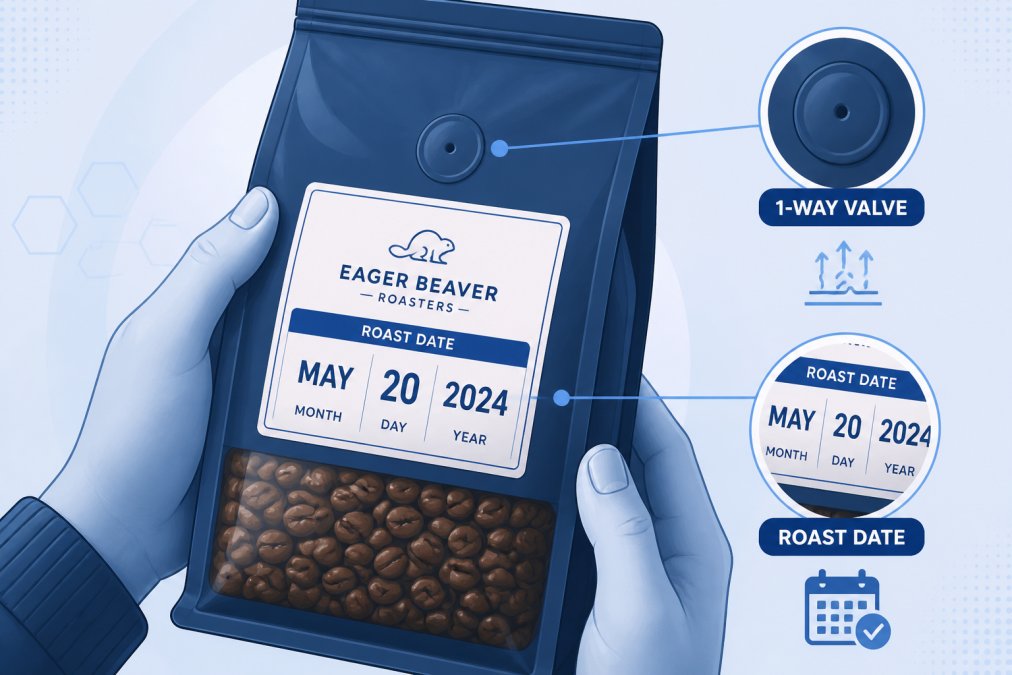
The roast date should be printed clearly on the bag in a format like "Roasted: 7/28/26." If today is August 10 and the roast date is August 3, your coffee is 7 days old, in the sweet spot. If the roast date is July 15, your coffee is 26 days old and past peak flavor.
Fresh coffee roasters should show roast dates within the last 14 days, ideally within 10. Since online orders take 3-5 days to arrive, the roaster needs to roast within 5-7 days of your order to guarantee optimal freshness upon arrival.
Checking Packaging and Valve Technology
Look for a one-way valve on the bag's front or side. This small vent allows CO2 to escape after roasting without letting oxygen back in. Bags without a valve are a red flag, they either contain very old coffee that's already finished degassing, or the roaster uses inferior packaging.
The bag material also matters. You want opaque packaging, usually kraft paper with an inner foil layer, that blocks light completely. Transparent bags let your coffee fade in real time.
When the package arrives, open it and smell. Fresh coffee smells vibrant and complex. Stale coffee smells flat and one-dimensional.
Sensory Evaluation for Beginners
Look at the beans, fresh ones should look glossy if dark roast, or have visible texture if light roast. Very old beans look dull and dusty.
Smell the beans right after opening. Fresh coffee should smell complex with fruity, chocolate, or nutty notes depending on origin and roast. Flat or cardboard smells indicate age.
Brew a small amount and taste it. Fresh coffee tastes bright and clean. Stale coffee tastes flat and muddy, regardless of brewing technique.
Evaluating Specialty Grade and Single Origin Options
Specialty grade coffee comes from specific farms or regions, has been carefully processed, and scores above 80 points on the Specialty Coffee Association's 100-point scale. The difference in the cup is enormous. Specialty grade has complexity, balance, and distinct tasting notes. Commodity coffee tastes generic and flat.
What Specialty Grade Actually Means
The Specialty Coffee Association defines specialty grade as coffee scoring 80 or above on their standardized cupping protocol. To achieve specialty grade, coffee must be sourced from a specific origin, processed carefully to preserve quality, and roasted to bring out its best characteristics.
When you buy specialty grade coffee from Eager Beaver Roasters, you're buying coffee that someone, a farmer, processor, roaster, has invested care and expertise into. The price difference between specialty and commodity coffee is modest. Specialty grade single origin might cost $15-24 per pound, while supermarket commodity costs $8-12 per pound.
Single Origin vs. Blends: Which to Choose
A single origin coffee comes from a specific farm, region, or country. A blend combines beans from multiple origins to create a balanced or interesting flavor profile.
Single origin coffees let you taste terroir, the environmental characteristics of where the coffee was grown. An Ethiopian natural-process coffee tastes fruity and floral because of altitude, climate, and processing specific to that region. Blends are designed to achieve a specific flavor goal by combining complementary origins.
For beginners, blends are often easier to enjoy because they're more balanced. Eager Beaver Roasters offers both. Their [Single Origin Favorites Sample Pack](https://eagerbeaverroasters.com/products/single-origin-favorites-sample-pack) ($24.99) lets you explore single origins in 2oz portions. Their Best Sellers Sample Pack ($24.99) includes both single origins and blends. Sample packs are the smart move to taste multiple origins without committing to full pounds.


Best Online Coffee Subscription Services and Roaster Models
The subscription model has transformed how people buy coffee online. Instead of reordering manually, coffee arrives on a schedule you set. Instead of buying pre-roasted inventory, subscriptions enable roasters to roast to order.
Understanding Subscription Flexibility and Frequency
A good subscription lets you control frequency and choose which coffee you receive each shipment. You should skip shipments, pause, or cancel without penalties. Pricing should be transparent. If a roaster buries fees or charges different amounts depending on subscription length, that signals opacity.
Shipping Logistics and Regional Delivery Costs
Shipping cost can make or break online coffee economics. When evaluating roasters, calculate the true cost per bag including shipping. A roaster charging $18 per bag with free shipping might be cheaper than one charging $15 per bag with $6 shipping.
Cost-Per-Cup Analysis: Is Premium Worth It
If you drink one cup of coffee per day, premium specialty coffee at $20 per pound works out to about $1.25 per cup. Commodity coffee at $10 per pound works out to about $0.60 per cup. That's about $240 per year if you drink daily. Sample packs let you taste specialty coffee without committing to full bags.
How to Store Coffee Beans for Maximum Freshness
Once your fresh coffee arrives, storage determines how long it stays fresh. Poor storage can undo all the benefits of ordering from a quality roaster.
Airtight Containers and One-Way Valve Bags
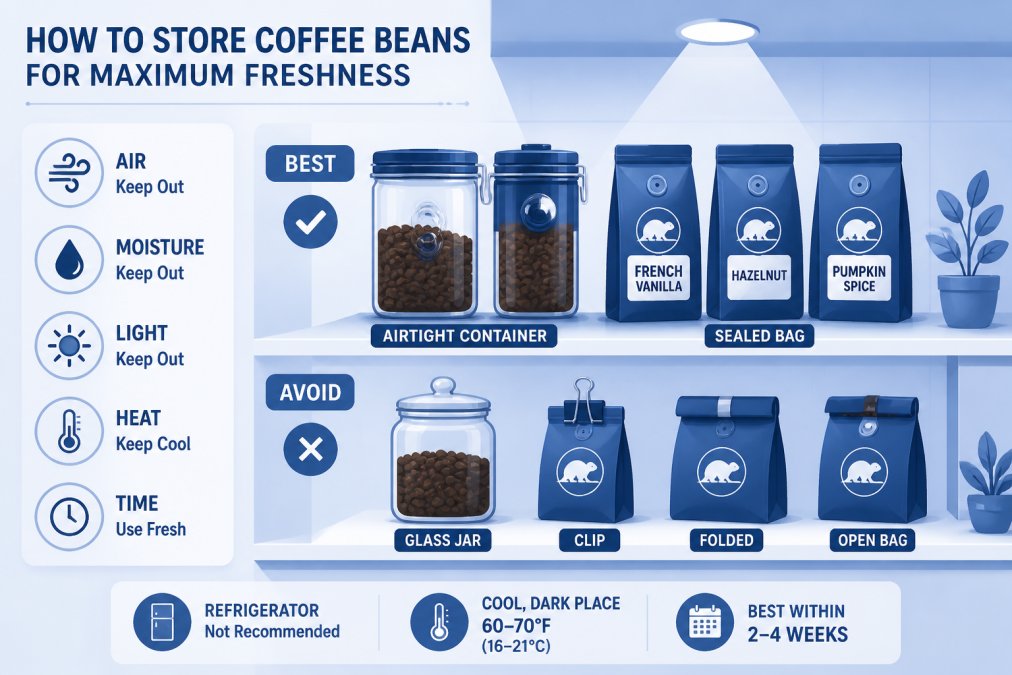
The original bag your coffee arrives in, assuming it has a one-way valve, is one of the best storage options. Fold the bag closed or use a clip to maintain freshness. If you transfer beans to another container, use an airtight container specifically designed for coffee. Glass jars with rubber seals work. Ceramic containers with tight-fitting lids work.
Temperature, Light, and Humidity Control
Coffee's enemies are heat, light, oxygen, and moisture. Store beans in a cool, dark place. Temperature matters most. Coffee stored at room temperature (around 70°F) stays fresh longer than coffee stored in a warm kitchen or near a heat source.
Light degrades coffee quality. Store beans in an opaque container or dark cabinet. For most people, a cool, dark cabinet is ideal. Keep beans sealed, maintain moderate temperature, and keep light out. Your coffee will stay fresh for 3-4 weeks.
Finding Fresh Coffee Roasters Online: Key Questions to Ask
Not every roaster that calls themselves "fresh" operates with freshness as a priority. Asking the right questions helps you separate genuine roasters from marketing-focused sellers.
Traceability and Direct Trade Sourcing
A quality roaster can tell you where their coffee comes from. Not just "Central America" or "Africa," but specific farms or cooperatives. They should name the farmer, altitude, processing method, and harvest date.
Direct trade means the roaster has a direct relationship with the farmer and pays prices reflecting quality and sustainability. When evaluating a roaster online, look for this information on their product pages. Eager Beaver Roasters sources from trusted farms worldwide and emphasizes quality over volume, meticulously sourcing beans and roasting them to order.
Small-Batch Roasting and Cupping Standards
Small-batch roasting means the roaster roasts in smaller quantities more frequently, rather than roasting large batches that sit in inventory. Cupping is the sensory evaluation method used in specialty coffee to assess quality. A roaster that cups their coffee is testing each batch to ensure it meets their standards.
Small-batch roasting also means the roaster has capacity to roast to order. A roaster running massive batches needs to forecast demand weeks in advance.
Roaster Transparency on Roast Profiles
Different roasts bring out different characteristics. A light roast emphasizes origin's acidity and brightness. A medium roast balances origin characteristics with roasted notes. A dark roast emphasizes body and roasted flavors.
A transparent roaster tells you which roast profile they're using for each coffee and why. Eager Beaver Roasters offers light, medium, and dark roast options for their coffees, giving you control over which flavor profile you want.
Common Mistakes When Ordering Fresh Coffee Online
The first mistake is ordering from a roaster that doesn't print the roast date. If they won't tell you when the coffee was roasted, assume it's old.
The second mistake is choosing based on price alone. The cheapest coffee online is often cheap for a reason, it's old, low-quality, or the roaster is cutting corners.
The third mistake is not accounting for shipping time. Plan accordingly when ordering from distant roasters.
The fourth mistake is overcommitting to a subscription before knowing what you like. Start with sample packs or one-off orders. Once you've found origins and roast profiles you love, then commit to a subscription.
The fifth mistake is storing beans incorrectly after arrival. You can order from the best roaster in the world, but poor storage will waste the freshness advantage.
Finding fresh coffee roasters online requires knowing what to look for: roast dates, one-way valve packaging, specialty-grade sourcing, and transparent roasting practices. Eager Beaver Roasters delivers on all these fronts, they roast to order in small batches, source from trusted farms, and offer light, medium, and dark roast options. Start with their [Best Sellers Sample Pack](https://eagerbeaverroasters.com/products/best-sellers-sample-pack-6bean-cowboy-breakfast-peru-mexico-bali) or Single Origin Favorites Sample Pack to experience the difference fresh, expertly roasted coffee makes. Find Your Perfect Roast and taste what specialty coffee is actually supposed to taste like.
Frequently Asked Questions
How do I know if coffee beans are actually fresh when they arrive at my door?
Check the roast date on the bag first. Fresh beans peak in flavor 5-14 days after roasting. Verify the roaster includes a roast date (not just an expiration date), and order from roasters who ship within 2-3 days of roasting. Look for airtight packaging with a one-way valve, which allows degassing while keeping oxygen out. When you open the bag, fresh beans should have visible sheen and release aroma immediately.
What's the difference between roast date and best by date on coffee bags?
Roast date tells you exactly when the beans were roasted, which determines their peak flavor window. Best by date is often a generic 12-18 months from packaging and doesn't reflect actual freshness. A bean roasted yesterday is fresher than one roasted six months ago, even if both have the same best by date. Prioritize roasters who prominently display roast dates. This transparency signals they're confident in their product's quality and freshness.
Is a coffee subscription service worth it if I only go through half a pound a week?
Yes, if the roaster offers flexible frequency. Look for subscriptions that let you pause, skip, or adjust delivery dates without penalty. Half a pound weekly (about 2 pounds monthly) works well with subscription models that send 1-2 pound shipments. Calculate cost-per-cup: specialty roasters typically cost $0.50-$0.80 per cup brewed, compared to $0.15-$0.30 for grocery store coffee. The flavor difference and freshness often justify the premium, especially if you brew daily.
How can I compare fresh coffee roasters online without getting overwhelmed by marketing claims?
Focus on verifiable facts: roast date transparency, bean sourcing (direct trade, fair trade, or named farms), small-batch roasting size, and shipping speed. Ask roasters their roast-to-ship timeline in writing. Check if they describe tasting notes with specifics (chocolate, berry, caramel) rather than vague language. Look for roasters who explain their processing methods (washed, natural, honey process) and offer sample packs before committing to larger quantities. Transparent roasters answer questions directly about their practices.
This article was written using GrandRanker