

How to Tell if Coffee Beans Are Fresh: 6 Tests That Work
Table of Contents
- Why the Coffee Bean Roast Date Matters Most
- Visual Inspection: What Fresh Coffee Beans Look Like
- The Coffee Bloom Test: A Hands-On Freshness Check
- Aroma and Scent Profiles: Your Nose Knows Fresh
- Taste Indicators: How to Recognize Stale Coffee Taste
- Coffee Bean Storage: Preserving Freshness at Home
- How to Tell if Coffee Beans Are Fresh: Common Mistakes
- Shelf Life Expectations and Freshness Windows
How to Tell if Coffee Beans Are Fresh: 6 Tests That Work
Last Updated: July 31, 2026
Learning how to tell if coffee beans are fresh is one of the most overlooked skills among home coffee enthusiasts. Freshness determines everything about flavor, aroma, and that satisfying morning ritual. The difference between a smooth, complex brew and something flat, papery, or stale is dramatic. At Eager Beaver Roasters, we've spent years helping coffee lovers understand what separates a vibrant cup from a disappointing one.

The challenge is that freshness isn't obvious at a glance. That's why we're breaking down six concrete tests you can run at home with tools you already have.
Why the Coffee Bean Roast Date Matters Most
The roast date is the single most important piece of information on your coffee bag. Unlike the "best by" date on milk, the roast date tells you when the beans were transformed from green (raw) to brown (roasted).
Understanding Degassing and Oxidation
Fresh coffee beans actively release carbon dioxide, a process called degassing. For the first 24 to 48 hours after roasting, beans emit so much CO2 that they can inflate a sealed bag. As days pass, degassing slows and oxidation takes over. Oxygen breaks down the volatile compounds responsible for flavor and aroma, this isn't reversible.

The first 2 to 4 weeks after roasting represent the peak freshness window. During this period, beans have finished initial degassing but retain the majority of their flavor compounds. After four weeks, decline accelerates. By eight weeks, most specialty coffee loses noticeably brightness and complexity.
Check your bag's roast date before you buy. If it's older than two weeks, the beans have already passed their optimal window. If it's older than four weeks, you're compromising the experience you paid for. Eager Beaver Roasters roasts to order and ships within 48 hours, which means your beans arrive in that critical peak-freshness window.
Visual Inspection: What Fresh Coffee Beans Look Like
Your eyes tell you more than you might think. Fresh beans have a distinct appearance that changes noticeably over time.
Glossy Shine vs. Dull Surface
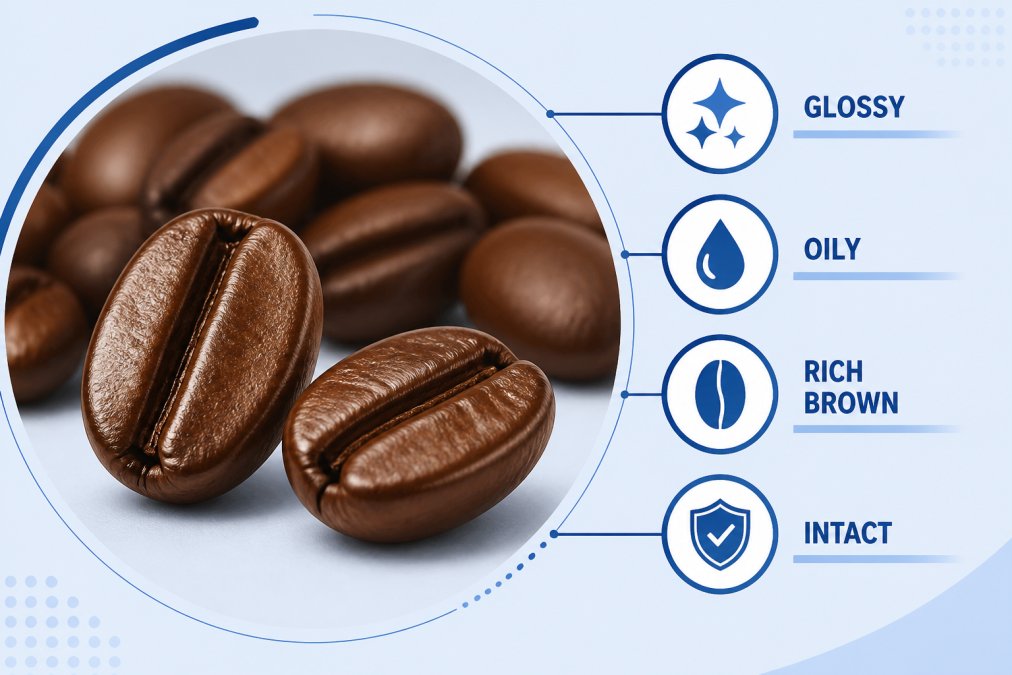
Fresh coffee beans have a subtle glossy sheen on their surface, coming from oils and volatile compounds that haven't yet oxidized. This oily residue is a sign that the bean's interior complexity is still intact. As beans age, that shine fades. Older beans look dull and matte, with a chalky or grainy appearance reflecting the breakdown of volatile compounds.

Bean Integrity and Density
Examine individual beans closely. Fresh beans should have intact skin with minimal cracks or splits. The bean structure feels dense and hard when you bite down. Stale beans become brittle and fracture easily, losing density and feeling lighter, almost hollow. Look for discoloration too. Fresh beans show a rich, even brown color appropriate to their roast level. Stale beans develop uneven coloring, sometimes with grayish or ashy patches, indicating oxidation has progressed significantly.
The Coffee Bloom Test: A Hands-On Freshness Check
The bloom test is the single most reliable indicator of freshness you can perform at home. It requires nothing but hot water and a few seconds of observation.
Step-by-Step Bloom Procedure
Here's exactly how to run the test:
- Grind your beans to a medium consistency, similar to sand. Use about 15 grams of coffee.
- Heat water to 195-205°F (90-96°C). If you don't have a thermometer, let boiling water cool for 30 seconds.
- Place grounds in a cup or small brewer and pour just enough hot water to saturate them, about 50 milliliters.
- Watch for 30 seconds. Fresh beans will visibly bubble and rise, creating a foamy layer on top. This is the bloom.
- Observe the intensity. A vigorous, thick bloom with large bubbles indicates fresh beans. A weak, thin bloom or no bloom at all indicates stale beans.
- Continue brewing normally after the bloom phase.
The bloom happens because carbon dioxide trapped in the beans is rapidly released when hot water hits them. Fresh beans still contain enough CO2 to create a dramatic, visible reaction. Stale beans have already lost most of their gas, so the bloom is weak or nonexistent.
What a Strong Bloom Tells You
A strong bloom is a direct indicator that your beans are within the freshness window. The more vigorous the bloom, the fresher the beans. A bean that's two weeks old will bloom dramatically. A bean that's eight weeks old might barely bubble.
Aroma and Scent Profiles: Your Nose Knows Fresh
Your sense of smell is extraordinarily sensitive to freshness. Before you even brew, your nose can tell you a lot.
Volatile Compounds and Peak Freshness
The aroma you smell when you open a bag of coffee comes from volatile compounds, molecules that evaporate easily and carry flavor information to your brain. Fresh beans release a complex, layered aroma: you might detect chocolate, fruit, nuts, flowers, or caramel depending on the origin and roast. These aromas are strongest in the first two to three weeks after roasting. Peak freshness smells bright and alive, with intensity that jumps out when you open the bag.
Recognizing Stale or Rancid Aromas
Stale beans smell flat and one-dimensional. Instead of layered complexity, you get a single, muted note, often described as cardboard-like or musty. Rancid aromas are different and more concerning. If beans smell sour, vinegary, or like wet cardboard, oxidation has progressed significantly and the beans should not be brewed. Trust your nose. If the aroma doesn't excite you, the taste won't either.
| Freshness Stage | Aroma Intensity | Aroma Profile | Time Since Roast |
|---|---|---|---|
| Peak Fresh | Strong, bright | Layered, complex notes | 1-3 weeks |
| Still Good | Moderate | Recognizable but muted | 3-6 weeks |
| Declining | Weak | Single, flat note | 6-8 weeks |
| Stale | Very weak or musty | Cardboard, muted | 8+ weeks |
Taste Indicators: How to Recognize Stale Coffee Taste
Ultimately, your palate is the final judge. Knowing what to taste for makes the difference between thinking "this coffee is okay" and recognizing "this coffee is past its prime."
Flavor Profile Changes Over Time
Fresh coffee tastes bright and alive. If the beans were roasted to showcase fruit notes, you taste fruit. If they were roasted to emphasize chocolate, chocolate comes through clearly. As beans age, the flavor profile flattens. Bright notes become muted. Subtle flavors disappear entirely. What remains is a simplified version of the original.
Papery, Hollow, or Flat Flavors
Stale coffee develops specific taste signatures. A papery taste is one of the most common, a dry, slightly astringent sensation on your tongue that feels like you're chewing paper. Hollow flavor is another telltale sign. The coffee tastes thin, like it's missing something. You get bitterness or acidity without the underlying sweetness or body that should balance it. The solution is simple: use fresher beans. The difference between a one-week-old bean and a six-week-old bean is dramatic when you taste them side by side.
Coffee Bean Storage: Preserving Freshness at Home
You can't stop beans from aging, but you can significantly slow the process by controlling their environment.
Airtight Containers and One-Way Valves
The enemy of freshness is oxygen and light. Store beans in an airtight container, preferably one that blocks light. Many specialty coffee bags come with a one-way valve, which allows carbon dioxide to escape without letting oxygen in. If you transfer beans to a different container, make sure it seals completely. Glass jars with rubber seals or opaque ceramic containers are better choices than ziplock bags. Store your container in a cool, dark place, a pantry or cabinet works well. Avoid the refrigerator or freezer unless you're planning long-term storage.
Freezing as a Preservation Method
Freezing is surprisingly effective for extending freshness. If you freeze beans properly, they can maintain quality for three to four months. Divide your beans into weekly portions and seal each portion in an airtight freezer bag, removing as much air as possible. Label each bag with the roast date. When you're ready to use a portion, remove it from the freezer and let it come to room temperature in a sealed container before opening. This prevents condensation from forming on the beans. Don't freeze and thaw repeatedly.
Environmental Factors That Speed Degradation
Heat accelerates oxidation dramatically. A warm kitchen will age beans twice as fast as a cool pantry. Humidity is another factor, moisture in the air can be absorbed by beans, accelerating degradation. Keep beans away from the sink, dishwasher, and any source of steam. Light exposure degrades beans through UV radiation, which breaks down flavor compounds directly. Opaque storage is worth the small investment.
How to Tell if Coffee Beans Are Fresh: Common Mistakes
Most people make predictable errors when trying to assess freshness. Knowing these mistakes saves you from wasting money on mediocre coffee.
The 'Bag Puff' Method Isn't Reliable
A puffy bag does indicate that carbon dioxide is being released, which happens with fresh beans. But the puff doesn't tell you how fresh. A bag that's one week old will be puffier than a bag that's three weeks old, but both are still in the freshness window. Always check the roast date. The bag puff is supplementary information at best, not a primary test.
Oily Residue Doesn't Always Mean Fresh
Some people assume that oily beans are fresh and dry beans are stale. In reality, oiliness depends heavily on roast level and bean origin. Dark roast beans are naturally oilier because the longer roast time brings oils to the surface. Use the bloom test and roast date instead. These give you objective information.
Troubleshooting Brew Method Variables
Sometimes stale beans taste better than fresh beans, depending on how you brew them. A very fresh bean (one week old) that's still actively degassing can be tricky to brew. The excessive carbon dioxide can make water channel through the grounds unevenly, producing an under-extracted, sour cup. The sweet spot is days 3 through 21 after roasting, when the bean has finished aggressive degassing but still retains full flavor complexity. If your fresh beans taste sour, adjust your brew method before assuming the beans are bad.
Shelf Life Expectations and Freshness Windows
Understanding realistic timelines helps you plan your purchases and storage.
Peak freshness lasts approximately 14 to 21 days after roasting. By day 28 (four weeks), most specialty coffee has noticeably declined. Acceptable freshness extends to about 28 to 35 days. Declining freshness begins around day 35 and extends to day 56 (eight weeks). Beyond eight weeks, coffee is genuinely stale.
Cool, dark, airtight storage extends these windows by a week or two. Warm, light, or humid storage shortens them significantly. Buying smaller quantities more frequently is better than buying in bulk. A half-pound of fresh beans every two weeks beats a two-pound bag that sits for two months. Eager Beaver Roasters offers flexible subscriptions so you can receive fresh beans on your schedule without committing to more coffee than you'll use.
The difference between stale coffee and fresh coffee isn't subtle, it's the difference between a cup that excites you and one that feels like an obligation. Now that you know how to tell if coffee beans are fresh, you have the tools to make sure every cup meets your standards. Start with a small order of freshly roasted beans from Eager Beaver Roasters, which arrive roasted to order and ship within 48 hours. You'll taste the difference immediately, and you'll understand why freshness matters so much to people who take their coffee seriously.
Frequently Asked Questions
How do I check the coffee bean roast date when buying?
Look for a printed roast date on the bag's label or packaging. Reputable roasters like Eager Beaver Roasters print this prominently because it's the most reliable freshness indicator. The roast date tells you exactly when degassing began, which determines the bean's peak window. If no roast date is visible, contact the seller before purchasing. Aim for beans roasted within 2-4 weeks of your purchase date for optimal flavor and extraction.
What does the coffee bloom test tell you about freshness?
During brewing, fresh beans release carbon dioxide vigorously, creating visible blooms and bubbles. A strong, sustained bloom indicates high volatile compound content and recent roasting. Stale beans produce little to no bloom because they've already degassed significantly. To test: pour hot water over grounds, wait 30-45 seconds, and observe the foam. A robust, bubbly bloom suggests beans are within their optimal freshness window and will extract better flavor and acidity.
Can I freeze coffee beans to extend shelf life?
Yes, freezing is an effective preservation method when done correctly. Store beans in an airtight container or vacuum-sealed bag to prevent moisture and oxidation. Frozen beans can maintain quality for 3-4 months. However, freeze in small portions, only thaw what you'll use within 1-2 weeks, as repeated thawing introduces moisture that degrades flavor. For best results, freeze beans immediately after purchase if you can't use them within 2-4 weeks of the roast date.
What does stale coffee taste like, and how can I tell?
Stale coffee develops papery, hollow, or flat flavor profiles as volatile compounds degrade and oxidation advances. You'll notice loss of acidity, body, and the nuanced taste notes typical of fresh beans. The cup may taste muted or one-dimensional. To identify staleness: brew a small sample and compare against a known fresh roast. If flavor is noticeably duller or lacks the brightness you expect, the beans are past their peak. Proper storage in airtight containers slows this degradation significantly.
This article was written using GrandRanker