

Sustainable Light Roast Coffee Farms: 2026 Guide
Table of Contents
- What Makes a Coffee Farm Truly Sustainable?
- Regenerative Coffee Farming Practices That Rebuild Soil
- Bird Friendly Coffee Certification and Shade-Grown Methods
- Organic Light Roast Coffee Benefits for Flavor and Farm Quality
- Direct Trade vs. Fair Trade: Which Model Supports Farms Better?
- How to Identify Sustainable Light Roast Coffee Farms When You Buy
- Carbon Footprint, Water Usage, and the Metrics That Matter
- Conclusion: Drinking Better Coffee Starts With Better Farms
- Frequently Asked Questions
Last Updated: October 2, 2026
What Makes a Coffee Farm Truly Sustainable?
A sustainable light roast coffee farm balances soil health, biodiversity, and farmer economics. Miss one and the operation eventually collapses, no matter how good the coffee tastes.
Most buyers think sustainability starts and ends with a certification logo. It doesn't. At Eager Beaver Roasters, we've learned the farms worth paying attention to rebuild their land while paying pickers a living wage, a harder bar than a sticker.
The three pillars: soil, biodiversity, and farmer economics
Soil is the foundation. Coffee grown on depleted, chemically farmed ground produces thin, flat-tasting beans. Healthy soil holds water, cycles nutrients, and feeds a coffee plant's roots.
Biodiversity comes next. A farm growing coffee as a single crop in full sun is fighting nature.
Farmer economics is the pillar most shoppers ignore.
Regenerative Coffee Farming Practices That Rebuild Soil
Regenerative coffee farming restores soil rather than merely avoiding damage, leaving the land better than the farmer found it.
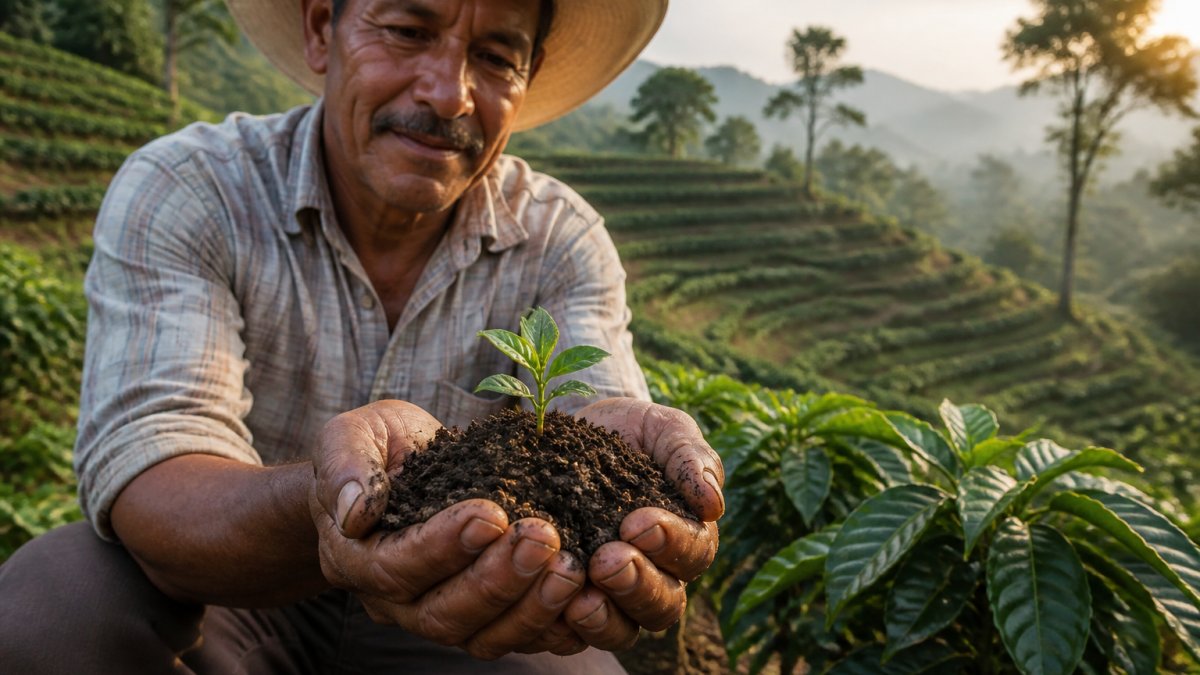
The most common regenerative techniques in coffee look like this:
- Agroforestry: Growing coffee under a canopy of shade and fruit trees, which drops leaf litter that feeds the soil and shelters the crop from harsh sun.
- Crop rotation and intercropping: Alternating coffee with nitrogen-fixing plants like beans or legumes to replenish nutrients naturally.
- Composting and mulch: Returning coffee pulp, cherry skins, and pruning waste to the soil.
- Cover cropping: Planting ground cover between rows to prevent erosion and hold moisture on steep hillsides.
Agroforestry, crop rotation, and carbon sequestration
Agroforestry is the headline practice for a reason. Shade trees pull carbon out of the atmosphere and lock it into wood and soil, carbon sequestration. Mature canopies store more carbon than sun-grown monocultures, and the shade slows cherry ripening, often concentrating flavor.
Crop rotation matters less in coffee than in row crops, since coffee is a perennial, but intercropping with nitrogen-fixers plays a similar role.
Bird Friendly Coffee Certification and Shade-Grown Methods
Bird Friendly coffee certification, administered by the Smithsonian Migratory Bird Center (SMBC), is widely regarded as the most rigorous shade standard in coffee.
What the Bird Friendly standard actually requires
The SMBC standard is built on measurable requirements inspectors verify on the farm:
- Canopy cover: A minimum percentage of the farm must be shaded by a tree canopy, with the exact threshold set by elevation and latitude.
- Canopy height: Trees must reach a minimum height to create the layered structure migratory birds use for foraging and nesting.
- Species diversity: A minimum number of shade tree species per acre, emphasizing native species rather than a single planted timber tree.
- Structural complexity: Multiple vegetation layers, ground cover, shrubs, mid-story, and canopy, rather than a single flat layer of shade.
- Buffer and border requirements: Vegetated borders and stream buffers that protect waterways and connect habitat patches.
Because these criteria are tied to elevation and geography, Bird Friendly is a farm-specific habitat plan audited on a recurring basis, not a one-size-fits-all badge.
Why shade-grown methods matter beyond birds
Shade-grown coffee mimics how coffee grows naturally in forest understories, benefiting more than birds:
- Slower cherry ripening: Shade reduces direct sun exposure, slowing cherry development and often concentrating sugars and acidity in the cup.
- Natural pest control: Birds, bats, and beneficial insects in the canopy handle many pests that would otherwise require synthetic pesticides.
- Soil protection: Leaf litter and root systems from shade trees reduce erosion on steep hillsides and feed the soil food web.
- Microclimate buffering: Shade moderates temperature swings, which matters more as growing regions experience more extreme heat events.
- Carbon storage: Mature shade canopies lock carbon into wood and soil, covered in more detail in the metrics section below.
The catch is yield. Sun-grown coffee produces more cherries per acre short term; shade-grown farms trade volume for longevity, lower input costs, and better flavor, which is why the premium is usually justified.
How Bird Friendly compares to other shade and habitat labels
Bird Friendly is not the only label that touches shade, but it is the most habitat-specific. Rainforest Alliance and Organic include some shade and biodiversity criteria, but they are broader and don't require the same documented canopy structure. For shoppers prioritizing biodiversity, Bird Friendly is the most direct signal on the bag.
Organic Light Roast Coffee Benefits for Flavor and Farm Quality
Organic light roast coffee benefits start at the farm and end in your cup. Organic certification prohibits most synthetic pesticides and fertilizers, protecting soil, water, and workers.
The light roast connection is where things get interesting. A light roast preserves more origin character, the citrus notes, floral acidity, and delicate cup that define a great single-origin coffee.
Why light roast profiles reveal farm-level quality
Light roasting is unforgiving: it leaves nowhere for a defect to hide. A bean grown on depleted soil, picked before ripe, or processed carelessly tastes thin and harsh when roasted light.
When you drink a light roast from a well-run farm, you're tasting healthy soil, careful harvesting, and clean processing. That's why we roast to order in light, medium, and dark profiles at Eager Beaver Roasters: each level tells you something different about the bean underneath.
Direct Trade vs. Fair Trade: Which Model Supports Farms Better?
Direct trade and Fair Trade both aim to get more money to the farmer.
Here's how they compare:
| Model | How It Works | Best For | Main Limitation |
|---|---|---|---|
| Fair Trade | Minimum price floor, third-party certified | Small co-ops needing price stability | Certification costs; floor may lag real costs |
| Direct Trade | Roaster buys straight from farm, negotiates price | Farms with consistent quality and volume | No universal standard; relies on roaster honesty |
| Bird Friendly | Requires shade-grown habitat criteria | Biodiversity-focused farms | Narrow scope; fewer certified farms |
Fair Trade's strength is its floor: when prices crash, certified farmers still get a guaranteed minimum.
Direct trade's strength is flexibility and traceability. A roaster who visits a farm and negotiates directly can pay well above market and get exactly the beans they want.
How to Identify Sustainable Light Roast Coffee Farms When You Buy
Identifying a genuinely sustainable coffee farm comes down to traceability, not logos. The more specific a roaster is about origin and growing methods, the more likely the sustainability claims are real.
Use this checklist the next time you're evaluating a bag:
- Does the label name the specific farm, cooperative, or region?
- Is the process listed (washed, natural, honey)?
- Is there a harvest or roast date, not just a "best by" date?
- Does the roaster publish farm-gate prices or sourcing relationships?
- Are certifications specific (Bird Friendly, Organic) rather than vague ("eco-friendly")?
Labels, traceability, and questions to ask a roaster
Traceability ties every genuine sustainability claim together. A roaster who can tell you the Sidama zone smallholders grew your Ethiopia Natural and that it was dried on raised beds knows their supply chain.

Ask direct questions: Where was this grown? How was it processed? What did the farm get paid? A roaster with real sourcing relationships answers without hesitation; one selling on vibes changes the subject.
Carbon Footprint, Water Usage, and the Metrics That Matter
The metrics that matter most in coffee sustainability are the ones most shoppers never see: carbon footprint, water usage, and the split between farming and shipping emissions.
Where coffee's carbon actually comes from
For most coffee, the farming stage, not shipping, dominates the carbon footprint. The main farm-level contributors are:
- Fertilizer production and application: Synthetic nitrogen fertilizer is energy-intensive to manufacture and releases nitrous oxide, a potent greenhouse gas, when applied to soil.
- Soil management: Tilled, bare soil loses carbon; shaded, mulched, and cover-cropped soil stores it.
- Processing method: Washed processing requires mechanical pulping and significant water heating and pumping; natural and honey processes use less energy and water but require careful drying.
- On-farm transport and drying: Fuel for vehicles and, in some regions, wood-fired dryers.
Ocean freight is comparatively efficient per pound over long distances. A farm using regenerative practices, agroforestry, composting, cover cropping, can offset more carbon than a shopper saves by buying locally roasted coffee from a conventionally farmed source. Farm-level practices move the needle more than shipping distance.
Water usage in wet-processing: the hidden metric
Water usage in wet-processing is the other hidden metric, and where washed and natural coffees diverge sharply.
The washed process, favored for its clean flavor clarity, uses significant water to remove fruit from the bean.
Natural process coffees, like our Ethiopia Natural, dry the whole cherry on raised beds and use far less water.
Neither process is universally better. They produce different flavors and carry different environmental trade-offs.
Regenerative agriculture as the next frontier
Organic certification prohibits most synthetic pesticides and fertilizers, a meaningful baseline. Regenerative agriculture goes further, requiring practices that measurably rebuild soil organic matter, sequester carbon, and improve water infiltration.
The distinction matters because a farm can be certified organic and still lose topsoil. Regenerative practices leave the land better than the farmer found it, increasingly the differentiator among forward-looking coffee farms.
A simple framework for comparing beans
When you evaluate a bag, compare it against three metrics:
- Carbon: Does the farm use shade trees, compost, and cover crops? Does the roaster disclose the processing method?
- Water: Was the coffee washed, honey, or natural? Does the mill recirculate water?
- Farmer economics: Does the roaster publish farm-gate prices or sourcing relationships?
No single bag scores perfectly on all three. The point is to know which trade-offs you're choosing.
Conclusion: Drinking Better Coffee Starts With Better Farms
The challenge with sustainable coffee is that the most important work happens thousands of miles away, long before the bag reaches your counter. You can't inspect the soil yourself, but you can buy from roasters who can tell you exactly where their beans came from and how they were grown.
That's the standard we hold at Eager Beaver Roasters. We source from trusted farms, roast to order in light, medium, and dark profiles, and skip the shortcuts that hide poor-quality green coffee. Our Ethiopia Natural and Tanzania lots are single-origin, traceable, and roasted fresh for maximum flavor and aroma.

Find your perfect roast and taste what a well-sourced bean actually delivers.
Frequently Asked Questions
Which coffee brand is the most sustainable?
There is no single most sustainable brand because sustainability depends on farming practices, supply chain transparency, and how a roaster sources beans. Look for brands that publish farm names, share roast dates, and source from farms using shade-grown or regenerative methods. Eager Beaver Roasters, for example, sources single-origin beans from smallholder farms and roasts to order, which reduces waste from stale inventory. The key is verifying specific claims rather than trusting a generic label.
Does organic certification guarantee sustainable farming practices?
No. Organic certification confirms a farm avoids synthetic pesticides and certain chemicals, but it does not require shade-grown methods, biodiversity protection, or fair labor practices. A farm can be certified organic while still using monoculture techniques that degrade soil health. For a fuller picture, look for additional certifications like Bird Friendly, which requires shade-grown agroforestry, or evidence of regenerative practices such as cover cropping and composting.
Why does light roast coffee highlight farm-level quality more than dark roasts?
Light roast profiles preserve the bean's natural acidity, floral notes, and citrus flavors, which come directly from the farm's altitude, soil, and processing method. Dark roasts mask those characteristics with caramelization and smoke. If a farm has poor soil health or inconsistent harvesting methods, a light roast will reveal those flaws. This is why roasters who offer light roast coffee often source from farms with strong traceability and quality control.
How can consumers verify if their coffee is sourced from regenerative farms?
Start by checking the roaster's website for farm names, regions, and processing details. Look for terms like shade-grown, agroforestry, or direct trade, which suggest closer relationships with farms. Some roasters publish annual sourcing reports or visit farms directly. If a bag only says a country name with no farm or cooperative information, that is a sign of low traceability. Asking a roaster directly about their sourcing is a fair and useful question.