

Best Milk Pairings for Dark Roast Espresso Drinks
Table of Contents
- How Dark Roast Oils and Milk Proteins Interact
- Best Milk Pairings for Dark Roast Espresso Drinks: A Comparison Table
- Dairy Milk Pairings: Whole, 2%, and Skim
- The Best Plant-Based Milk for Espresso and Barista Editions
- How to Steam Milk for Latte Art with Dark Roast Espresso
- Dark Roast vs Light Roast for Milk Drinks
- Temperature-Specific Pairing Guide: 130°F to 160°F
- Drink-by-Drink Pairings: Latte, Cappuccino, Flat White, and Mocha
- Frequently Asked Questions
Last Updated: September 13, 2026
How Dark Roast Oils and Milk Proteins Interact
Dark roast espresso carries more surface oils than lighter roasts, and those oils are the first thing milk meets in the cup. During roasting, beans lose moisture and their cell walls break down, pushing lipids to the surface. Those oils are hydrophobic, so they resist water but bind readily to the fat and protein in milk. The result: a rounder, heavier cup where bitterness softens and sweetness steps forward.
This is the mechanism most pairing guides skip. At Eager Beaver Roasters, we roast dark profiles to order because those oils peak in the first days after roasting. The best milk pairings for dark roast espresso drinks give those oils something to cling to. Skim milk, with almost no fat, has little to bind; whole milk and barista-edition plant milks have plenty. That variable explains more about your drink than grind size ever will.
Best Milk Pairings for Dark Roast Espresso Drinks: A Comparison Table
Whole milk is the default pairing for dark roast espresso: its fat supports the heaviest body and steams into the most stable microfoam. The table below maps each option's strengths and trade-offs.
| Milk | Fat/Protein | Steaming Quality | Flavor Match | Best For |
|---|---|---|---|---|
| Whole milk | High fat, high protein | Excellent microfoam | Chocolate, caramel | Lattes, flat whites |
| 2% milk | Moderate fat | Good, slightly thinner | Balanced | Cappuccinos |
| Skim milk | Minimal fat | Foamy but dry | Washes out roast | Light drinks only |
| Barista oat | Added fat, high protein | Very good | Nutty, sweet | Dairy-free lattes |
| Barista almond | Added fat, lower protein | Fair, separates easily | Delicate | Small milk drinks |
| Soy | Moderate fat, high protein | Good | Neutral, creamy | Mochas |
Read the rows by what you're drinking, not by what's trendy. A dark roast wants fat and protein to anchor its oils; the top three rows deliver that, and among plant options only barista editions earn their place.
Dairy Milk Pairings: Whole, 2%, and Skim
Whole Milk and Fat Content
Whole milk is the strongest dairy match for a dark roast. Its fat gives the espresso oils somewhere to dissolve, which is why a whole-milk latte tastes like dark chocolate rather than scorched sugar. Its protein also builds microfoam that holds a pour, so latte art survives to the table.
2% and Skim: Where Texture Starts to Slip
2% milk lands in a useful middle ground: it steams cleanly and keeps enough body for a cappuccino, though the texture thins against whole milk. Skim is the weak link. With fat stripped out, there's little for the roast's oils to bind to, so the espresso reads sharp and the foam turns dry and bubbly. If you drink skim for health reasons, a medium roast will flatter it far more than a dark one.
The Best Plant-Based Milk for Espresso and Barista Editions
The best plant-based milk for espresso is a barista edition, not a standard carton, and the reason is formulation, not marketing. Standard oat and almond milks are built for cereal and smoothies, where stability in a cold bowl matters more than emulsification under a steam wand.
What Barista Editions Actually Add
Read the ingredient panel on a barista oat and you'll usually find three things a standard carton lacks:
- Added fat, often a neutral vegetable oil such as rapeseed or sunflower. Fat gives the dark roast's surface oils somewhere to dissolve, the same mechanism whole milk uses. Without it, those oils float on top instead of blending in.
- An emulsifier, commonly sunflower lecithin or a mono- and diglyceride blend. Emulsifiers keep fat droplets suspended so the milk doesn't split past 140°F. This is the biggest reason barista oat pours glossy microfoam while standard oat foams into large bubbles that collapse in a minute.
- A stabilizer or acidity regulator, often dipotassium phosphate or a gellan-type gum. Dark roast espresso is more acidic than many people assume, and these buffers keep plant proteins from tightening and separating when they meet it.
That additive package is why barista editions cost more per carton. You are paying for the emulsification system, not the oats.
Barista Oat, Barista Almond, and Soy Side by Side
| Option | Protein | Added Fat | Emulsifier/Stabilizer | Behavior With Dark Roast |
|---|---|---|---|---|
| Barista oat | Low to moderate | Yes | Lecithin, gum or phosphate | Glossy microfoam, natural sweetness flatters chocolate and caramel notes |
| Standard oat | Low | No | Minimal | Large bubbles, quick collapse, watery finish |
| Barista almond | Low | Yes | Lecithin, gum | Improves on standard, but lower protein means it separates faster under sustained heat |
| Soy | Moderate to high | Naturally present | Often none needed | Neutral flavor, enough protein for decent texture, stands up to mochas |
Soy is the sleeper here. It has more protein than oat or almond, so it doesn't depend on additives to build texture, and its neutral flavor won't fight a smoky or earthy dark roast. The trade-off is a slightly beany edge some drinkers notice in a plain latte.
The Additive Trade-Off Nobody Names
Stabilizers and emulsifiers make barista editions work, but they also change how the milk tastes as it cools. A barista oat latte at 150°F reads sweet and round; at 110°F it can taste flat and slightly chalky as the gums set. Standard oat has nothing to set, it just tastes thin the whole way down. If you drink slowly, that's a real consideration.
How to Steam Milk for Latte Art with Dark Roast Espresso
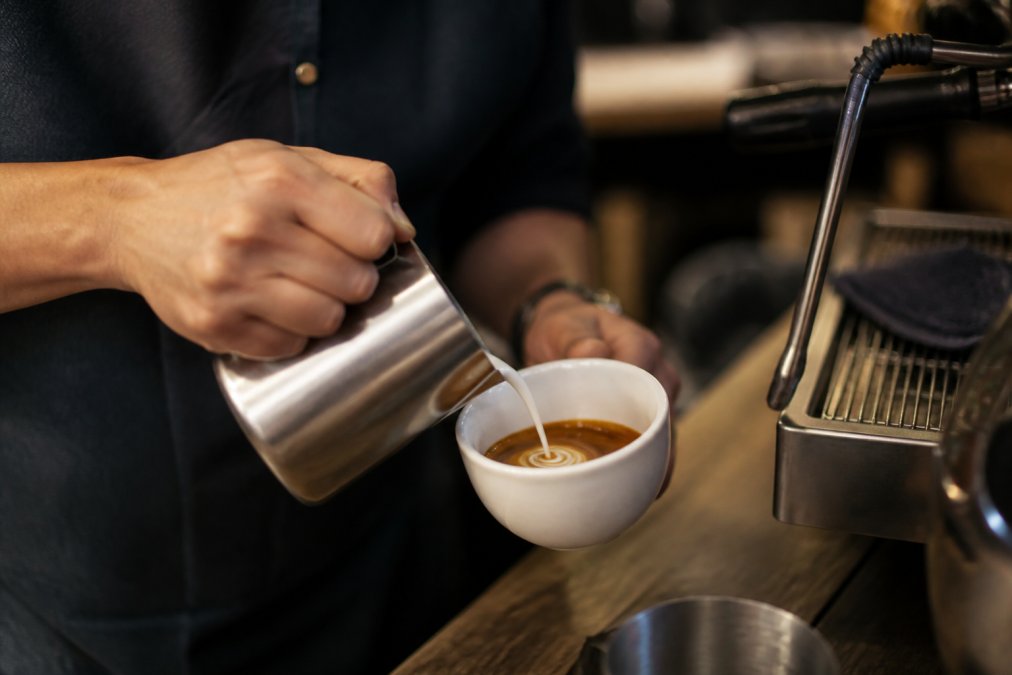
Learning how to steam milk for latte art starts with cold milk, a clean pitcher, and a purged steam wand. Pour cold milk to just below the pitcher's spout base, submerge the tip slightly off-center, and open the valve. Hold the tip just under the surface for a few seconds to draw in air, then lower the pitcher to bury the tip and create a rolling vortex. Stop when the pitcher feels too hot to hold comfortably, roughly 140°F to 150°F. Swirl, tap out large bubbles, and pour immediately. Dark roast gives you an advantage here: its oils create a denser crema that holds a pour longer than a light roast's thinner crema.
Dark Roast vs Light Roast for Milk Drinks
Dark roast wins for milk drinks, and it isn't close. Darker roasting drives caramelization and Maillard reactions that convert sugars into the chocolate, molasses, and toasted notes that survive dilution in milk. Light roasts keep more origin character, but those bright, fruity, acidic notes get buried under dairy, a light roast latte often tastes like warm milk with a faint fruitiness underneath.
There's a trade-off worth naming. Dark roast gives up acidity and complexity for body and sweetness, exactly the exchange a milk drink rewards. If you drink espresso straight, a medium or light roast shows more; if you drink lattes and cappuccinos, the darker the better.
Temperature-Specific Pairing Guide: 130°F to 160°F
Temperature changes how a pairing reads, and most guides ignore it. As milk heats, its proteins denature and its sugars break down, so sweetness climbs while the roast's sharper edges round off. The same milk can flatter a dark roast at one temperature and flatten it at another, which tells you when to stop steaming, not just what number to aim for.
What Is Happening at Each Band
130°F to 140°F, sweetness peaks, roast notes stay distinct. Milk proteins have begun to unfold, but the dark roast's Maillard and caramelization compounds are still volatile enough to read on the nose. Lactose hasn't broken down much, so the milk's sweetness is restrained. This is the band where a flat white or cortado tastes like the roast first and the milk second.
140°F to 150°F, balanced, full microfoam stability. This is the working range for most drinks. Proteins have denatured enough to build stable foam, and the milk's sugars have started to caramelize slightly, which is why a latte here tastes rounder than the same drink at 135°F. Microfoam holds its shape long enough to pour art and survive to the table.
150°F to 160°F, roast turns ashy, foam thins. Past 150°F, the volatile compounds carrying a dark roast's chocolate and molasses notes cook off, leaving ash and scorched sugar. The foam structure also collapses as proteins over-coagulate, so texture goes from glossy to dry. A drink in this band isn't ruined, but it no longer shows what the roast can do.
Above 160°F, scalded. Milk proteins coagulate hard and the drink takes on a cooked, cabbage-like note no good espresso can cover. Most commercial steam wands can push milk past this in seconds if you're not watching the pitcher.
Pairing by Temperature and Drink
| Milk Temp | What Happens | Best Paired With | Why |
|---|---|---|---|
| 130°F-140°F | Sweetness peaks, roast notes stay distinct | Flat white, cortado | Low milk volume lets the roast's oils carry; cooler milk keeps volatiles intact |
| 140°F-150°F | Balanced, full microfoam stability | Latte, cappuccino | Protein structure supports art; sugars round the roast's edges |
| 150°F-160°F | Roast turns ashy, foam thins | Drink quickly, or avoid | Volatiles cook off; foam collapses |
| Above 160°F | Scalded, cooked aftertaste | Avoid | Proteins coagulate hard |
How to Hit the Band You Want
A thermometer is the reliable way, but you can also learn the pitcher. At 130°F it feels warm but comfortable against the palm; at 140°F it's hot but holdable for a few seconds; at 150°F you want to put it down. Most home steam wands run hot, so stop steaming one beat earlier than feels right and swirl the pitcher, residual heat carries it up a few degrees while you tap out bubbles.
For the roast's flavor notes front and center, steam to the lower end. For a sweeter, more dessert-like drink, aim for the middle. Past 160°F you're scalding the milk, which mutes the dark roast's chocolate notes and leaves a cooked aftertaste no milk choice can fix.
Drink-by-Drink Pairings: Latte, Cappuccino, Flat White, and Mocha
Each drink changes the milk-to-espresso ratio, so the right pairing shifts with it.
- Latte: Whole milk or barista oat. The high milk volume needs fat and body to keep the roast present.
- Cappuccino: Whole milk or 2%. The drier, thicker foam rewards a milk with structure.
- Flat white: Whole milk, steamed to 130°F-140°F. Less milk means the roast's oils carry further.
- Mocha: Soy or whole milk. Both stand up to chocolate syrup without turning the drink cloying.
A dark roast's chocolate and nutty notes are the throughline across all four. Start with a dark espresso like [our 6 Bean Blend](https://eagerbeaverroasters.com/products/6-bean-blend), built for espresso, or the Italian Roast if you want the darkest profile we make. For a single-origin option with molasses and brown sugar notes, the Bali Blue pairs beautifully with whole milk.


Choosing the right milk is the difference between a dark roast that sings and one that just tastes burnt. Eager Beaver Roasters roasts every dark profile to order and ships it fresh, so the oils that make these pairings work are still at their peak when the bag reaches your door. Our Italian Roast and 6 Bean Blend are both built for milk drinks, and every order ships fast with a simple reorder process. Find your perfect roast and taste what fresh, filler-free dark coffee does in a latte.
Frequently Asked Questions
Does dark roast espresso taste better with dairy or plant-based milk?
It depends on the flavor you want. Whole dairy milk brings lactose sweetness and fat that round off the bitter, smoky edges of a dark roast, which is why it stays the default for lattes and cappuccinos. Barista-edition oat milk comes close because added oils and stabilizers mimic that body, and its oat sugars soften the roast without adding dairy. Almond milk is the weakest match here, since its thin texture and nutty notes can leave the dark roast tasting sharp and one-dimensional.
Why does dark roast coffee pair well with milk?
Dark roasting pushes sugars through caramelization and builds up oils on the bean surface. Those oils carry bitter, smoky, cocoa-heavy flavor notes that read as harsh in a straight shot but balance out once milk fat and protein enter the cup. Milk proteins coat the palate, fat adds body and mouthfeel, and lactose adds a mild sweetness that counters bitterness. The result is a smoother, rounder drink where the roast still leads instead of getting buried.
What is the best milk for latte art with dark roast espresso?
Whole milk remains the easiest to work with because its fat and protein content holds microfoam structure long enough to pour a clean rosetta or heart. If you want a plant-based option, choose a barista-edition oat milk, which is formulated with extra fat and stabilizers to steam and stretch like dairy. Standard almond and standard oat milks tend to foam thin and collapse quickly. Whatever you pick, keep the pitcher cold and aim for a final temperature around 140°F to 150°F.
Should I use oat milk or almond milk for dark roast espresso?
Oat milk wins for dark roast drinks. Its natural sugars and creamier body soften the roast's bitterness and hold up in a latte or flat white, especially in barista-edition versions. Almond milk is thinner, lower in protein, and its nutty flavor can clash with smoky, cocoa-forward notes. If almond is your only option, look for a barista-style version with added fat and use it in smaller drinks like a cortado, where the espresso carries more of the flavor.