

7 Coffee Grinder Settings for Every Brew Method
Last Updated: October 26, 2026
Quick Summary
Coffee grinder settings should match your brew method: fine for espresso, medium for drip coffee, medium-fine to medium-coarse for pour-over, coarse for French press, and extra-coarse for cold brew. Start at the middle of your grinder's suggested range, then adjust one increment at a time and taste after each change.
- Grind size runs from extra-fine powder under 200 microns to extra-coarse peppercorn chunks above 1,300 microns.
- Grinder numbers are not standardized, so a 12 on one burr grinder differs from a 12 on another.
- Find your grinder's zero point first, then pick the middle of the manufacturer's suggested range as your baseline.
- Steep French press for about four minutes and cold brew for 12 to 18 hours.
- Keep dose, ratio, temperature, and brew time fixed while dialing grind, and log each result.
Table of Contents
- Why Coffee Grinder Settings Decide How Your Cup Tastes
- The Coffee Grind Size Chart: Extra-Fine to Extra-Coarse
- Best Grind Size for Drip Coffee and Filter Brewers
- The Espresso Grind Setting: Fine, Consistent, and Dialed In
- French Press, Pour-Over, and Cold Brew Grind Targets
- How to Adjust Coffee Grinder Settings Without Wasting Beans
- Troubleshoot by Taste: Sour, Bitter, or Weak Cups
- Find Your Perfect Roast and Grind It Fresh
- Frequently Asked Questions
Why Coffee Grinder Settings Decide How Your Cup Tastes
Grind size is the biggest lever you control after the beans. Change it and the same coffee tastes sweet or harsh.
Grinding creates surface area. For a deeper look at the mechanics, see how burr grinder settings affect espresso extraction. The Specialty Coffee Association's brewing guidance explains that extraction depends on how quickly water pulls flavor from those grounds.
Get the match wrong and you taste it immediately. Too fine for a drip brewer and the water stalls, leaving bitterness. Too coarse for espresso and the shot races through, tasting thin and sour.
The goal: pick the grind that lets water pass through in the right time.
The Coffee Grind Size Chart: Extra-Fine to Extra-Coarse
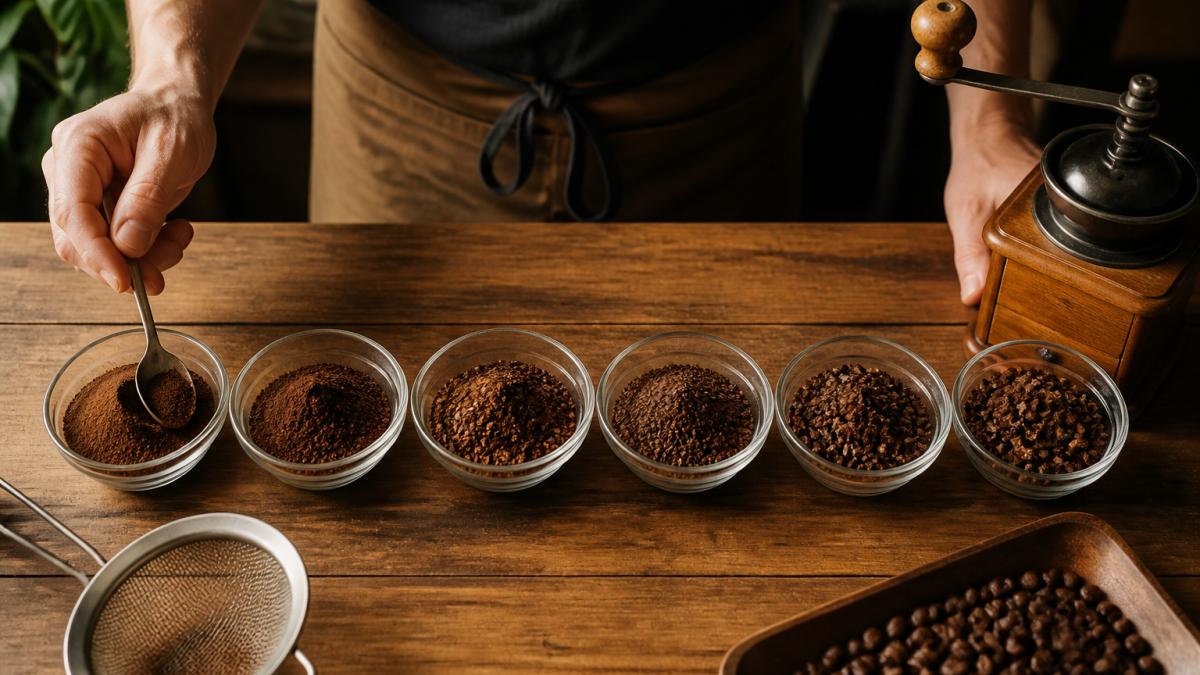
Coffee grind size runs on a scale from powdery extra-fine to chunky extra-coarse.
| Grind Level | Texture Cue | Approx. Particle Size | Best For |
|---|---|---|---|
| Extra-fine | Powder, like flour | Under 200 microns | Turkish-style coffee |
| Fine | Smooth, slightly gritty | 200-400 microns | Espresso |
| Medium-fine | Soft sand | 400-600 microns | Pour-over, AeroPress |
| Medium | Table salt | 600-800 microns | Drip coffee, flat-bottom brewers |
| Medium-coarse | Coarse sand | 800-1,000 microns | Chemex, clever drippers |
| Coarse | Sea salt | 1,000-1,300 microns | French press |
| Extra-coarse | Peppercorn chunks | 1,300+ microns | Cold brew |
The micron ranges are approximate starting bands, not lab tolerances. Most home burr grinders produce a spread of particle sizes around a target, so a "medium" setting still contains fines and boulders.
The best way to learn the scale is to feel it: rub a pinch between your fingers and compare it to salt, sand, or flour.
Why the Same Number Means Different Things on Different Grinders
A coffee grind size chart is a starting point, not a rule. Grinder settings are not standardized: a "12" on one burr grinder can sit two or three clicks from a "12" on another, and stepless grinders use no numbers at all. Three things drive the difference:
- Burr geometry and size. Flat burrs and conical burrs cut differently, and a larger burr set usually shifts the whole scale.
- Adjustment mechanism. Stepped grinders move in fixed increments; stepless grinders move continuously, so a "half step" is possible on one and not the other.
- Calibration and burr wear. A grinder that has been zeroed recently will not match one that has drifted, and worn burrs produce more fines at the same setting.
Translating a Grind Description Into a Starting Point
Use this process to convert a general grind label into a first setting on your own grinder:
- Find your grinder's zero point. With the burr set empty, turn the adjustment until the burrs just touch, then back off. Note that position. This is your reference, not a number to brew at.
- Locate the manufacturer's suggested range. Most grinder manuals list a brew-method range (for example, espresso near the fine end, French press near the coarse end). Treat it as a band, not a single number.
- Pick the middle of that band as your baseline for the method you are brewing.
- Brew and taste. Move one increment at a time from there, following the dial-in workflow later in this guide.
- Record the setting alongside the method, dose, and brew time so the number means something next time.
A chart tells you what texture to aim for. Your grinder tells you which number gets you there. Keep the two separate and you will stop chasing someone else's settings.
Best Grind Size for Drip Coffee and Filter Brewers
The best grind size for drip coffee is medium, roughly the texture of table salt.
Most drip machines brew in a fixed time window, so your grind has to fit it; a medium grind keeps flow balanced from first drop to last.
A few practical notes for filter brewers:
- Start at medium and adjust one notch at a time.
- If the brew tastes hollow, grind finer.
- If it tastes bitter or the filter overflows, grind coarser.
That last point matters. Change grind and dose at the same time and you will not know which one fixed the cup.
The Espresso Grind Setting: Fine, Consistent, and Dialed In
Espresso needs a fine grind. The puck must resist pressurized water just enough to build pressure and pull a rich, syrupy shot, the most demanding setting on any grinder.
Consistency is everything.
Dialing in espresso means small moves. Turn the adjustment a little finer if the shot runs fast and tastes sour. Go a touch coarser if it chokes and tastes bitter.
French Press, Pour-Over, and Cold Brew Grind Targets
French press, pour-over, and cold brew each need a different grind, and the differences are bigger than most people expect.
French press takes a coarse grind, like sea salt. A metal mesh filter lets fine particles through, so coarse grounds keep the cup clean and full-bodied.
Pour-over (including Chemex) wants a medium-fine to medium-coarse grind: medium-fine suits a standard cone, while Chemex and its thicker filter do better with medium-coarse. For a complete walkthrough, try this medium roast pour over recipe.
Cold brew needs an extra-coarse grind, like peppercorn chunks. Our cold brew coffee is a blend specifically made for cold brew, with very coarse grounds.

How to Adjust Coffee Grinder Settings Without Wasting Beans
Adjust in small steps, change one variable at a time, and taste after each change. Most people turn the dial too far, change dose at the same time, then chase flavor back and forth without knowing what fixed the cup. Here is a repeatable workflow that keeps grind as the only moving part.
The One-Variable Dial-In Workflow
- Set a baseline. Start at the middle of your grinder's suggested range for the method (see the chart above).
- Lock every other variable. Fix your dose, coffee-to-water ratio, water temperature, and brew time target before you touch the grind. Write them down.
- Brew one cup and record it. Note the grind setting, dose, brew time, and a one-word taste impression (sour, bitter, weak, muddy, balanced).
- Make one change. Move the grinder a single increment finer or coarser, never both directions in the same session.
- Purge and re-brew. Run a few grams through to clear old grounds, then brew again with the same dose and ratio.
- Compare against your notes, not your memory. Taste is unreliable across minutes; written notes are not.
- Stop when the cup is balanced. Sweet, clear, and smooth is the target. If you overshoot, step back one increment rather than two.
Grind Is Not the Only Variable
Grind size interacts with the rest of the brew. Before blaming the grind, check whether one of these is the real culprit:
- Dose and ratio. A finer grind and a larger dose both slow the brew. If you change both, you cannot tell which one fixed it. Keep dose fixed while dialing grind, then adjust ratio only after the grind is close.
- Water temperature. Cooler water extracts more slowly. A brew that tastes sour at 195°F may taste balanced at 200°F without touching the grind. Most drip and pour-over brewers do best in the 195-205°F range.
- Brew time and flow. Espresso shots that run fast or slow are a grind signal, but so is a drip bed that stalls. Watch the flow, not just the clock.
A common pattern is chasing grind when the real problem is water temperature or an uneven pour. Rule those out first, then dial grind.
Troubleshoot by Taste and Flow
Your palate and your brew's behavior tell you which way to turn the dial. Use both.
| What You Taste or See | Likely Cause | First Fix |
|---|---|---|
| Sour, sharp, thin | Under-extracted | Grind finer, one increment |
| Bitter, dry, harsh | Over-extracted | Grind coarser, one increment |
| Weak, watery | Too coarse or too little dose | Grind finer; verify dose |
| Muddy, silty | Too many fine particles | Use a burr grinder; go coarser |
| Espresso shot runs fast, no crema | Grind too coarse | Grind finer; check dose |
| Espresso shot chokes, drips slowly | Grind too fine | Grind coarser; check dose |
| Drip bed stalls or overflows | Grind too fine or filter clogged | Grind coarser; check filter |
| Pour-over drains too fast | Grind too coarse | Grind finer; slow the pour |
One rule keeps this simple: adjust grind before anything else, but only after dose, temperature, and agitation are steady. Grind moves the needle fastest, so it should be the last variable you change, not the first you blame.
Keep a Grind Log
A short log turns guesswork into a repeatable recipe. Record the date, coffee, roast level, method, grind setting, dose, water amount, temperature, brew time, and a taste note. After a few sessions you will see patterns, for example, that your dark roast espresso consistently needs two increments coarser than your medium roast. A burr grinder calibration guide from Coffee Review notes that zeroing your grinder helps you track settings accurately over time, which is what makes a log useful across weeks and bags.
Troubleshoot by Taste: Sour, Bitter, or Weak Cups
Your palate tells you which way to turn the dial. Sour and thin means under-extraction. Bitter and harsh means over-extraction. If your dark roast shot tastes bitter, jump to troubleshooting bitter dark roast espresso shots. Weak and watery usually means too coarse a grind or too little coffee.
| What You Taste | Likely Cause | The Fix |
|---|---|---|
| Sour, sharp, thin | Under-extracted | Grind finer |
| Bitter, dry, harsh | Over-extracted | Grind coarser |
| Weak, watery | Too coarse or too little dose | Grind finer, check dose |
| Muddy, silty | Too many fine particles | Use a burr grinder, coarser setting |
| Fast shot, no crema | Espresso grind too coarse | Grind finer, check dose |
Find Your Perfect Roast and Grind It Fresh
Fresh beans and the right grind work together. That is why we roast to order.
Our beans are carefully sourced from trusted farms and roasted to order in light, medium, and dark profiles. We eliminate fillers and shortcuts.
Getting the grind right is half the battle. Browse our roast options and match your grind to your brew method.
Frequently Asked Questions
What grind setting should I use for a drip coffee machine?
Start at medium, roughly the texture of table salt, and adjust from there. If your cup tastes thin and sour, go finer in small steps, and if it tastes bitter or the filter clogs, go coarser. Treat medium as a starting point rather than a fixed rule.
How do I adjust coffee grinder settings if my coffee tastes bitter or sour?
Change one variable at a time and brew another cup before adjusting again. On a stepped grinder, note the setting number; on a stepless grinder, mark the collar.
Does the same grinder setting work for every coffee bean?
No. When you open a new bag, brew one cup at your usual setting, taste it, and adjust by one or two steps. Keeping a small log of bean, roast, and setting helps you rebuild a starting point quickly for the next bag.
What is the best grind size for French press and cold brew?
Both methods use coarse grounds, but cold brew goes coarser. French press wants a medium-coarse to coarse grind, similar to sea salt. Cold brew needs an extra-coarse grind. If your French press cup feels silty, go one step coarser; if cold brew tastes weak, go slightly finer.
Ready to put these coffee grinder settings to work? Find your perfect roast at Eager Beaver Roasters and brew a cup worth dialing in for.
