

Fair Trade Medium Roast Coffee Brands: 2026 Review
Table of Contents
- How We Evaluated Fair Trade Medium Roast Coffee Brands
- The Best Medium Roast Coffee Beans: A Tasting Comparison
- Fair Trade Certified Coffee Brands: What the Label Actually Means
- Organic Fair Trade Coffee: Reading the Fine Print
- How to Choose Sustainable Coffee for Your Brew Method
- Price and Value Per Serving for Fair Trade Medium Roast Coffee
- Conclusion
- Frequently Asked Questions
Last Updated: October 8, 2026
How We Evaluated Fair Trade Medium Roast Coffee Brands
Fair trade medium roast coffee brands earn their label through verified sourcing, not marketing copy. We built this guide around what we can verify: certification on the bag, the grower named on the label, the roast profile, and the price per ounce at your door. At Eager Beaver Roasters, we roast to order in light, medium, and dark profiles, so we think a lot about what separates a genuinely well-sourced medium roast from one that just prints a logo.
Our evaluation rests on five weighted criteria:
Fair Trade Certified program standards
The Best Medium Roast Coffee Beans: A Tasting Comparison
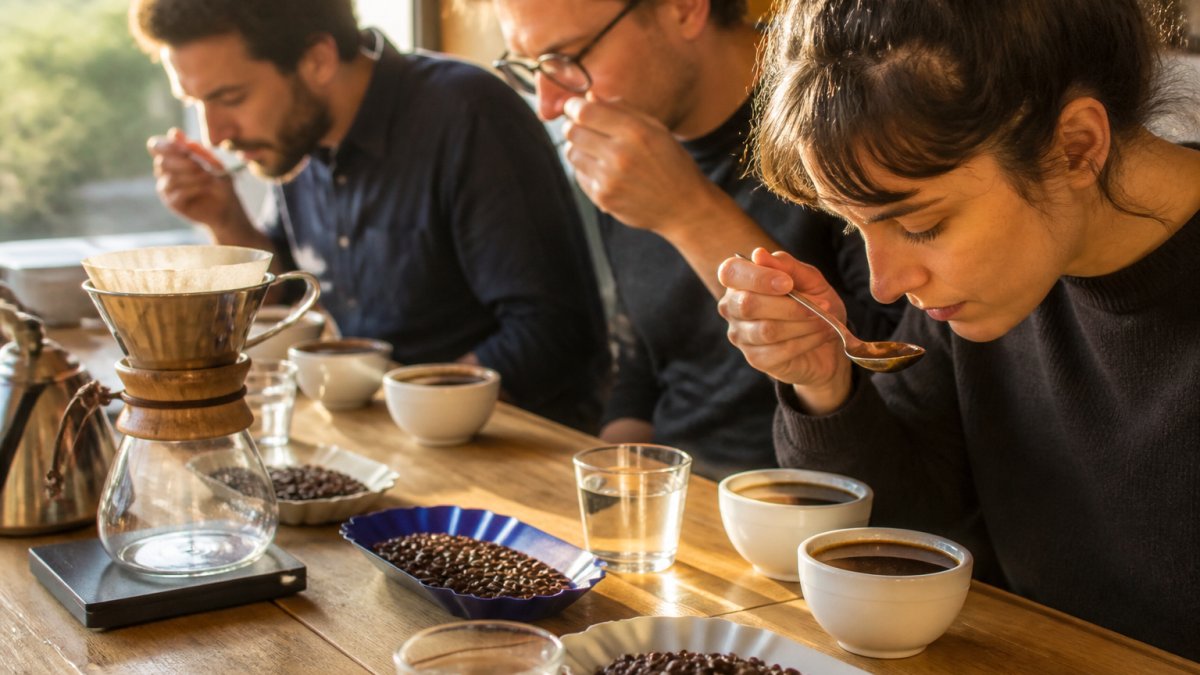
The best medium roast coffee beans balance sweetness, body, and acidity without tipping into the grassy brightness of a light roast or the smoky weight of a dark one. To compare medium roasts fairly, we score every coffee on the same five axes, using a 1-5 scale.
Our scoring rubric
- Acidity: 1 = flat and muted, 5 = bright and juicy. Medium roasts usually land at 3.
- Body: 1 = tea-like, 5 = syrupy. Medium roasts usually land at 3.
- Sweetness: 1 = bitter or savory, 5 = honeyed or fruity. Medium roasts usually land at 3-4.
- Bitterness: 1 = none, 5 = drying and ashy. A clean medium roast stays at 1-2.
- Finish: 1 = short and hollow, 5 = long and clean. A well-sourced medium roast lands at 3-4.
We also note the roast date, certifying body, and grind format, three details that change the cup more than any flavor adjective.
| Coffee | Type | Fair Trade Certifier on Bag | Tasting Notes | Acidity | Body | Sweetness | Bitterness | Finish | Best For |
|---|---|---|---|---|---|---|---|---|---|
| House Blend | Blend | Fair Trade Certified | Nutty, sweet chocolate, mild citrus | 3 | 3 | 4 | 1 | 4 | Everyday drip |
| Breakfast Blend | Blend | Fair Trade Certified | Smooth, clean South American cup | 3 | 3 | 3 | 1 | 3 | Morning pour-over |
| Colombia | Single origin | Fair Trade Certified | Dried orange, berry, chocolate | 4 | 3 | 4 | 1 | 4 | French press |
| Guatemala | Single origin | Fair Trade Certified | Dark chocolate, bright fruit, butterscotch | 3 | 4 | 4 | 2 | 4 | Espresso |
| Costa Rica | Single origin | Fair Trade Certified | Sweet apple, raisin, honey | 4 | 3 | 5 | 1 | 4 | Pour-over |
| Brazil Santos | Single origin | Fair Trade Certified | Cocoa, elegant and smooth | 2 | 4 | 3 | 1 | 4 | Drip and espresso |
| Peru | Single origin | Fair Trade Certified | Salted caramel, silky sweet, citrus | 3 | 3 | 4 | 1 | 3 | Cold brew |
| Mexico | Single origin | Fair Trade Certified | Chocolate, cinnamon, green apple | 3 | 3 | 3 | 1 | 3 | Drip |
| Nicaragua | Single origin | Fair Trade Certified | Cocoa, floral, citrus | 4 | 3 | 3 | 1 | 4 | Pour-over |
How to read the table

- If you drink your coffee black and want brightness, look for acidity 4 and bitterness 1, Costa Rica and Nicaragua fit.
- If you add milk or cream, body 4 holds up better than body 3, Guatemala and Brazil Santos fit.
- If you pull espresso, a slightly darker medium roast with sweetness 4 and body 4 pulls a sweeter, thicker shot, Guatemala fits.
- If you brew cold, a low-acid, sweet profile at acidity 2-3 and sweetness 4 keeps the concentrate from turning bitter, Peru fits.
Grind and dose guidance by brew method
| Brew method | Grind size | Dose per 6 oz cup | Water temp |
|---|---|---|---|
| Drip | Medium | 10-12 g | 195-205°F |
| Pour-over | Medium-fine | 12-15 g | 195-205°F |
| French press | Coarse | 14-16 g | 195-205°F |
| Espresso | Fine | 18-20 g per double shot | 195-205°F |
| Cold brew | Coarse | 1:8 coffee-to-water by weight | Cold |
What most guides miss is that a single origin and a blend solve different problems. Blends chase consistency bag to bag; single origins chase a moment in a harvest.
Fair Trade Certified program standards
Fair Trade Certified Coffee Brands: What the Label Actually Means
Fair Trade certified coffee brands meet a third-party standard covering minimum prices paid to growers, safe working conditions, and community investment. It is a sourcing and labor standard, audited independently, not a flavor claim or a guarantee of organic growing.
That distinction matters: a roaster can sell Fair Trade coffee grown with conventional pesticides, or organic coffee that was not Fair Trade certified.
When you see a certification mark, check three things: the certifying organization, the specific product it covers, and whether it appears on the exact bag you are buying. Certification often applies to some products in a catalog and not others.
Organic Fair Trade Coffee: Reading the Fine Print
Organic coffee carries specific claims. Organic certification covers how the coffee was grown: no prohibited synthetic pesticides or fertilizers, with a documented audit trail. Fair Trade certification covers how growers were paid and treated. A bag can carry both, one, or neither.
The fine print to check on any organic claim:
- The name of the USDA-accredited certifier
- Whether the claim says "100% organic" or just "organic" (blends can use the latter with 95% organic content)
- Whether the certification applies to the coffee or only to a flavoring
For Fair Trade, look for the specific certifying body rather than a generic phrase like "fairly traded." That wording has no legal definition and anyone can print it.
USDA organic labeling standards
How to Choose Sustainable Coffee for Your Brew Method
Sustainable coffee choices start with matching the bean to how you brew it, because the wrong roast for your method wastes good sourcing. Medium roast is the most forgiving profile across brew methods, which is why it dominates most kitchen counters.
- Drip: Any medium roast works. Blends shine here because consistency matters more than a single note.
- Pour-over: Reach for a single origin with a clean finish, like Costa Rica or Nicaragua.
- French press: A fuller-bodied medium roast holds up to the metal filter, so Colombia or Brazil Santos fit well.
- Espresso: A slightly darker medium roast with chocolate and caramel notes pulls a sweeter shot. Guatemala is built for this.
- Cold brew: A sweet, low-acid medium roast like Peru brews into a smooth concentrate.
Freshness and sourcing are not in conflict: a well-sourced bean roasted to order beats a certified bean that sat on a shelf for months.

Price and Value Per Serving for Fair Trade Medium Roast Coffee
Price per serving, not price per bag, tells you whether a medium roast is worth it. A 12-ounce bag at $23.99 brews roughly 24 to 30 cups depending on dose. Grocery-store coffee often looks cheaper per bag while costing more per cup, because you use more grounds for comparable flavor.
The per-cup math, worked through
A 12-ounce bag holds about 340 grams. At a 12-gram dose per 6-ounce cup, that is about 28 cups; at 15 grams, about 22. The same bag can swing from $0.86 to $1.09 per cup depending on how strong you brew, which is why the bag price alone tells you almost nothing.
| Bag size | Typical price range | Price per ounce | Cups at 12 g dose | Price per cup |
|---|---|---|---|---|
| 12 oz | $14-$24 | $1.17-$2.00 | ~28 | $0.50-$0.86 |
| 16 oz | $18-$30 | $1.13-$1.88 | ~38 | $0.47-$0.79 |
| 2 lb (32 oz) | $32-$52 | $1.00-$1.63 | ~76 | $0.42-$0.68 |
These ranges reflect what medium roasts commonly sell for across whole-bean, ground, and subscription formats. Larger bags win on price per ounce, but only if you finish them before the roast date fades, most roasters recommend 4-6 weeks for peak flavor.
Whole bean vs. ground vs. subscription
- Whole bean: Highest price per ounce in some catalogs, but you control grind and freshness. Best value if you own a burr grinder.
- Pre-ground: Often priced the same per ounce as whole bean, but stales faster once opened. Best if you brew drip and finish a bag within two weeks.
- Subscription: Most roasters discount 10-20% off the one-time price, real savings only if you drink the coffee before the next bag arrives.
Shipping changes the true cost
A $6 flat shipping fee on a single 12-ounce bag adds about $0.21 per cup at a 12-gram dose. That is why most roasters set a free-shipping threshold, commonly $35-$50, and why buying two bags at once beats buying one bag twice.
| Factor | What to Check | Why It Matters |
|---|---|---|
| Bag weight | Ounces, not "large bag" | Price per ounce is the real comparison |
| Roast date | Printed date, not "best by" | Freshness drives flavor per cup |
| Dose per cup | Grams of grounds you use | A stronger bean needs less per cup |
| Shipping | Cost per order or free threshold | Changes true cost per serving |
| Grind format | Whole bean vs. pre-ground | Affects freshness and how fast you must finish the bag |
| Subscription discount | Percent off and cadence | Real savings only if you drink the coffee in time |
A common mistake is comparing a $10 grocery bag to a $23.99 craft bag without the per-cup math. The craft bag usually wins on flavor per dollar, and definitely on freshness. The second mistake is buying the largest bag for the lowest price per ounce, then letting half go stale, pushing the effective price per good cup above the smaller bag.
Specialty Coffee Association brewing standards
Conclusion
Choosing among medium roast coffee brands comes down to verification and freshness, and most shoppers only check one. If you want a medium roast roasted to order, sourced from named farms, and shipped to your door, Eager Beaver Roasters roasts in light, medium, and dark profiles with no fillers or shortcuts. Our Breakfast Blend and House Blend give a consistent everyday cup, while single origins like Colombia and Guatemala let you chase a specific flavor profile.

Frequently Asked Questions
Which coffee brands are Fair Trade certified?
Many specialty roasters carry Fair Trade certification, but availability varies by roast and origin. Look for the Fair Trade Certified seal on the bag or product page. Eager Beaver Roasters sources from trusted farms and offers medium roasts like Breakfast Blend and House Blend. Always check the label rather than assuming a brand is certified across its entire lineup.
What does Fair Trade certification mean for coffee?
Fair Trade certification sets minimum prices paid to farmers, adds a community development premium, and requires safe working conditions. For coffee, it means small-scale farmers receive a baseline price that covers sustainable production costs, plus extra funds for local projects. Certification also restricts child labor and certain pesticides. It does not guarantee organic status, so you may need to look for both seals if that matters to you.
Is Fair Trade coffee also organic?
Not automatically. Fair Trade and organic are separate certifications with different standards. Fair Trade focuses on farmer compensation, labor practices, and community investment. Organic certification addresses pesticide use, soil health, and environmental practices. Some coffees carry both seals, but many Fair Trade coffees are not certified organic. If avoiding synthetic pesticides matters to you, check for the USDA Organic label in addition to the Fair Trade mark.
How does medium roast coffee taste?
Medium roast coffee balances acidity and body, with tasting notes that often include chocolate, nuts, caramel, and mild fruit. It is less bright than light roast and less smoky than dark roast. Eager Beaver Roasters offers medium roasts like Colombia with dried orange, berry, and chocolate notes, and Guatemala with dark chocolate, bright fruit, and butterscotch. The flavor profile depends on origin, processing, and roast level.
How can you tell whether coffee is Fair Trade certified?
Look for the Fair Trade Certified seal printed on the bag or listed on the product page. You can also verify certification through the Fair Trade USA database or by contacting the roaster directly. Some brands list certification only for specific origins or blends, so check the exact product you are buying. Do not rely on general brand claims; certification can vary by SKU.