

Medium Roast Coffee Brewing Methods: A How-To Guide
Table of Contents
- Why Medium Roast Coffee Works With Almost Any Brewing Method
- What You'll Need Before You Start Brewing
- Medium Roast Coffee Grind Size: Match It to Your Brewer
- Medium Roast Coffee-to-Water Ratio and Water Temperature
- A Medium Roast Pour-Over Recipe Step by Step
- Medium French Press: A Full-Immersion Method
- How the Four Main Brewing Methods Compare
- Troubleshooting: Fixing Sour or Bitter Medium Roast Coffee
- Frequently Asked Questions
Last Updated: October 6, 2026
Why Medium Roast Coffee Works With Almost Any Brewing Method
Medium roast coffee is the most forgiving roast profile for home brewing because it sits between the bright acidity of a light roast and the smoky heaviness of a dark roast.
That versatility is no accident: a medium roast keeps enough origin character to stay interesting while building the body that makes a cup feel full.
This guide covers grind size, ratio, water temperature, and recipes for four brewing methods, plus how to fix a sour or bitter cup.
What You'll Need Before You Start Brewing
Good medium roast coffee brewing methods start with the right gear and fresh beans, no professional setup required.
Here is the short list:
- Fresh medium roast coffee beans, ideally roasted within the last few weeks
- A burr grinder for consistent grind size
- A digital scale that reads in grams
- A kettle, ideally with temperature control
- Filtered water
- Your brewer: pour-over dripper, French press, drip machine, or espresso machine
Freshness matters more than most people think. Coffee loses aroma and flavor soon after roasting, and whole beans hold up far longer than pre-ground. We ship roasted-to-order so the beans reach you near their peak. Store them airtight, away from light and heat, and grind right before you brew.
Medium Roast Coffee Grind Size: Match It to Your Brewer
Medium roast coffee grind size is the single biggest lever you control, and it should match your brewing method. Grind too coarse and water runs through without pulling out enough flavor; too fine and the water stalls, leaving a bitter, muddy cup.
The rule is simple: the longer the water touches the coffee, the coarser the grind. A French press steeps four minutes, so it wants a coarse grind; an espresso shot runs in under 30 seconds, so it wants a fine grind.
Grind Size Chart by Brewing Method
| Brewing Method | Grind Size | Brew Time | Best For |
|---|---|---|---|
| Pour-over | Medium | 2-4 min | Clarity and clean flavor |
| French press | Coarse | 4 min | Full body and rich mouthfeel |
| Drip machine | Medium | 4-6 min | Easy daily batches |
| Espresso | Fine | 25-30 sec | Concentrated, intense shots |
| Moka pot | Fine-medium | 3-5 min | Strong, stovetop concentration |
| Cold brew | Coarse | 12-18 hr | Smooth, low-acid concentrate |
| AeroPress | Medium-fine | 1-2 min | Fast, flexible single cups |
A medium grind is the safe default for medium roast coffee. It works in a pour-over and most drip machines. If unsure, start at medium and adjust one notch at a time.
Calibrating Your Grinder to the Chart
Grind charts describe a target, not a setting. Every grinder numbers its steps differently, so translate the chart to your own equipment.
Burr grinders with numbered settings. Start at the midpoint of the manufacturer's recommended range for your brewer.
Stepped vs. stepless grinders. A stepped grinder clicks into fixed positions, so you adjust in whole notches.
Blade grinders. A blade grinder produces a mix of fine dust and coarse chunks, which extracts unevenly and tastes sour and bitter at once.
Reference points you can feel. If you do not have a grinder with labeled settings, compare against these physical references:
- Espresso: finer than table salt, closer to powdered sugar
- Pour-over and drip: like granulated table sugar
- French press and cold brew: like coarse sea salt or raw sugar
Reading the Brew to Adjust the Grind
The cup tells you which way to move: use drawdown time for pour-over and drip, shot time for espresso.
- Pour-over finishes under 2:30 and tastes sour or thin: grind finer.
- Pour-over stalls past 4:00 and tastes bitter or dry: grind coarser.
- Espresso shot pulls in under 20 seconds and tastes sharp: grind finer.
- Espresso shot pulls past 35 seconds and tastes harsh: grind coarser.
- French press tastes muddy or silty: grind coarser to reduce the fines that slip through the mesh.
Change one notch at a time and brew again. Grind size moves extraction more than any other variable, so small steps add up quickly.
Medium Roast Coffee-to-Water Ratio and Water Temperature
The standard medium roast coffee-to-water ratio is about 1:16 by weight, one gram of coffee to sixteen grams of water. For a single 12-ounce cup, that is roughly 22 grams of coffee and 350 grams of water, which keeps the cup balanced without turning it weak or overpowering.
Water temperature matters just as much. The sweet spot is 195-200°F (91-93°C): too cool under-extracts and tastes sour, too hot scorches the grounds and tastes bitter.
Why 91-93°C (195-200°F) Is the Sweet Spot
Water in the 195-200°F range dissolves the sugars and oils that give medium roast coffee its caramel and chocolate notes without pulling out harsh, bitter compounds. Most home kettles boil well above this, so let the water sit 30 to 60 seconds after boiling, or set a temperature-controlled kettle directly to 200°F.
Water quality plays a role too: very soft or heavily filtered water can taste flat, while hard water mutes flavors. If your tap water tastes off on its own, brew with filtered water.
A Medium Roast Pour-Over Recipe Step by Step
This medium roast pour-over recipe gives a clean, bright cup that shows off the beans' origin character. Use a medium grind and a 1:16 ratio; total time is about 3 to 4 minutes.
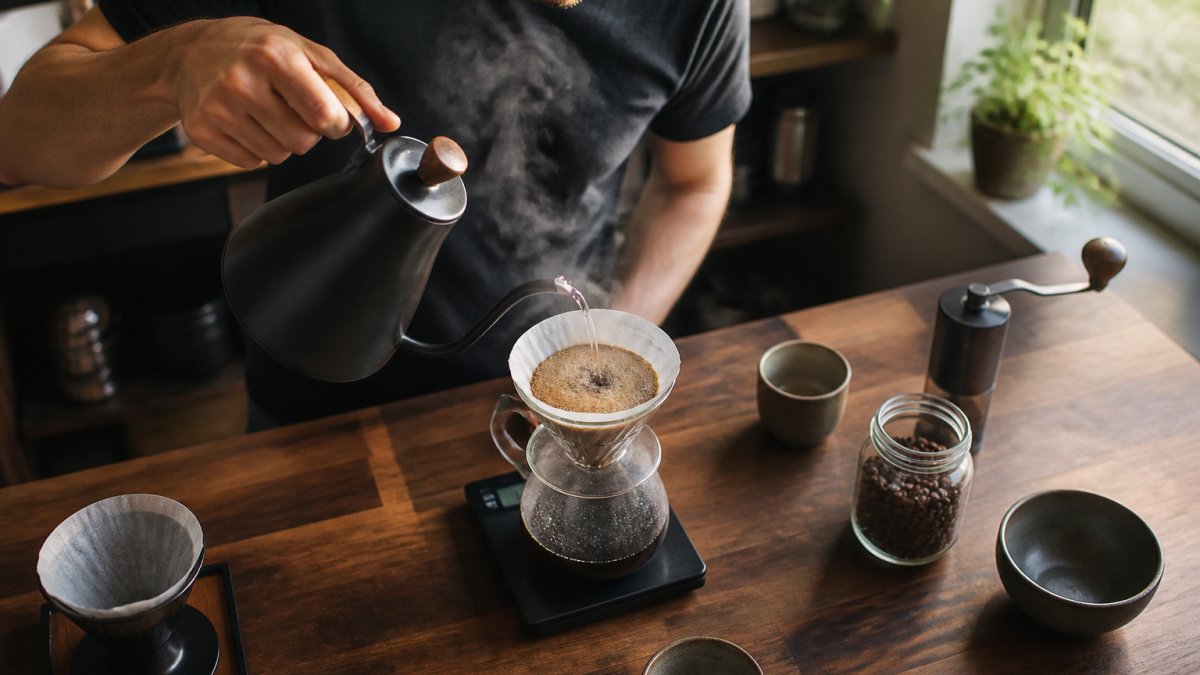
- Preheat your dripper and rinse the paper filter with hot water. Dump the rinse water.
- Add 22 grams of medium grind coffee to the filter. Shake gently to level the bed.
- Place the dripper on your scale and zero it out.
- Start your timer and pour 60 grams of 200°F water over the grounds. This is the bloom.
- Wait 30 to 45 seconds while the coffee degasses and bubbles.
- Pour in slow circles up to 350 grams total, finishing around the 2:30 mark.
- Let it drain fully. You should finish near 3:30.
- Swirl the carafe and serve.
If the drawdown runs past 4 minutes, your grind is too fine. If it finishes under 2 minutes, go finer.
Medium French Press: A Full-Immersion Method
A medium roast French press gives a heavier, richer cup than a pour-over because the grounds steep fully in the water. It is forgiving and hard to ruin: use a coarse grind and a 1:15 ratio for more body.
- Preheat the French press with hot water, then dump it.
- Add 30 grams of coarse grind coffee.
- Pour in 450 grams of 200°F water, saturating all the grounds.
- Stir gently once, then place the lid on with the plunger up.
- Steep for 4 minutes.
- Press the plunger down slowly and steadily.
- Pour immediately to stop the extraction.
The main mistake with a French press is over-steeping: leave the coffee on the grounds and it keeps extracting, turning the cup bitter. Pour it all out as soon as you press.
How the Four Main Brewing Methods Compare
Each brewing method pulls different qualities out of the same medium roast coffee; the one you pick depends on the cup you want and the effort you will spend. Imagine brewing the same medium roast, say a washed Central American bean with caramel and milk chocolate notes, four ways and tasting them side by side.
| Method | Grind | Ratio | Time | Body | Clarity | Effort | Flavor Focus |
|---|---|---|---|---|---|---|---|
| Pour-over | Medium | 1:16 | 3-4 min | Light-medium | High | High | Clean, bright, clear |
| French press | Coarse | 1:15 | 4 min | Full | Low | Low | Full body, rich |
| Drip machine | Medium | 1:16 | 4-6 min | Medium | Medium | Lowest | Consistent, easy |
| Espresso | Fine | 1:2 | 25-30 sec | Syrupy | Low | High | Intense, concentrated |
What the Same Bean Tastes Like Across Methods
Pour-over. The paper filter traps oils and fine particles, so the cup reads clean and the acidity stays lifted.
French press. The metal mesh lets oils and some fines into the cup, which adds weight and rounds off the acidity.
Espresso. Pressure concentrates everything. A medium roast pulled as espresso gives a thick, syrupy shot with pronounced chocolate and caramel sweetness and a short, clean finish.
Choosing by What You Value
- If you want clarity and origin character: pour-over.
- If you want body and richness with minimal effort: French press.
- If you want consistency for daily batches: drip machine.
- If you want intensity and a small, concentrated cup: espresso.
- If you want flexibility in one device: AeroPress, which can mimic a pour-over or a French press depending on grind and steep time.
For most home brewers, a pour-over or French press delivers the best results for the effort. Espresso rewards investment in a capable grinder and machine, and a drip machine wins on convenience when brewing for more than one person.
Troubleshooting: Fixing Sour or Bitter Medium Roast Coffee
Sour and bitter cups come from the same root cause: extraction that is off. Sour coffee is under-extracted, meaning the water did not pull out enough from the grounds. Bitter coffee is over-extracted, meaning it pulled out too much.
Here is how to fix each one:
- Sour, thin, or weak: grind finer, raise the water temperature, or extend the brew time.
- Bitter, harsh, or dry: grind coarser, lower the water temperature, or shorten the brew time.
- Both sour and bitter: your grind is uneven. Switch to a burr grinder for a consistent particle size.
- Weak but bitter: you may be using too little coffee. Check your ratio and weigh your dose.
Change one variable at a time. Adjust your grind first, since it has the biggest effect. Then adjust temperature, then time.
Brewing a great cup of medium roast coffee comes down to matching your grind, ratio, and water temperature to your method. At Eager Beaver Roasters, we roast medium profiles to order and ship them fresh, so the beans you brew carry the caramel, chocolate, and nutty notes they were roasted for. Our Breakfast Blend and House Blend are both medium roasts built for everyday brewing, and we offer light and dark profiles if you want to explore.

Frequently Asked Questions
What is the best way to brew medium roast coffee?
There is no single best method, but pour-over gives you the most control over extraction and highlights the caramel and chocolate notes in medium roast coffee. French press delivers a fuller body with less equipment. For a balanced cup, use a 1:16 coffee-to-water ratio, water at 195-200°F, and a medium grind. Drip machines work well too if you preheat the carafe and use fresh beans.
What coffee-to-water ratio works best for medium roast coffee?
Start with 1 gram of coffee to 16 grams of water (roughly 1:16). For a standard 12-ounce cup, that means about 22 grams of coffee and 355 milliliters of water. If the cup tastes weak, tighten the ratio to 1:15. If it tastes too strong or bitter, loosen it to 1:17. Adjust one variable at a time so you know what changed.
Should medium roast coffee be brewed with hot or cooler water?
Medium roast coffee brews best between 195°F and 200°F (91-93°C). Water that is too hot extracts bitter compounds and can scald the grounds. Water that is too cool under-extracts, leaving the cup sour and thin. If you do not have a temperature-controlled kettle, boil water and let it sit for 30 to 45 seconds before pouring.
How fine should you grind medium roast coffee?
Match grind size to your brewing method, not the roast level. Use a medium grind for drip and pour-over, coarse for French press, and fine for espresso. A burr grinder gives more consistent particle size than a blade grinder.