

How to Brew Single Origin Coffee at Home
Table of Contents
- What Makes Single Origin Coffee Different
- Essential Equipment and Preparation
- Coffee Grind Size Chart and Consistency
- Water to Coffee Ratio for Pour Over and Other Methods
- Water Temperature Control and Brewing Steps
- Evaluating Flavor and Troubleshooting Common Issues
- Conclusion
Last Updated: August 27, 2026
What Makes Single Origin Coffee Different
Single origin coffee is sourced from a single, specific geographic location, a farm, region, or country, rather than blended from multiple origins. Coffee's flavor profile is shaped by altitude, soil type, climate, and processing method. When you brew single origin coffee, you're tasting the distinct characteristics of that specific terroir, much like wine from a particular vineyard.
Blends combine beans from multiple origins to create consistency and balance. Single origins celebrate individuality. A coffee from Colombia tastes different from one grown in Bali because the growing conditions, plant varieties, and harvest methods differ fundamentally. The acidity, body, and tasting notes, chocolate, berry, or floral hints, come directly from where the beans were grown and how they were processed.

Single origin coffee demands more attention during brewing. You're not masking flavors with a blend; you're extracting them. Water temperature, grind size, brew ratio, and steeping time all influence whether you'll taste the intended flavor profile or muddy it. At Eager Beaver Roasters, we roast single origin beans to order in light, medium, and dark profiles so you can control how those origin characteristics come through in your cup.
Many of our coffees come from smallholder farmers or specific micro-lots, limited quantities from a particular harvest. When you know the origin, you're supporting a specific community and understanding the story behind your morning cup.
Essential Equipment and Preparation
Brewing single origin coffee at home requires intentional setup. You don't need expensive gear, but you do need consistency.
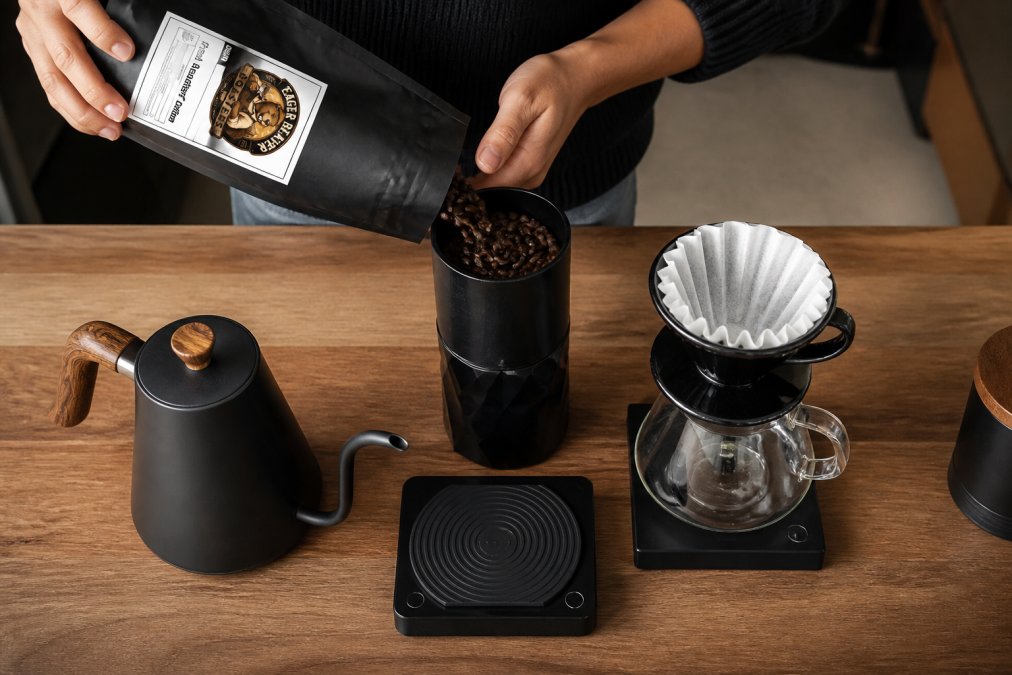
Start with a burr grinder, not a blade grinder. Blade grinders produce inconsistent particle sizes, causing some grounds to over-extract while others under-extract (peer-reviewed research). A burr grinder creates uniform grind size, essential for even extraction. You'll also need a scale to measure both coffee and water precisely. A gooseneck kettle gives you control over water flow during pour over brewing. A thermometer helps you hit your target water temperature.
For equipment beyond these basics, your choice depends on your preferred brewing method. Pour over setups require a dripper, filters, and a carafe. French press needs only the press itself. Espresso machines offer precise pressure control. Start simple, a pour over dripper and filters cost under $20 and produce excellent results.
Preheating Your Equipment
Cold equipment absorbs heat from your brewing water, lowering the actual temperature that contacts your coffee grounds. If your target is 200°F but your equipment is cold, you might actually brew at 190°F, a significant difference in extraction.
Preheat your equipment by pouring hot water through it 30 seconds before you brew. For pour overs, rinse the dripper and filter with hot water, which also removes paper flavor. For French press, fill it with hot water, let it sit for 10 seconds, then discard. This simple step ensures your water temperature stays consistent throughout brewing and improves flavor clarity noticeably.
Coffee Grind Size Chart and Consistency
Grind size directly controls extraction speed. Finer grinds have more surface area, so water extracts flavor faster. Coarser grinds extract slower. Miss the right size for your brewing method, and you'll either under-extract (weak, sour cup) or over-extract (bitter, harsh cup).
| Brewing Method | Grind Size | Texture | Best For |
|---|---|---|---|
| French Press | Coarse | Like breadcrumbs | Immersion brewing, 4+ minutes |
| Pour Over | Medium-fine | Like sand | Percolation, 2-4 minutes |
| Espresso | Fine | Like flour | High pressure, 25-30 seconds |
| Drip Coffee Maker | Medium | Like granulated sugar | Automatic drip, 5-10 minutes |
| AeroPress | Medium-fine | Like sand | Hybrid method, 1-2 minutes |
Consistency matters as much as size. A burr grinder produces uniform particle size; a blade grinder does not.
When brewing single origin coffee, dial in your grind size first. Make one adjustment at a time. If your cup tastes sour and weak, go finer. If it tastes bitter and harsh, go coarser. Most home brewers start too coarse, but under-extraction is actually more common and produces a sour, astringent cup that masks the origin's intended flavor notes.
Water to Coffee Ratio for Pour Over and Other Methods
The brew ratio, the proportion of coffee to water, is foundational. Too little coffee and you'll get a weak, thin cup. Too much and you'll over-extract, creating bitterness. The standard ratio is 1:16 (one part coffee to 16 parts water by weight), which works well for most brewing methods.
- Pour over: Use 1:16 as your baseline. For a 10-ounce cup, use 0.625 ounces of coffee (about 18 grams) and 10 ounces of water.
- French press: Use 1:15 for a stronger cup. The longer steeping time means you can use slightly less coffee.
- Espresso: Use 1:2 or 1:2.5 (very concentrated). A 1-ounce shot typically uses 0.5 ounces of ground coffee.
- Drip coffee maker: Use 1:16 to 1:17. Automatic drip machines are less efficient at extraction, so slightly more water helps.
When you measure by weight rather than guessing, you remove variables and can isolate other factors like grind size, water temperature, and steeping time. Start at 1:16, brew a cup, taste it, and adjust from there. Keep notes on what works for each coffee you buy.
Water Temperature Control and Brewing Steps
Water temperature is one of the most impactful variables home brewers ignore. Too hot and you over-extract, pulling out bitter compounds. Too cool and you under-extract, leaving bright acidity and sourness. The ideal range for most brewing methods is 195-205°F (sca.coffee).
At these temperatures, water dissolves the soluble compounds in coffee grounds at the right speed. Below 195°F, extraction slows dramatically. Above 205°F, you risk pulling out undesirable compounds that create harshness.
Measure water temperature with a simple instant-read thermometer. Boil water, let it cool for 30 seconds to 1 minute (bringing it from 212°F to roughly 200°F), then check. French press, which steeps for 4 minutes, can use water closer to 195°F because the longer contact time extracts fully. Pour over, which is faster, benefits from water closer to 205°F.
Step-by-Step Brewing Instructions
Pour Over Brewing (2-4 minutes total)
-
Measure and grind (1 minute): Weigh your coffee and water using a 1:16 ratio. For a 10-ounce cup, use 18 grams of coffee and 10 ounces of water. Grind to medium-fine texture.
-
Preheat equipment (30 seconds): Pour hot water through your dripper and filter into your cup. Discard the water. This stabilizes temperature and removes paper flavor.
-
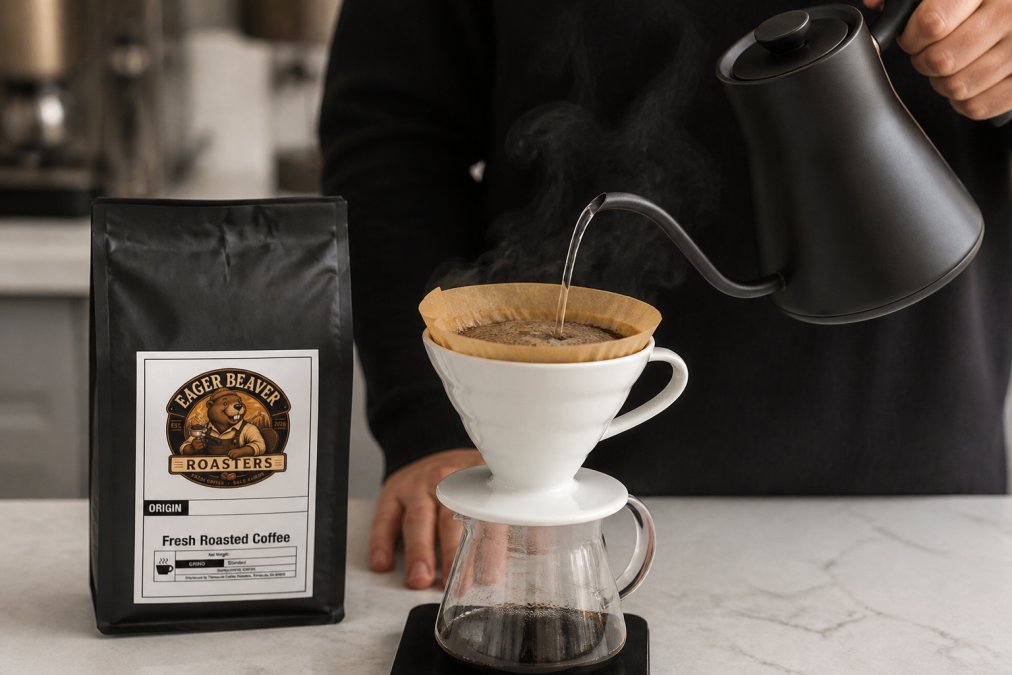
Bloom (30 seconds): Place the dripper on your cup. Add your ground coffee, creating a flat bed. Pour just enough hot water (around 200°F) to saturate the grounds, roughly twice the weight of your coffee. This releases CO2 trapped in the grounds and prepares them for extraction.
-
Pour (2-3 minutes): After the bloom, pour the remaining water slowly in circular motions. Pour in stages rather than all at once. The total brew time should be 2-4 minutes. If it's faster, your grind is too coarse. If it's slower, your grind is too fine.
-
Finish: Once all water has passed through, remove the dripper. Your cup is ready immediately.
French Press Brewing (4 minutes total)
-
Measure and grind (1 minute): Use a 1:15 ratio. For a standard 34-ounce French press, use 30 grams of coffee and 500 grams of water. Grind coarse, like breadcrumbs.
-
Preheat and add grounds (30 seconds): Preheat the press with hot water, then discard. Add your ground coffee to the empty, warm press.
-
Bloom (30 seconds): Pour hot water (around 195-200°F) to just cover the grounds. Let it sit for 30 seconds.
-
Fill and steep (3.5 minutes): Pour the remaining water slowly. Place the lid on top but don't press yet. Let it steep for 3.5 to 4 minutes total.
-
Press and serve (30 seconds): Press the plunger down slowly over 10-15 seconds. Serve immediately. Leaving coffee in the press continues extraction and creates bitterness.
Espresso Extraction Techniques
Espresso uses pressure-driven extraction. Water forced through finely ground coffee at 9 bars of pressure for 25-30 seconds produces a concentrated, rich shot. The variables are tighter and the margin for error smaller.
Tamping and Basket Preparation: Use a portafilter basket sized for your shot volume. Add finely ground coffee and distribute evenly. Tamp with firm, level pressure. Inconsistent tamping creates channeling, where water finds paths of least resistance and under-extracts some areas while over-extracting others.
Yield and Ratio: A standard double shot uses about 18-20 grams of ground coffee and yields 36-40 grams of liquid espresso (a 1:2 ratio). If your shot pulls too fast (under 20 seconds), your grind is too coarse or your tamp is too light. If it pulls too slowly (over 35 seconds), your grind is too fine or your tamp is too firm.
Temperature Stability: Espresso machines vary in temperature stability. If you're brewing single origin espresso, temperature consistency matters. A machine that swings 10°F during extraction will produce inconsistent shots.
Taste and Adjustment: Pull a shot and taste it. Espresso should be balanced, not sour, not bitter. If it's sour, extend the shot time (finer grind or firmer tamp). If it's bitter, shorten the shot time (coarser grind or lighter tamp). Make one adjustment per shot before making another change.
Evaluating Flavor and Troubleshooting Common Issues
Once you've brewed, taste your cup intentionally. Single origin coffee rewards attention. Notice the acidity, body, and tasting notes. A Colombian might show dried orange and chocolate. A Costa Rican might have apple and honey.
Sour, Weak Cup: Your coffee is under-extracted. Solutions: grind finer, use hotter water, increase brew time, or increase the coffee-to-water ratio slightly.
Bitter, Harsh Cup: Your coffee is over-extracted. Solutions: grind coarser, use cooler water, decrease brew time, or decrease the coffee-to-water ratio slightly.
Flat, Muted Flavor: Your equipment or water might be the issue. Cold equipment absorbs heat. Minerals in water affect extraction. Solution: preheat equipment thoroughly, use filtered water, and ensure your water temperature is in the 195-205°F range.
Inconsistent Results: You're varying one or more variables between brews. Solution: use a scale to measure coffee and water precisely. Use a thermometer to verify water temperature. Use a timer to track brew time. Lock down each variable and change only one at a time when troubleshooting.
When you're brewing single origin coffee from Eager Beaver Roasters, you're working with freshly roasted beans that have been carefully sourced and roasted to order. Your brewing technique determines whether that quality makes it into your cup.
Brewing single origin coffee at home is straightforward once you understand the core variables: grind size, water temperature, and brew ratio. Start with a pour over or French press. Measure your coffee and water by weight. Control your water temperature. Adjust one variable at a time based on how your cup tastes. The difference between a mediocre cup and an excellent one often comes down to these small, controllable details.
Specialty Coffee Association brewing guidelines provides standards for brew ratios and water temperature that align with what works in practice. At Eager Beaver Roasters, we roast our single origin coffees, including Brazil Santos, Colombia, Costa Rica, and Bali Blue, to order so they arrive at peak freshness. Your brewing technique unlocks the flavor potential we've built into every roast. Find Your Perfect Roast and start experimenting with the method and variables that work best for your palate.


Frequently Asked Questions
What is the best water to coffee ratio for brewing single origin coffee?
The standard ratio is 1:16 (one part coffee to 16 parts water by weight). For example, use 25 grams of coffee with 400 grams of water. This ratio works well for pour over, drip, and immersion brewing methods. Adjust slightly based on your taste preference: use less water for a stronger cup or more water for a lighter extraction. Always measure by weight rather than volume for consistency.
How does single origin coffee differ in flavor compared to blends?
Single origin coffee expresses the unique characteristics of its specific region, altitude, and processing method. A Colombia single origin might show dried orange and berry notes, while a Brazil Santos offers smooth cocoa flavors. Blends combine beans from different origins to create balanced, consistent flavor profiles. Single origin coffees highlight the producer's craft and terroir, making each origin taste distinctly different based on soil type, climate, and crop variability.
What water temperature should I use to brew single origin coffee?
Brew single origin coffee between 195°F and 205°F (90°C to 96°C). Water hotter than 205°F over-extracts and creates bitter flavors; cooler than 195°F under-extracts and tastes sour. Use a thermometer or let boiling water cool for 30 seconds before brewing. For espresso machines, follow manufacturer guidelines as they maintain precise temperature control. Consistent water temperature is critical for revealing the true tasting notes of your single origin beans.
How do I know if my grind size is correct for brewing single origin coffee?
Match your grind size to your brewing method: use coarse grounds for French press (steeping 4 minutes), medium grounds for pour over (dripping 3-4 minutes), and fine grounds for espresso (2-3 second flow). The coffee bed should feel slightly gritty, not powdery or chunky. If your brew tastes bitter, your grind is too fine; if it tastes sour or weak, it's too coarse. Adjust incrementally and brew the same origin twice to compare results.
This article was written using GrandRanker