

Best Coffee Beans for Pour Over Brewing
Table of Contents
- What Makes Coffee Beans Ideal for Pour Over Brewing
- Best Roast Levels for Pour Over Coffee
- Single Origin vs Blend for Pour Over Coffee
- Top Coffee Bean Recommendations for Beginners
- Pour Over Coffee Ratio for Beginners
- Pour Over Coffee Grind Size Chart
- Step-by-Step Brewing Guide for Beginners
- How to Store Beans and Maintain Freshness
What Makes Coffee Beans Ideal for Pour Over Brewing
Pour over brewing demands coffee beans with specific characteristics. Unlike immersion brewing, where grounds steep in water, pour over extracts through direct contact with hot water flowing through a bed of grounds. The best beans for beginners share three traits: they're freshly roasted (ideally within 2-4 weeks), they have a medium grind consistency that allows proper water flow, and they possess flavor clarity that shines through the method's light body. Single-origin beans perform better than blends for beginners because their distinct flavor profiles teach you what you're tasting. Medium roasts are the sweet spot, forgiving enough for newcomers while showcasing the origin's character.
At Eager Beaver Roasters, freshness and roast profile matter more than origin. A well-roasted medium-roast bean will outperform a stale, dark-roasted bean from any specialty roaster.
Best Roast Levels for Pour Over Coffee
Light roasts highlight the bean's origin characteristics but are unforgiving, under-extract and you get sour, thin coffee; over-extract and it becomes astringent. Medium roasts are the beginner's advantage. They have enough body to mask minor brewing mistakes while retaining origin character. The roasting process has progressed far enough to round out rough edges without burying the bean's inherent flavors. Medium roasts also have a wider extraction window, giving you more room for error.
Dark roasts work for pour over but are less common in specialty coffee because the roasting process dominates the flavor profile. For beginners, this can be a strength: dark roasts are forgiving and deliver the bold, full-bodied cup many expect from coffee.
| Roast Level | Flavor Profile | Difficulty | Best For |
|---|---|---|---|
| Light | Bright, floral, acidic, origin-forward | High | Experienced brewers |
| Medium | Balanced, clean, sweet, approachable | Low | Beginners and daily drinking |
| Dark | Bold, full-bodied, chocolatey, low acidity | Medium | Those who prefer heavier cups |
Single Origin vs Blend for Pour Over Coffee
Single-origin beans come from one farm or region. Blends combine beans from multiple origins to achieve a consistent flavor profile. For beginners learning pour over, single-origin beans teach you what's possible. When you brew a Tanzania single-origin with its floral and bright fruit notes, you're tasting terroir, altitude, soil, climate, and processing method all expressed through the cup. That clarity is educational.
Blends are engineered for consistency and taste the same week to week. This consistency is valuable for daily drinking, but for learning, blends obscure the relationship between origin and flavor.
Top Coffee Bean Recommendations for Beginners
1. Colombia: Balanced Chocolate and Citrus Notes
Colombia produces roughly 12% of the world's coffee (ico.org). The country's volcanic soil, high altitude, and consistent rainfall create ideal growing conditions. Colombian beans typically have balanced acidity and natural sweetness that works beautifully with pour over's clean extraction.
Eager Beaver Roasters' Colombia comes from smallholder farmers in Medellin at 1,300-1,500 meters elevation. The beans are fully washed and dried in solar dryers. The roast profile brings out dried orange, berry, and chocolate notes. When you brew it, you'll get a medium-bodied cup with distinct flavors and a clean finish. It's forgiving enough that a slightly longer brew time won't ruin it, yet precise enough that you'll notice when you dial it in correctly.

For beginners, Colombia is the no-wrong-move choice.
2. Costa Rica: Sweet Apple and Honey Flavors
Costa Rican coffee occupies a middle ground between the bright, acidic coffees of East Africa and the heavier coffees of South America. The country's volcanic terrain produces beans with natural sweetness and moderate body.
Eager Beaver Roasters' Costa Rica comes from micro farms in Alajuela at 1,300-1,445 meters. These beans are eco-pulped and sun-dried. The tasting profile features sweet apple, raisin, and honey. The medium roast preserves natural sweetness without adding roasted bitterness. When you brew it, the cup will feel slightly fuller than the Colombia, with more pronounced sweetness on the finish.

Costa Rica is ideal if you prefer sweeter cups and teaches you how processing method influences flavor.
3. Ethiopia Natural: Fruity and Caramel Profile
Ethiopia is coffee's birthplace. Natural-process Ethiopian beans, where the fruit dries on the bean before removal, deliver the most intense fruit flavors. Pour over's clarity lets those delicate fruity notes shine.
Eager Beaver Roasters' Ethiopia Natural comes from smallholder farmers in the Sidama zone at 1,700-1,900 meters. The beans are full natural, sorted by hand, and dried on raised beds. The medium-light roast brings forward milk chocolate, fruity, and caramel notes. When you brew it, you'll notice a layered quality where different flavors emerge at different moments. The body is lighter, so precision matters more, but the flavors are distinctive enough that you'll know instantly when you've nailed the technique.
Ethiopia Natural is for beginners ready to explore.
4. Tanzania: Floral and Bright Fruit Notes
Tanzanian beans typically have bright acidity, floral aromatics, and stone fruit flavors. The combination is delicate, it's easy to over-extract and turn those floral notes harsh.
Eager Beaver Roasters' Tanzania comes from small cooperative farmers in the Mbeya area at 1,200-1,900 meters. The beans are fully washed and dried on raised beds. The medium-light roast preserves acidity and aromatic character. When you brew it, you'll get pear, floral, jasmine, and strawberry notes with a crisp, clean finish. This bean is more technique-sensitive, but if you're ready for that challenge, Tanzania teaches you what brightness and floral character can taste like.

5. House Blend: Consistent and Smooth
If single-origin feels overwhelming, start here. Eager Beaver Roasters' House Blend is a medium roast blend of select coffees from Central and South America. It's engineered for consistency: smooth, clean, and flavorful every time. The blend balances beans from different origins to hit a target flavor profile of nutty, sweet chocolate, mild citrus, and a clean bright finish.
The advantage for beginners is that it forgives brewing mistakes better than single-origins. Use the House Blend as your training ground. Once you understand pour over technique, move to single-origins to explore what different coffees taste like.
Pour Over Coffee Ratio for Beginners
The coffee-to-water ratio is the single most important variable in brewing. The industry standard is 1:16, one part coffee to 16 parts water by weight. This ratio produces a balanced cup with good body and clarity.
To use the 1:16 ratio, measure your coffee in grams. If you're brewing 25 grams of coffee, use 400 grams of water (25 × 16 = 400). A kitchen scale that measures in 0.1-gram increments costs under $20 and is essential for pour over.
Some brewers prefer 1:15 for a slightly stronger cup, or 1:17 for a lighter cup. But 1:16 is the sweet spot for beginners.
| Ratio | Strength | Body | Best For |
|---|---|---|---|
| 1:15 | Stronger | Fuller | Those who prefer bolder cups |
| 1:16 | Balanced | Medium | Beginners and standard brewing |
| 1:17 | Lighter | Thinner | Those who prefer delicate, bright cups |
The ratio stays constant regardless of brewing method or bean origin. This consistency makes ratios a reliable lever you can adjust independently from everything else.
Pour Over Coffee Grind Size Chart
Grind size controls how fast water flows through the coffee bed. Finer grounds slow water down, increasing extraction time and strength. Coarser grounds speed water up, decreasing extraction time and strength.
For pour over, you want a medium-fine grind, roughly the texture of sea salt or sand. This is finer than French press but coarser than espresso. The medium-fine grind gives you an extraction time of 3-4 minutes, the sweet spot for pour over.
The only reliable way to dial in grind size is to brew and taste. If your coffee tastes sour and thin, your grind is too coarse. If it tastes bitter and harsh, your grind is too fine.
| Grind Size | Texture | Extraction Time | Taste If Wrong |
|---|---|---|---|
| Too coarse | Breadcrumbs | 1-2 min | Sour, thin, weak |
| Ideal | Sea salt | 3-4 min | Balanced, clean, sweet |
| Too fine | Powder | 5+ min | Bitter, harsh, astringent |
Invest in a burr grinder, not a blade grinder. Burr grinders produce consistent particle size. A decent burr grinder costs $30-50 and will outlast you.
Step-by-Step Brewing Guide for Beginners
Pour over brewing is straightforward once you understand the variables.
What You'll Need:
- Pour over dripper (Melitta, Chemex, Hario V60, or Kalita Wave)
- Paper or metal filter
- Burr grinder
- Kettle (gooseneck is ideal but not required)
- Kitchen scale
- Timer
- Fresh coffee beans
- Water heated to 195-205°F (scaa.org)
Step 1: Prepare Your Setup (1 minute)
Place the dripper on top of your mug or carafe. Insert a paper filter and rinse it with hot water to remove the paper taste and preheat the dripper. If using a metal filter, skip the rinse.
Step 2: Grind Your Coffee (2 minutes)
Grind your beans to a medium-fine consistency just before brewing. Measure out your coffee using the 1:16 ratio. If brewing 400 grams of water, grind 25 grams of coffee.
Step 3: Bloom (30 seconds)
Pour just enough hot water to saturate the grounds, roughly twice the weight of the coffee. For 25 grams of coffee, pour 50 grams of water. Let it sit for 30 seconds. This allows trapped carbon dioxide to escape, improving extraction.
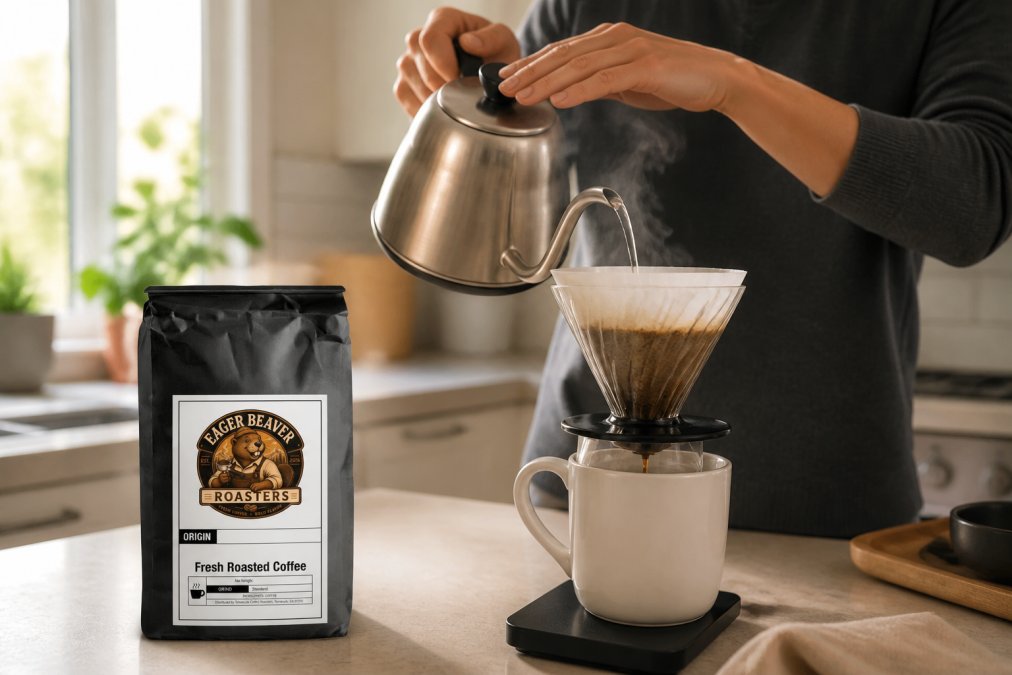
Step 4: Main Pour (2-3 minutes)
Pour the remaining water slowly in circular motions. Keep the water level consistent as it drains through the grounds. Pour in stages if easier. The total brew time should be 3-4 minutes from the start of the bloom.
Step 5: Finish (10 seconds)
When the water has finished dripping through, remove the dripper. Your cup is ready to drink.
How to Store Beans and Maintain Freshness
Coffee freshness determines flavor more than anything else. Store your beans correctly and they'll stay fresh for 3-4 weeks (ncausa.org). The enemies of freshness are air, light, heat, and moisture. Oxygen causes oxidation, which breaks down aromatic compounds. Light accelerates this process. Heat speeds up oxidation. Moisture causes beans to absorb flavors from their environment.
The best storage method is an airtight container in a cool, dark place. A kitchen cupboard away from the stove is ideal. Avoid the refrigerator; temperature fluctuations and moisture promote mold. Avoid the freezer unless storing beans for months.
Buy beans in quantities you'll use within 3-4 weeks. Whole beans stay fresh longer than pre-ground coffee, so grind just before brewing. If you must buy pre-ground, use it within 2 weeks.
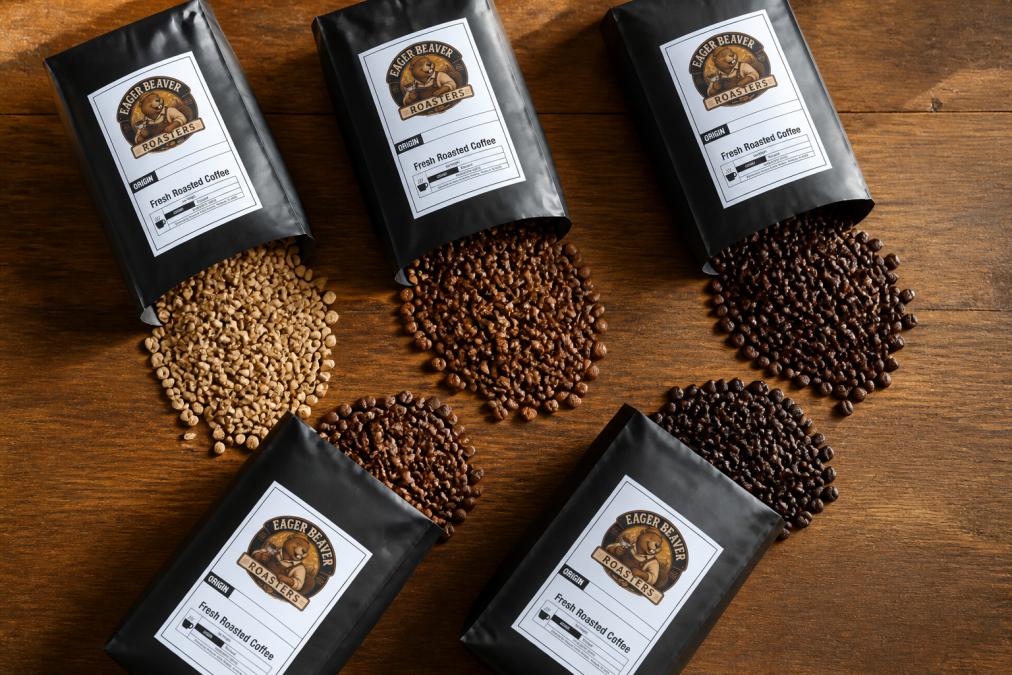
Many beginners buy too much coffee at once. They end up with stale beans they're forced to drink. Buy smaller quantities more often. Fresh coffee at a higher price is better than stale coffee at a discount.
Eager Beaver Roasters roasts to order and ships within 24 hours. Your beans arrive at peak freshness, typically 3-5 days after roasting. The roast date is printed on every bag so you know exactly how fresh your coffee is.
Choosing the best coffee beans for pour over brewing comes down to three things: freshness, roast profile, and origin character. Start with a medium roast from a single origin like Colombia or Costa Rica. These beans are forgiving, interesting, and teach you what good pour over tastes like. Once you've dialed in your technique, explore lighter roasts and more delicate origins. Eager Beaver Roasters offers all of these options roasted to order, which means your beans arrive fresh and ready to brew. Find Your Perfect Roast and experience the difference freshness makes.
Frequently Asked Questions
What roast level is best for pour over coffee as a beginner?
Medium roast is the ideal starting point for pour over brewing. It balances acidity, body, and sweetness without the harshness of light roasts or the heaviness of dark roasts. Medium roasts highlight the origin characteristics of the beans while remaining forgiving if your brewing technique isn't perfect. Once you're comfortable, experiment with medium-light roasts for brighter flavors or medium-dark for deeper chocolate notes.
How does grind size affect pour over coffee extraction?
Grind size directly controls how fast water passes through the grounds. A medium-fine, consistent grind (similar to sand) is standard for pour over. Too coarse and water rushes through, leaving the coffee under-extracted and sour. Too fine and water moves slowly, over-extracting and creating bitterness. Invest in a burr grinder to maintain consistent particle size, which is crucial for balanced extraction and flavor.
Should I choose single origin or blend for pour over brewing?
Single-origin beans showcase distinct regional flavors and are excellent for learning how different origins taste. Blends like the House Blend offer consistency and smooth, balanced profiles ideal for beginners who want reliable results every brew. Start with a single-origin to explore flavor complexity, then try a blend for everyday drinking. Both work beautifully in pour over if the grind size and ratio are correct.
How fresh should coffee beans be when I brew pour over?
Beans are best brewed 5-30 days after roasting. This window allows CO2 to escape (degassing) while retaining peak flavor. Freshly roasted beans (within 3 days) can taste grassy; aged beans (over 4 weeks) lose brightness and complexity. Buy from roasters who print roast dates on the bag and order small quantities you'll use within 3-4 weeks. Proper storage in an airtight container away from light and heat extends freshness.
What's the best pour over coffee ratio for beginners?
Use a 1:16 coffee-to-water ratio as your starting point: 1 gram of coffee to 16 grams of water. For example, 25 grams of coffee with 400 grams of water. This ratio produces a balanced cup with good body and clarity. If your coffee tastes weak, try 1:15. If it's too strong or bitter, adjust to 1:17. A kitchen scale removes guesswork and ensures consistency across brews.
This article was written using GrandRanker