

Flexible Coffee Subscription for Single Drinkers in 2026
Table of Contents
- Why Single Drinkers Need a Flexible Coffee Subscription
- How Much Coffee Do I Need Per Month?
- Coffee Subscription Skip and Pause Features That Matter
- How to Store Coffee Beans for Freshness
- Matching Roast Profiles to a Single-Cup Routine
- Our Flexible Coffee Subscription Picks for Solo Drinkers
- Budget-Conscious Scaling Without the Waste
- Conclusion
- Frequently Asked Questions
Last Updated: September 4, 2026
Why Single Drinkers Need a Flexible Coffee Subscription
Most coffee subscriptions assume you drink like a household of four. A flexible subscription for single drinkers solves the real issue: getting freshly roasted beans without watching half a bag go stale.
At Eager Beaver Roasters, we roast to order and ship fast, but flexibility goes beyond fresh beans. You need control over delivery frequency, the ability to pause when you travel, and portion sizes that match your consumption.
How Much Coffee Do I Need Per Month?
A typical single cup of coffee uses about 10 grams of ground coffee, or roughly 0.35 ounces (ncausa.org). If you brew one 12-ounce cup every morning, that is about 2.5 ounces per week and roughly 10 ounces per month. Two cups a day doubles that to about 20 ounces.
That math matters because it tells you whether a monthly delivery is even the right cadence.
| Daily Cups | Weekly Coffee Use | Ideal Delivery Cadence | Best Format |
|---|---|---|---|
| 1 cup | ~2.5 oz | Every 4-5 weeks | 12 oz bag or 12-pack capsules |
| 2 cups | ~5 oz | Every 2-3 weeks | 12 oz bag or larger pack |
| 3+ cups | ~7.5 oz | Every 1-2 weeks | 60-pack capsules or bulk bags |
Coffee Subscription Skip and Pause Features That Matter
Skip and pause features are the difference between a plan that works and one that piles up stale bags on your counter.
Skipping a delivery should be a one-click action, not a phone call or email chain. Pausing your subscription for two weeks or two months should not cancel your plan or reset your pricing. And changing your delivery frequency should be possible from a dashboard without losing your place in the rotation.
These features only matter if the roaster actually roasts to order. A roaster that roasts in bulk and warehouses inventory means your "fresh" beans may have been roasted weeks before they ship.
How to Store Coffee Beans for Freshness
Proper storage is the single highest-impact habit for a single drinker. Whole bean coffee stays fresh for two to four weeks after roasting when stored correctly, but ground coffee starts losing flavor within minutes of grinding.
The rules are simple. Keep beans in an airtight, opaque container at room temperature. Do not refrigerate or freeze beans you are actively using, because condensation introduces moisture and accelerates staling. Buy whole bean whenever possible and grind only what you need for each brew.
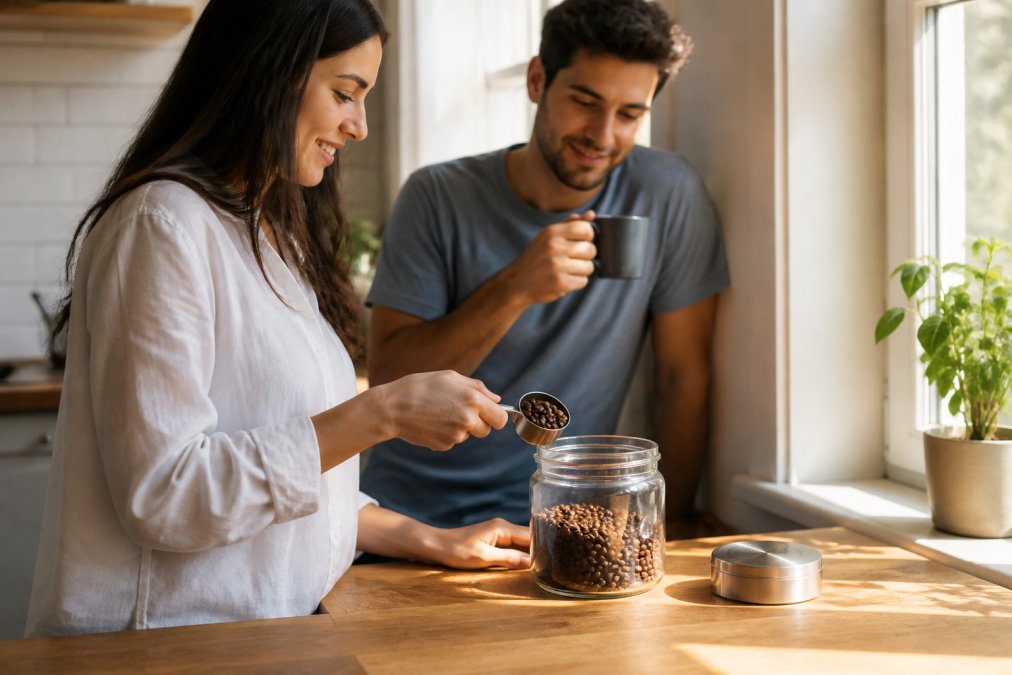
For single drinkers, a 12-ounce bag lasts over a month if you drink one cup a day. The solution is to buy smaller quantities more frequently or use a format that locks in freshness per serving.
The Solo Drinker's Storage Strategy: Vacuum-Sealing and Portioning
An airtight canister slows staling but does not stop it, which falls short for a single drinker who needs a 12-ounce bag to last five weeks.
A more effective approach is to portion and vacuum-seal beans the day your order arrives. Divide your bag into weekly portions, vacuum-seal each in a food-safe bag, and store them in a cool, dark cabinet. Each week, open one portion and transfer it to a small airtight canister for daily use.
If you do not own a vacuum sealer, use small mason jars. Fill each jar to the brim with beans, leaving minimal headspace, and seal tightly.
Why Smaller Bags Beat Bigger Bags for Solo Drinkers
A growing number of roasters offer 6-ounce or 8-ounce bags for single drinkers. These smaller formats are a freshness mechanism: a 6-ounce bag of whole beans, stored properly, can be finished within two weeks of the roast date, well within the peak flavor window.
Smaller bags cost more per ounce because overhead is spread across less product, but for a single drinker the effective cost is often lower because you waste less.
The Freezer Question: What Actually Works
Conventional wisdom says never freeze coffee beans. That is correct for beans you are actively using, but overly broad for long-term storage. If you buy a multi-bag subscription or larger quantity to save on shipping, freezing can preserve beans for up to three months without significant flavor loss.
Portion beans into daily or weekly amounts before freezing, and never repeatedly remove a bag, scoop out beans, and return it. Use an airtight, freezer-safe container or vacuum-sealed bag. Thaw beans completely before opening the container to prevent condensation. Never freeze ground beans.
This approach is not ideal for everyday use, but it is a practical workaround for single drinkers who want to take advantage of bulk pricing without sacrificing freshness.
Single-Serve Capsules: The Zero-Storage Alternative
Single-serve capsules solve the storage problem entirely. Each capsule is sealed with no oxygen inside, so the coffee stays fresh until you brew it. You can stock a 12-pack or 60-pack without worrying about the last capsule tasting flat.
Capsules eliminate the need for canisters, vacuum sealers, or portioning routines. There is no roast date to track, no bag to reseal, and no risk of leaving beans exposed. The trade-off is that you are locked into the roaster's capsule format and cannot grind your own beans for a pour-over or French press.
Matching Roast Profiles to a Single-Cup Routine
Your roast preference should match how you brew and what you taste. Light roasts preserve more origin character with brighter acidity. Medium roasts balance body and acidity, making them the most forgiving for daily drinking. Dark roasts deliver bold, smoky flavors with lower acidity.
If you are unsure whether you prefer light, medium, or dark, start with a medium roast. It is the safest entry point, offering enough body to feel satisfying while retaining enough origin character to stay interesting.
For single drinkers, variety is easier to manage than you might think. Sample packs in 2-ounce portions let you try multiple roasts without committing to a full bag that might go stale.
Our Flexible Coffee Subscription Picks for Solo Drinkers
The best flexible coffee subscription for single drinkers is one that combines roasted-to-order freshness with portion control and genuine scheduling flexibility. Our top pick is Eager Beaver Roasters because we roast to order in light, medium, and dark profiles, source beans from trusted farms, and ship directly to your door with no fillers or shortcuts.
For solo drinkers who brew one cup at a time, the 12 Pack Single Serve Coffee Capsules at $19.99 are the most practical entry point. Each capsule is sealed with no oxygen inside, so every cup tastes as fresh as the first. The improved filter design stops coffee from shooting through the middle, absorbing more grounds for a lively cup without slowing down brew time.

If you drink two or more cups daily, the 60 Pack Single Serve Coffee Capsules at $59.99 give you a longer runway between orders. The per-capsule cost drops, and because each capsule is individually sealed, you do not lose freshness waiting to get through the box.

For those who prefer brewing their own grounds, the Best Sellers Sample Pack at $24.99 is the smart way to find your roast. Six 2-ounce packs let you test a dark house blend, a medium breakfast blend, and single origins from Peru, Mexico, and Bali without committing to a full bag you might not love.
| Option | Price | Best For | Freshness Mechanism |
|---|---|---|---|
| 12-Pack Capsules | $19.99 | 1 cup daily, trying the service | Oxygen-free sealed capsules |
| 60-Pack Capsules | $59.99 | 2+ cups daily, fewer orders | Oxygen-free sealed capsules |
| Sample Packs | $24.99 | Finding your preferred roast | 2-oz portions, minimal waste |
| Instant Coffee | $22.99 | Travel, office, zero prep | Resealable pouch, 30 servings |
Budget-Conscious Scaling Without the Waste
Buying in bulk only saves money if you actually consume what you buy. For single drinkers, waste is the real cost driver.

Start small and scale based on your actual consumption. Begin with a sample pack or a 12-pack of capsules to confirm you like the roast and format, and track how long it takes you to work through that order.
Roasted-to-order coffee costs more per bag than grocery store commodity coffee, but the value calculation changes when you account for what you are actually drinking. National Coffee Association guidelines on freshness and storage note that coffee is a perishable product, and flavor degrades rapidly after roasting. Paying for freshness you can taste beats paying for volume you cannot finish.
The Solo Drinker's Cost-Per-Cup Calculator
To make scaling decisions concrete, use this framework based on your daily consumption and price per bag. The goal is to minimize cost per good cup, not cost per bag.
Start with your daily cup count. One cup per day uses roughly 10 ounces per month, two cups roughly 20 ounces, and three cups roughly 30 ounces.
Scenario A: Monthly 12-ounce bag at $15.99
- You use 10 ounces per month, so 2 ounces go stale and are discarded.
- Effective cost per usable ounce: $15.99 / 10 oz = $1.60/oz
- Cost per cup (0.35 oz): $0.56
Scenario B: Bi-weekly 6-ounce bag at $9.99
- You use 5 ounces every two weeks, finishing the bag before it stales.
- Effective cost per usable ounce: $9.99 / 5 oz = $2.00/oz
- Cost per cup (0.35 oz): $0.70
Scenario B costs more per cup, but every cup is at peak flavor. Scenario A is cheaper per cup but includes stale cups in the final week. If you value consistent quality, Scenario B is the better choice.
How to Optimize Delivery Frequency to Avoid Over-Accumulation
Over-accumulation is the silent budget killer for solo drinkers. You sign up for a monthly subscription, skip a delivery because you are traveling, and suddenly you have three bags on your counter, two of which are past their prime.
Here is a practical rule of thumb: take the number of ounces you consume per week and multiply by 1.5. That is the maximum bag size you should order. If you drink 5 ounces per week, order bags no larger than 7.5 ounces. If you drink 2.5 ounces per week, order bags no larger than 3.75 ounces.
Most subscription platforms let you set delivery intervals in weeks, so round to the nearest whole number and adjust based on whether you prefer a small buffer or a slight gap.
The Hidden Cost of Shipping and How to Neutralize It
Shipping fees can add $3 to $5 per order, which significantly impacts cost per cup for small orders. A $9.99 6-ounce bag with $4 shipping costs $13.99, bringing the cost per cup to $0.98.
To neutralize shipping costs, look for roasters that offer free shipping thresholds. If free shipping kicks in at $35, a single drinker can order three 6-ounce bags at once, freeze two, and use one immediately. This combines bulk shipping savings with portioned freshness.
Another option is to consolidate orders with a friend or family member who also drinks coffee. Split a larger order at the free shipping threshold, then divide the bags.
A Budget-Friendly Scaling Path for New Subscribers
If you are new to coffee subscriptions, follow this progression to avoid waste and overspending:
- Start with a sample pack (2-ounce portions) to identify your preferred roast profile. Cost: $15-$25.
- Order a single 6-ounce bag of your chosen roast. Cost: $10-$14. Track how long it lasts and whether you crave more or less.
- Adjust your delivery interval based on your consumption data. If the 6-ounce bag lasted 12 days, set your subscription to deliver every 10 days to build a small buffer.
- Scale to a 12-ounce bag only if you are drinking two or more cups daily and can finish it within three weeks of the roast date.
- Reassess quarterly. Your consumption may change with seasons, travel schedules, or new brewing equipment.
Gift subscriptions are another angle worth considering. If you are a single drinker, a Specialty Coffee Association guide to coffee quality explains that a gift subscription to a fellow coffee lover lets you share the experience without adding more bags to your own counter. It is a practical way to explore new roasters through other people's consumption.
Conclusion
A flexible coffee subscription for single drinkers comes down to three things: freshness, portion control, and scheduling control. Buy coffee roasted to order, choose a format you can finish before it stales, and keep the ability to pause or skip when life gets in the way.
At Eager Beaver Roasters, we roast to order and ship fast, with light, medium, and dark profiles sourced from trusted farms worldwide. Whether you start with a 12-pack of capsules, a sample pack to find your roast, or instant coffee for travel, the goal is the same: every cup at its peak, nothing wasted.
Get started with Eager Beaver Roasters and find a subscription that fits your actual coffee consumption, not the other way around.
Frequently Asked Questions
Is a coffee subscription worth it for someone who only drinks one cup a day?
Yes, if the subscription offers flexible delivery frequency and small batch sizes. A flexible coffee subscription for single drinkers lets you schedule deliveries around your actual coffee consumption rate, ensuring you always have freshly roasted beans without waste. You get consistent quality and avoid stale grocery store coffee.
How do I choose a coffee subscription that allows for pause and skip?
Look for a subscription dashboard where you can pause or skip delivery up to a few days before the next shipment. The best flexible coffee subscription for single drinkers lets you adjust delivery frequency without penalties or complicated cancellation policies. Check if you can change the roast profile or coffee variety for each shipment, which is useful if you brew more or less in certain months.
How can I ensure my coffee stays fresh if I don't drink it quickly?
Store beans in an airtight, opaque canister away from heat, light, and moisture. Do not freeze beans you use daily, as condensation degrades flavor. For a single drinker, buying smaller 2-ounce sample packs or 12-count capsule boxes reduces the risk of staleness. Always check the roast date and grind only what you need for each brew.
What features should single drinkers look for in a coffee subscription?
Prioritize flexible delivery frequency, small order sizes, and easy subscription management. Single drinkers should also look for sample packs to explore roast profiles before committing to a full bag. A service with skip and pause features prevents coffee buildup, while options like single-serve capsules or instant coffee offer convenience for low-volume consumption.
This article was written using GrandRanker