

Sustainable Coffee Roasting Practices for 2026
Table of Contents
- Why Sustainable Coffee Roasting Practices Matter for Your Roastery
- Electric vs Gas Coffee Roasting: Which Cuts Energy Costs?
- Reducing Waste in Coffee Roasting: Chaff, Byproducts, and Workflow
- Eco-Friendly Coffee Packaging That Keeps Beans Fresh
- The ROI of Sustainable Upgrades: What Actually Pays Back
- The ROI of Sustainable Upgrades: What Actually Pays Back
- Maintenance and Regulatory Compliance for Eco-Friendly Equipment
- Sustainable Roasting Profiles: Flavor Without the Fuel Penalty
- Frequently Asked Questions
Last Updated: September 26, 2026
Why Sustainable Coffee Roasting Practices Matter for Your Roastery
Sustainable coffee roasting practices are the operational choices a roastery makes, energy source, roast profile, chaff handling, packaging, that cut environmental impact while protecting cup quality and margin. For most small roasteries, the biggest gains come from energy efficiency, waste diversion, and ethical sourcing.
Electric vs Gas Coffee Roasting: Which Cuts Energy Costs?
Electric roasting wins on emissions and air quality; gas still wins on upfront cost and batch size for many small shops. The right answer depends on your volume, utility rates, and whether you have three-phase power.
How Electric Roasters Compare on Emissions and Air Quality
Electric roasters produce no direct combustion emissions, so no afterburner is needed to meet most air quality standards. Gas roasters release greenhouse gases and particulate matter that must be vented and often filtered. Near residences or in mixed-use buildings, electric roasting technology removes a whole category of complaints and permitting headaches. The trade-off: your emissions shift to whatever generates your electricity.
| Factor | Electric Roasting | Gas Roasting |
|---|---|---|
| Upfront cost | Higher | Lower |
| Direct emissions | None at roaster | CO2 and particulates |
| Ventilation needs | Minimal | Afterburner required |
| Best for | Urban shops, small batches | High volume, lower budget |
Reducing Waste in Coffee Roasting: Chaff, Byproducts, and Workflow
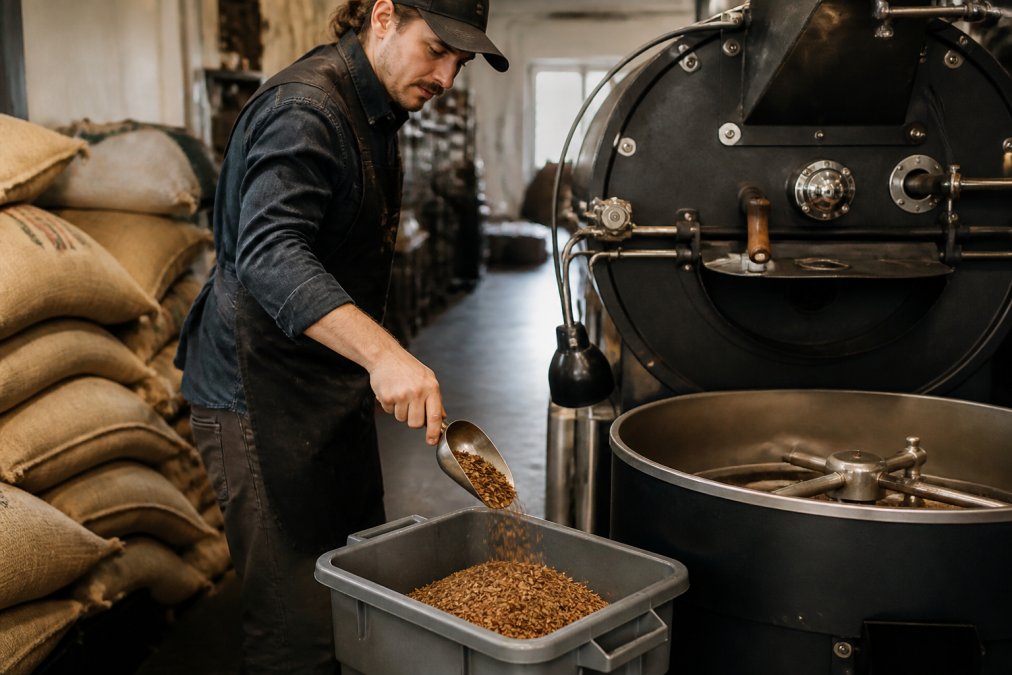
Chaff is the most visible waste stream in a roastery and the easiest to divert. A drum roaster sheds chaff during roasting, and most shops simply bag it and toss it, a missed opportunity.
Eco-Friendly Coffee Packaging That Keeps Beans Fresh
Eco-friendly coffee packaging solves a real tension: roasted coffee needs a high-barrier seal against oxygen and moisture, and the cheapest high-barrier materials are multi-layer plastic laminates no municipal program accepts. The answer is not one bag, it is matching the barrier to your turnover rate, then being honest with customers about end-of-life.
The three formats you will actually choose between:
-
Compostable kraft with a plant-based liner. Best for fast local turnover and customers with curbside organics collection. Watch the valve, many are still plastic and must be cut out before composting, so print that instruction on the bag.
-
Recyclable mono-material (single-resin) bags. Designed so the whole bag, film and valve, passes store drop-off recycling for plastic film. This format has grown fastest because it keeps a real barrier while staying in one resin stream.
-
Conventional foil laminate. Highest barrier, lowest cost per unit, and the one format that is genuinely not recyclable in most curbside programs. If you use it, say so plainly rather than calling it eco-friendly.
-
Do not print "compostable" or "recyclable" without the certification behind it. In the United States, compostability claims are typically backed by certification to ASTM D6400 (industrial composting) or ASTM D6868 (coatings and liners), and recyclability claims are judged against the Federal Trade Commission's Green Guides, which require that a recyclable claim reflect what a substantial majority of consumers or communities can actually recycle.
-
Match the valve to the format. A one-way degassing valve lets CO2 out without letting oxygen in, but valves are a separate material stream. Confirm with your supplier whether the valve is compatible with your chosen end-of-life path before you commit to a print run.
-
Buy in the smallest run that still hits your unit cost target. Packaging is a large share of a small roastery's per-pound cost, and over-ordering a format you later abandon is a sunk cost you cannot compost.
The ROI of Sustainable Upgrades: What Actually Pays Back
- Batch scheduling and roast-profile discipline. No capital cost. Grouping roasts so the drum stays hot between batches, and eliminating unnecessary development time, cuts fuel per pound immediately. Almost always the fastest payback because the investment is attention, not equipment.
- Heat recovery. Exhaust heat exchangers that preheat incoming combustion or make-up air cut gas consumption on every batch, so savings scale with volume. Payback is fastest at high utilization and slowest for a roaster that runs a few hours a week.
- Afterburner and ventilation tuning. A clogged or mistuned afterburner burns extra fuel to destroy the same smoke. Cleaning and tuning is low-cost maintenance with a measurable fuel effect.
- Insulation and door/gasket upgrades. Cheap, unglamorous, and effective, heat that stays in the drum is heat you did not pay to replace.
- Electric roasting conversion. Highest upfront cost and the one most sensitive to your building's electrical service. If you need a service upgrade to three-phase power, that cost can exceed the machine itself, which is why this belongs at the bottom of the list for most small shops.
- On-site solar. Attractive for marketing and long-run emissions, but the payback is typically the longest of the group and depends heavily on your utility's rate structure and any net-metering rules that apply to you.
- Utilization rate. A heat recovery system that saves 15% of fuel on a roaster running 40 hours a week pays back far faster than the same unit on a roaster running 6 hours a week. Run the numbers at your real hours, not a best case.
- Utility rate structure. Demand charges, time-of-use rates, and seasonal gas pricing can swing the math. If your utility offers a time-of-use rate, shifting roast sessions to off-peak hours can cut cost with no equipment change at all.
A common pattern among small roasteries is that the free and cheap operational changes, scheduling, profile discipline, maintenance, deliver more savings in the first year than any capital purchase. Spend the first 90 days measuring, then let the data rank your capital projects.
The ROI of Sustainable Upgrades: What Actually Pays Back
Most sustainable upgrades pay back through reduced energy and waste costs, not through a price premium. Heat recovery systems that capture exhaust heat to preheat incoming air are the clearest example: they cut gas consumption on every batch, so the savings scale with volume.
Maintenance and Regulatory Compliance for Eco-Friendly Equipment
Eco-friendly equipment needs a maintenance schedule, or the savings evaporate, and a compliance plan, or the savings turn into fines. For a roastery these are the same discipline: know what your equipment emits, prove it, and keep the proof.
Maintenance that protects the savings
Afterburners, heat recovery systems, and electric heating elements all drift out of tune, invisibly until you check the numbers.
- Afterburner. A clogged or mistuned afterburner burns extra fuel to destroy the same smoke. Inspect and clean on a set interval, and log fuel used per batch so you can see the drift before it shows up on a utility bill.
- Heat recovery. Dirty heat exchanger surfaces lose thermal efficiency. Check filters and clean surfaces on schedule; a fouled exchanger quietly erases the savings you paid for.
- Electric elements. Resistance elements degrade and controllers drift. Verify roast profile consistency against a baseline profile so you catch a weakening element before it ruins a batch.
- Gaskets, doors, and insulation. Cheap to replace, and a leaking door is heat you paid for and lost.
The regulations that actually apply to a roastery
The main federal air rule you should know is the Clean Air Act, which the U.S. Environmental Protection Agency administers. Coffee roasting is not one of the source categories with a dedicated federal standard, so in practice your obligations are set by your state or local air agency, and they vary widely by location and roaster size. That is why "check with your local agency" is not a dodge, it is the actual answer, because there is no single national roastery rule to point to.
- Do I need a permit for my roaster size and throughput? Many agencies set a small-source threshold below which no permit is required, based on pounds roasted per hour or per year, not on the size of the machine.
- What emission limits or control requirements apply? Afterburners and catalytic oxidizers are the common control technologies, and the requirement is usually tied to your throughput and how close you are to sensitive receptors like residences.
- What recordkeeping and reporting do I owe? Even small sources are often required to keep throughput and operating logs. Your energy and batch log doubles as this record.
- Are there local zoning or odor rules? Odor and nuisance rules are typically local, not federal, and they are the most common source of complaints for roasteries near housing.
Certifications and claims you can actually stand behind
If you want to make a public sustainability claim, back it with a recognized program, not a self-written badge. The two most common for roasteries:
- B Corp certification, administered by B Lab, which assesses a company's overall social and environmental performance, accountability, and transparency, not just its roasting operations.
- Carbon-neutral or climate-neutral claims, which require measuring your emissions and then reducing and offsetting them. The U.S. Federal Trade Commission's Green Guides govern how you may phrase environmental marketing claims, and a carbon-neutral claim without a documented measurement and offset plan is the kind of claim that draws scrutiny.
Keep the paper trail
Compliance is mostly documentation. Keep energy and throughput logs, maintenance records, permits, and certification documents in one place. When an inspector, wholesale buyer, or customer asks how you know your operation is sustainable, the answer is the file, not the label on the bag.
Sustainable Roasting Profiles: Flavor Without the Fuel Penalty
Sustainable roasting profiles reach the same flavor target with less fuel by shortening unnecessary development time and avoiding overshoot. Every extra minute in the drum costs gas and can flatten acidity.
Frequently Asked Questions
What makes a coffee roasting process environmentally sustainable?
A sustainable coffee roasting process cuts energy use, reduces waste, and lowers emissions at every step. That means choosing efficient roasting technology, recovering heat from the roaster exhaust, composting chaff and byproducts, and using packaging that breaks down or gets recycled. Sourcing beans through ethical and direct trade channels also matters because it supports sustainable agriculture at the farm level. The goal is to shrink your carbon footprint without sacrificing roast quality or consistency.
How does electric roasting compare to traditional gas roasting in terms of sustainability?
Electric roasting produces zero direct emissions at the roaster, while gas roasting releases greenhouse gas emissions on site. Electric models also tend to have better thermal efficiency because there is no combustion loss. The tradeoff is that the carbon footprint of electric roasting depends on how your local grid generates power. In regions with a lot of renewable energy, electric wins clearly. Where the grid is coal-heavy, gas may still come out ahead on total emissions.
How can coffee roasters reduce their carbon footprint during production?
Start with energy consumption metrics: track how much gas or electricity each roast profile uses, then optimize for thermal efficiency. Install heat recovery systems to capture exhaust heat. Reduce waste by composting chaff and recycling byproducts. Switch to eco-friendly coffee packaging made from compostable or recyclable materials. Source beans through direct trade or fair trade channels to cut supply chain emissions. Each change adds up, and a life cycle assessment helps you prioritize the biggest wins first.
Are there certifications that verify sustainable coffee roasting practices?
Yes. There are various certifications that address sustainable practices in coffee, from how beans are grown and sourced to how roastery operations manage energy consumption. These certifications give buyers verifiable proof that a supply chain meets specific environmental and social standards.