

How to Adjust Espresso Grind Size for Dark Roasts
Table of Contents
- Why Dark Roasts Need a Different Espresso Grind Size
- Espresso Brew Ratio for Dark Roast: Start Here Before You Touch the Grinder
- Dialing In: A Step-by-Step Grind Adjustment Process
- Grind Size vs Extraction Time: What Your Shot Clock Is Telling You
- How to Fix Bitter Espresso from Dark Roasts
- Equipment Factors That Change Your 'Correct' Grind Setting
- Frequently Asked Questions
Last Updated: September 14, 2026
Why Dark Roasts Need a Different Espresso Grind Size
Learning how to adjust espresso grind size for dark roasts starts with a single truth: the same setting that makes a light roast sing will punish a dark roast. At Eager Beaver Roasters, we roast dark profiles to order, and the most common support question we get is why a bag that tasted incredible in our cupping room turns harsh at home. The answer is almost always the grind.

Dark roasts are roasted longer, driving off moisture and making the bean more porous and brittle. The burrs shatter it into more fines and a wider particle distribution than a light roast, and more surface area plus a fragile cell structure equals faster extraction. A medium-roast grind will over-extract a dark roast in seconds.
The Dark Roast Paradox: More Solubility, Less Room for Error
Dark roasts are easier to extract, which many read as "easier to brew." The opposite is true: because solubles leave the puck so quickly, the window between under- and over-extracted collapses. A light roast gives a 6-8 second grace period on either side of ideal; a dark roast gives 2-3 seconds. You are fighting the lack of margin, not solubility.
Espresso Brew Ratio for Dark Roast: Start Here Before You Touch the Grinder
The espresso brew ratio for dark roast is the variable you set first, because it defines what "correct" extraction means for your shot. It is the relationship between your dose of dry coffee and your yield of liquid espresso, by weight.

Most dark roast espresso lands between 1:1.5 and 1:2, 18 grams in produces 27 to 36 grams out (How Strong is the Coffee You’re Cupping? New Model Captures the Equilibrium Extraction...). A shorter, ristretto-style ratio (closer to 1:1.5) tames the sharper bitter notes dark roasts develop. A longer ratio (1:2 or beyond) can brighten a flat dark roast, but pulls more charcoal character into the cup.
Pick your ratio, write it down, and do not change it while you dial in grind size. Changing two variables at once tells you nothing.
| Roast Level | Typical Brew Ratio | Target Shot Time | Grind Direction |
|---|---|---|---|
| Light | 1:2 to 1:2.5 | 25-30 sec | Finer |
| Medium | 1:2 | 25-30 sec | Medium |
| Dark | 1:1.5 to 1:2 | 22-28 sec | Coarser |
Dialing In: A Step-by-Step Grind Adjustment Process
Dialing in means adjusting grind setting, dose, and yield until a shot tastes balanced rather than bitter or sour. Work through it in order, changing one thing at a time.
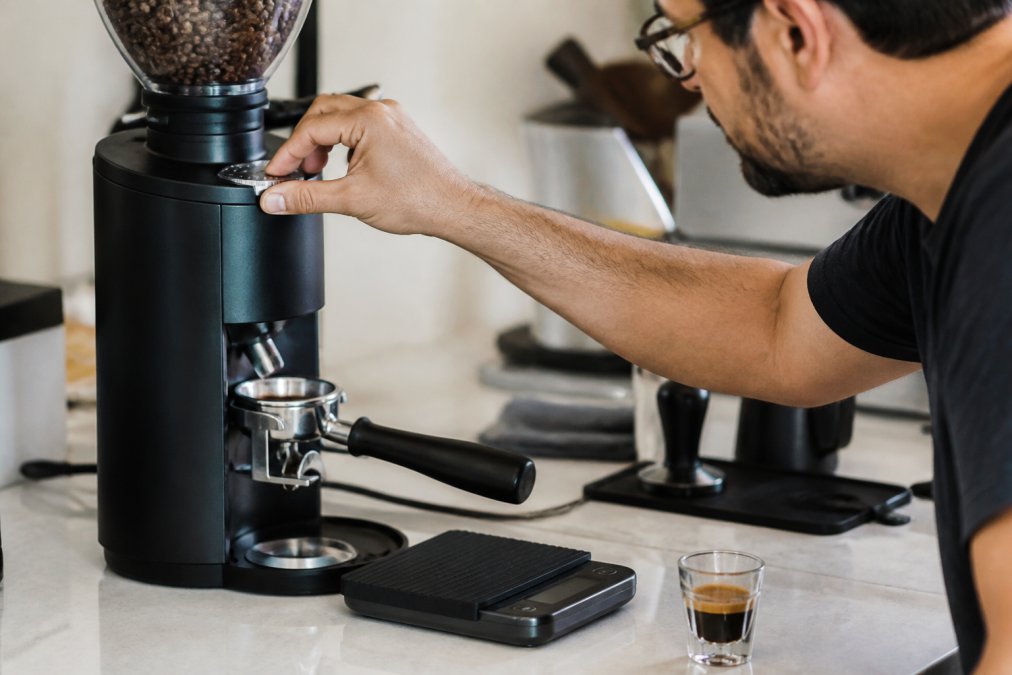
Step 1: Lock In Your Dose and Yield
Weigh your dose to 0.1 gram accuracy, an 18-gram basket wants 18 grams, not "about 18." Then stop the shot at your target yield by weight, not by eye. Volume in the shot glass lies; the scale does not.
Step 2: Pull a Shot and Read the Flow
Watch the first drops. On a dark roast, espresso should begin flowing at roughly 6-10 seconds and finish in the 22-28 second range. If liquid gushes out in 15 seconds, your grind is too coarse. If nothing appears until 15 seconds and the shot crawls past 35, you are too fine. The Specialty Coffee Association's brewing standards treat shot time and yield as the primary reference points for evaluating extraction.
Step 3: Adjust One Variable at a Time
Move the grind in small increments, then re-pull. On most grinders, a single "click" or one number on the dial is the right step size. Taste, adjust, repeat. Change grind, dose, and temperature together and you will never know which change helped.
Grind Size vs Extraction Time: What Your Shot Clock Is Telling You
Grind size vs extraction time is a direct relationship: finer grind slows the flow and lengthens contact time, while coarser grind speeds the flow and shortens it. For dark roasts, aim coarser and pull a slightly shorter shot than for a lighter bean.
Read your shot clock as a diagnostic, not a score:
- Under 20 seconds: grind too coarse, water is racing through the puck
- 20-28 seconds: the target zone for most dark roasts
- Over 32 seconds: grind too fine, likely channeling or stalling
If the shot time is right but the taste is wrong, the problem is probably not grind size, check water temperature next. Dark roasts extract well at roughly 195-200°F; higher temperatures pull out more bitter compounds (How Hot is Hot Enough? Brew Temperature, Sensory Profile, and Consumer Acceptance of...).
How to Fix Bitter Espresso from Dark Roasts
To fix bitter espresso from a dark roast, coarsen the grind slightly, shorten the shot time, or drop your brew temperature a few degrees. Bitterness is the signature of over-extraction, and dark roasts over-extract faster than any other profile, but first make sure bitterness is actually the problem.
Sour vs. Bitter: Getting the Diagnosis Right
Sour and bitter sit on opposite ends of the extraction spectrum, and confusing them sends you the wrong way. Sour, sharp, or salty flavors mean under-extraction: the water moved too fast and left the sweetness behind. Bitter, dry, ashy flavors mean over-extraction: the water stayed too long.
A useful test: let the shot cool two or three minutes and taste again. Bitterness intensifies as the cup cools, while sourness softens. If the cooled shot is harsher, you are over-extracting; if it gets more pleasant, you were probably under-extracting and mistook sharpness for bitterness.
The Diagnostic Order: Change One Thing at a Time
Work through these in order. Each step isolates a single variable so you know what actually helped.
- Check the shot time first. If the shot ran past 32 seconds, the grind is too fine. Coarsen by one click and re-pull before changing anything else.
- Check the yield. If the shot time is in range but the taste is bitter, you may be pulling too long a ratio. A dark roast at 1:2 can taste ashy where the same coffee at 1:1.5 tastes sweet. Shorten the yield by 3-5 grams and taste again.
- Check the dose. A dose too high for the basket compresses the puck and mimics a too-fine grind. If your 18-gram basket is loaded to 19 or 20 grams, drop back to 18 and re-pull.
- Check the temperature. If you are running at 203-205°F, drop 3-4 degrees and taste; higher temperatures pull out more bitter compounds.
- Check the puck. A soggy, muddy puck with a crater in the center signals channeling, not over-extraction. Channeling needs a distribution fix (level the bed, use a WDT tool), not a grind change.
Dark Roast Failure Modes You Will Actually See
- Ashy or charcoal finish: the classic dark-roast over-extraction, usually a too-fine grind plus too long a yield. Coarsen one click and shorten the ratio by 3-5 grams.
- Dry, powdery mouthfeel: over-extraction pulling tannins. Same fix, plus a temperature drop.
- Hollow sweetness with a bitter edge: channeling, the puck is extracting unevenly. Fix distribution before touching the grind dial.
- Sour and bitter at the same time: severe channeling or very uneven grind distribution. Check burr alignment and whether your grinder produces too many fines for a dark roast.
When Grind Is Not the Problem
If shot time, yield, and temperature are all right and the shot is still bitter, the issue is likely upstream of the grinder:
- Stale beans. Dark roasts fade faster than light roasts because the flavor-carrying oils sit on the surface and oxidize quickly. A dark roast past its peak tastes flat and bitter no matter how you dial it in.
- Water chemistry. Very hard water can push extraction toward bitterness. If your tap water leaves scale in the kettle, it is leaving something in the cup too.
- Grinder retention. Old grounds from a previous setting can contaminate the first shot after an adjustment. Purge 3-5 grams before you taste.
Equipment Factors That Change Your 'Correct' Grind Setting
There is no universal correct grind setting, because your equipment sets the rules. Two grinders set to the same number can produce completely different particle sizes, and two baskets can behave differently with the same coffee. That is the biggest reason online advice contradicts itself: the writer is dialing in on different hardware than you are.
Burr Geometry: Flat vs. Conical React Differently to Brittle Beans
Flat and conical burrs do not just grind at different speeds, they fracture coffee differently, and dark roasts expose that difference more than any other roast level.
- Flat burrs cut and shear the bean between two parallel discs, producing a narrower particle distribution with fewer fines. On a brittle dark roast, that means more even extraction and a wider margin for error, you can be a click or two off and still pull a drinkable shot.
- Conical burrs crush and tear the bean against a cone-shaped burr, generating more fines that migrate to the bottom of the puck and restrict flow. On a dark roast, which already shatters into more fines than a light roast, a conical grinder compounds the problem. A dark roast that channeled on a conical grinder often pulls clean on a flat-burr grinder at a similar setting.
Practical takeaway: on a conical grinder, expect to grind slightly coarser than a flat-burr recipe suggests, and purge more aggressively between adjustments because fines cling to the burr chamber.
Basket Size and Puck Depth
Basket diameter and depth change how much resistance the puck offers to water. A larger, deeper basket (say an 18-gram or 20-gram precision basket) gives you a taller puck with more distance for water to travel, adding resistance and letting you grind slightly coarser for the same shot time. A shallow basket with the same dose compresses the puck and often forces you to grind coarser still, or reduce dose, to avoid stalling.
If you are chasing a specific shot time on a dark roast, basket depth often lets you keep your preferred grind setting instead of fighting it.
Pressure Profiling and the 6-Bar Question
Most home machines run a fixed 9 bar at the group. Pressure profiling machines let you change that, and dark roasts respond more than light roasts do.
- Lower pressure (around 6 bar) slows the flow rate without changing grind size. That extra contact time can pull more sweetness out of a dark roast without dragging out the ashy, charcoal notes of a 9-bar shot.
- Declining pressure profiles, starting near 9 bar and dropping toward 6 bar in the last third of the shot, soften the bitter finish dark roasts develop. The grind requirement shifts coarser, because lower pressure means less force pushing water through the puck.
If your machine does not profile, approximate the effect by grinding slightly coarser and pulling a slightly shorter ratio, you will not get the same curve, but you will get closer to the balance a profiled shot delivers.
Visual Cues: What a Correctly Extracted Dark Roast Looks Like
Numbers tell you whether the shot is in range. The pour tells you whether the puck is behaving. On a dark roast, watch for these signals:
- First drops: should appear at roughly 6-10 seconds. Earlier means the grind is too coarse or the puck is channeling; later means too fine or the dose is too high.
- Stream: should start as a thin, dark, syrupy ribbon and thicken into a steady, honey-like flow. A stream that turns pale and watery within seconds signals over-extraction.
- Crema: a well-extracted dark roast pours a thick, hazelnut-to-dark-cocoa crema that holds together and fades slowly. Pale, thin, or fast-collapsing crema points to under-extraction or stale beans.
- Tiger striping: darker and lighter streaks down the stream signal even extraction. A uniform stream with no striping means the puck is likely channeling.
Why This Matters for the Dark Roast Paradox
The conflicting advice you read, some sources say grind coarser for dark roasts, others say finer, is not a contradiction but a description of two different setups. On a flat-burr grinder with a deep basket and a 9-bar machine, coarser is usually right. On a conical grinder with a shallow basket and a pressure-profiled machine running 6 bar, the same coffee may need a finer setting to reach the same shot time. Match the advice to your hardware before your taste.
Frequently Asked Questions
What grind size should I use for dark roast espresso?
Start slightly coarser than you would for a light or medium roast. Dark roast beans are more brittle and porous, so they extract faster and can turn bitter quickly. Begin with a grind that gives you a 1:2 brew ratio in about 25 seconds, then adjust finer or coarser in small increments based on taste. The exact setting depends on your grinder, basket, and dose, so dialing in by taste matters more than chasing a number.
Why does dark roast coffee require a different grind size than light roast?
Roasting darker makes beans less dense and more brittle because the extended heat breaks down cell structure. That means water reaches the soluble compounds faster during extraction. A grind that works for a dense light roast will over-extract a dark roast, producing bitterness and ash. Going coarser slows the flow and balances the shot. This is the core of why you cannot copy a friend's grind setting across roast levels.
How do I fix bitter espresso from a dark roast?
Bitterness usually means over-extraction. First, check your grind size vs extraction time: if the shot runs longer than 30 seconds at your target yield, grind coarser. Second, verify your espresso brew ratio for dark roast, a 1:2 ratio in 25 to 30 seconds is a solid baseline. Third, drop your water temperature a few degrees, since dark roasts extract well at lower heat. Change one variable at a time and taste after each adjustment.
Should I grind dark roast coffee coarser or finer for espresso?
Coarser, in most cases. The common mistake is grinding dark roasts as fine as lighter ones, which chokes the shot or rushes it into bitterness. Because dark roast particles dissolve faster, a coarser grind slows extraction and lets sweetness and body come through. That said, basket size and pressure profiling shift the target. A larger basket or lower pressure may let you grind slightly finer without bitterness, so treat coarser as your starting point, not a fixed rule.