

Troubleshooting Sour Light Roast Coffee (2026 Guide)
Table of Contents
- Why Light Roasts Turn Sour: Density, Solubility, and the Extraction Gap
- Under-Extracted Coffee Symptoms: How to Read Sourness vs. Acidity
- Step 1: Dial In Grind Size Before You Touch Anything Else
- Step 2: Set the Ideal Water Temperature for Light Roast
- Step 3: Extend Contact Time and Tighten Your Brew Ratio
- Step 4: How to Increase Coffee Extraction With Agitation and Pour Technique
- Water Chemistry and Equipment Thermal Stability: The Two Variables Most Brewers Skip
- Espresso vs. Drip: Fixing Sour Shots Without Breaking Your Recipe
- Frequently Asked Questions
Last Updated: October 1, 2026
Why Light Roasts Turn Sour: Density, Solubility, and the Extraction Gap
Sour light roast coffee usually means one thing: under-extraction. Light roasts are denser than dark roasts, so they resist water and give up their sugars slowly. At Eager Beaver Roasters, we roast light, medium, and dark profiles to order, and light beans are the fussiest to dial in.

What Under-Extraction Actually Means in the Cup
Under-extraction is when water pulls acids and salts from the coffee but leaves the sugars and caramelized compounds behind. The result tastes sour, salty, and hollow; over-extraction is bitter, dry, and harsh. Land in the middle.
Under-Extracted Coffee Symptoms: How to Read Sourness vs. Acidity
Not all brightness is a defect. Light roasts are supposed to taste lively. The trick is telling good acidity from bad sourness. Under-extracted coffee symptoms include a sharp bite at the front of your tongue, a watery middle, and a finish that vanishes fast.
The Sensory Test: Sour Tip, Hollow Middle, Fast Finish
Try this before you change anything:
- Sour tip: The first sip stings the tip of your tongue.
- Hollow middle: No sweetness, no body, nothing in the center.
- Fast finish: The flavor disappears within a second or two.
- Cooling check: Let the cup cool. If it gets worse, you're under-extracted.
If all four show up, move to Step 1.
Step 1: Dial In Grind Size Before You Touch Anything Else
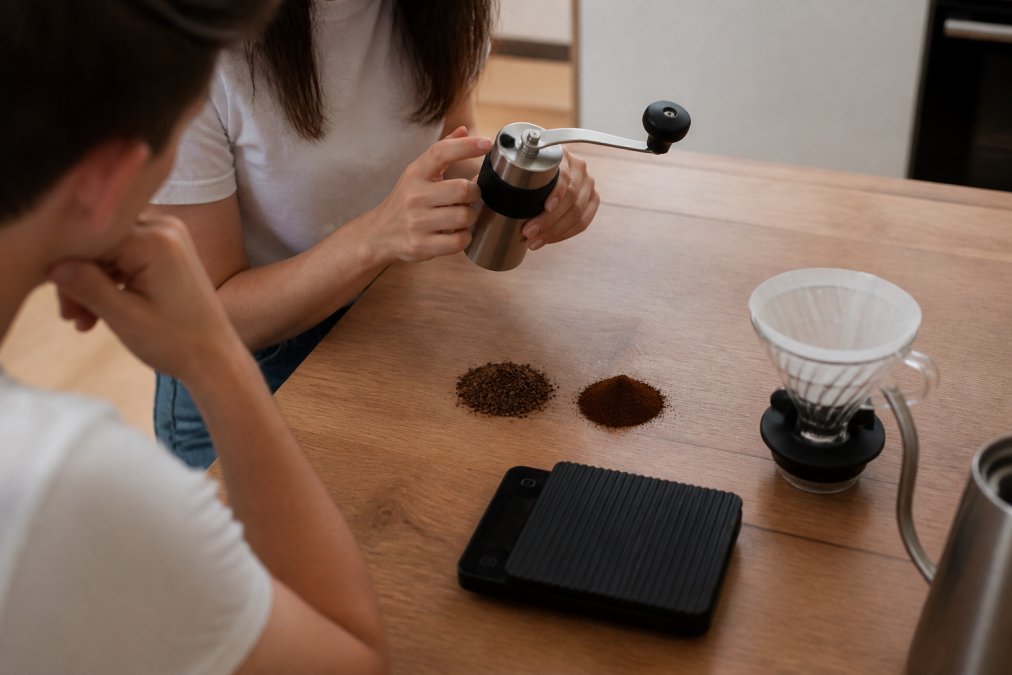
Grind size is the single biggest lever you control. Go finer first, and change nothing else. A finer grind gives water more surface area, speeding up extraction. For light roasts, start two clicks finer than for a medium roast.
Step 2: Set the Ideal Water Temperature for Light Roast
The ideal water temperature for light roast sits between 195°F and 205°F. Light beans need the higher end of that range because their dense structure resists heat, at 185°F, you're leaving flavor behind.
- Light roast: 200-205°F
- Medium roast: 195-200°F
- Dark roast: 185-195°F
Step 3: Extend Contact Time and Tighten Your Brew Ratio
Contact time is how long water touches the grounds. Longer contact means more extraction. If your pour-over finishes in two minutes, slow down. Aim for three to four minutes total.
- Weigh your beans. Eyeballing leads to inconsistency.
- Pour in stages, not all at once.
- Let the bed drain between pours.
Small changes add up fast here.
Step 4: How to Increase Coffee Extraction With Agitation and Pour Technique
Learning how to increase coffee extraction comes down to movement. Agitation stirs the grounds so water reaches more of them. A gentle swirl after your first pour does more than a hard stir, which can push fines through the filter and clog it.
Try this pour pattern:
- Bloom with twice the coffee's weight in water.
- Wait 30 seconds for degassing.
- Pour in slow circles from the center out.
- Swirl the dripper once at the halfway mark.
- Finish with a gentle spin to level the bed.
Swirl, Stir, or Pulse: Matching Agitation to Your Brewer
- Pour-over: Swirl gently. Skip the spoon.
- French press: Stir once, then plunge slowly.
- Espresso: Use a distribution tool, then tamp level.
- Drip machine: Pulse brewing adds agitation for you.
Match the method to the brewer and you'll see the difference in the cup.
Water Chemistry and Equipment Thermal Stability: The Two Variables Most Brewers Skip
Most brewers obsess over grind and ignore water, but water is roughly 98% of your cup by mass, and its mineral content decides which compounds it pulls out of a light roast, and how fast.
Why Magnesium and Calcium Matter More Than "Soft vs. Hard"
Light roast beans are dense, with acids and sugars locked inside intact cell walls. Water can't dissolve those compounds alone, minerals act as carriers, and two do most of the work:
- Magnesium binds readily to the fruity, acidic compounds in light roasts and pulls them into solution. It's the mineral most associated with the bright, juicy character people want from a light roast.
- Calcium is a strong extractor of heavier, sweeter, caramelized compounds. It builds body and sweetness.
- Bicarbonate (alkalinity) is the buffer. It neutralizes acids. A little alkalinity smooths a sharp cup; too much flattens the brightness entirely and can leave a chalky, muted finish.
Diagnosing Your Water in Three Steps
- Taste the water alone. Flat or chalky tap water does the same to your coffee; metallic or chlorine notes carry straight into the cup.
- Check a water report or use a test strip. Most utilities publish an annual consumer confidence report with hardness and alkalinity figures, and a $10 aquarium-style GH/KH test strip gives a rough read in a minute.
- Brew a control cup with bottled or reconstituted water. If the sourness disappears when you swap water and change nothing else, water was your variable.
Fixing Sour Water Without a Lab
- Too soft (under-extracted, sour, thin): Add minerals. The simplest home fix is a pinch of Epsom salt (magnesium sulfate), roughly 0.1-0.2 grams per liter of brew water, or a commercial remineralization packet.
- Too hard or too alkaline (flat, chalky, muted): Dilute. Cut your tap water with distilled water at a 1:1 or 1:2 ratio until the cup brightens. An activated-carbon filter removes chlorine but not hardness minerals, so it won't fix an over-mineralized supply.
- Chlorine or chloramine: Carbon filtration handles chlorine; chloramine needs a catalytic carbon block or dedicated filter. Don't brew with unfiltered municipal water if you can taste it in the glass.
Equipment Thermal Stability: Why Your Brewer Shape Changes the Fix
Water chemistry is half the story; the other half is how well your brewer holds heat, and geometry changes how heat and water move through the bed.
- Cone drippers (V60-style): The tall, narrow bed promotes even extraction but is sensitive to pour technique. A thin plastic cone loses heat fast; a ceramic cone holds it but must be preheated thoroughly or it will pull 10-15°F out of your first pour.
- Flat-bottom drippers (Kalita Wave-style): The shallow, wide bed distributes water evenly and drains uniformly, forgiving a sloppy pour, a good choice if you're fighting sourness from channeling.
- Immersion brewers (French press, AeroPress): Full immersion means extraction is driven almost entirely by time, temperature, and grind, not pour pattern. Thermal loss is the main risk; a thick-walled press or preheated carafe keeps brew temperature from sagging mid-steep.
- Batch drip machines: The heating element and showerhead design matter more than the carafe. Many home drip machines brew below 195°F, the most common cause of sour light-roast drip coffee. Check the showerhead temperature with a thermometer during a brew cycle.
Preheating: The Cheapest Fix in Coffee
A cold brewer steals heat from your brew, so preheat everything that touches the water: the dripper, carafe, cup, and filter. Rinse a paper filter with hot water for 20-30 seconds to preheat the cone and wash out papery taste. For a ceramic dripper, fill it with boiling water and let it sit a full minute, ceramic has high thermal mass and needs more preheating than plastic or glass.
Espresso vs. Drip: Fixing Sour Shots Without Breaking Your Recipe
Sour espresso and sour drip coffee need different fixes because the two methods extract under completely different conditions. Espresso uses roughly 9 bars of pressure, a very fine grind, and a 25-30 second contact time; drip uses gravity, a coarser grind, and a 3-5 minute contact time. The fastest lever differs for each.
Sour Espresso: Grind First, Then Dose, Then Temperature
Espresso is unforgiving because the brew happens so fast. A few seconds of shot time is a large percentage change in total contact time.
- Grind finer. This is the primary lever. Go one small step finer and pull another shot. Keep going until the shot turns bitter, then back off one step. A light roast typically needs a noticeably finer grind than a medium or dark roast to hit the same shot time.
- Watch shot time, not just taste. A light-roast espresso that pulls in 20 seconds is almost certainly under-extracted and sour. Aim for 25-30 seconds for a standard double, with light roasts at the longer end.
- Raise the dose slightly. If you're already at a fine grind and the shot is still sour, increasing the dose by 0.5-1 gram adds more coffee to the same water, pushing extraction up and adding body.
- Raise brew temperature. Espresso machines with PID control let you bump the temperature 2-4°F. Light roasts benefit from the higher end of the machine's range, often 200-205°F at the group.
- Check your puck prep. Channeling, where water finds a path of least resistance through the puck, causes uneven extraction that tastes sour and thin even when grind and dose are correct. Distribute the grounds evenly, tamp level, and consider a puck screen if channeling persists.
Sour Drip Coffee: Temperature and Ratio Before Grind
Drip coffee gives you more room to maneuver because the brew is longer and gentler. The order of operations is different from espresso.
- Check brew temperature first. This is the most common cause of sour drip coffee and the easiest to overlook. Many home drip machines brew at 185-195°F, too cool for a dense light roast. Measure the water temperature at the showerhead during a brew cycle; below 195°F, you're leaving extraction on the table.
- Tighten the ratio. A 1:16 or 1:17 ratio is common for drip, but light roasts often need 1:15 to taste sweet rather than sour. More coffee per unit of water increases extraction strength.
- Extend brew time. If your drip machine finishes a full pot in under 4 minutes, contact time may be too short. A coarser grind with a longer brew time extracts more evenly than a fine grind with a fast brew.
- Grind finer last. With drip, grind is a slower lever than temperature or ratio because the brew is already long. Adjust grind only after temperature and ratio are dialed in.
The Freshness Variable
Bean freshness affects both methods, but differently. Very fresh beans (under 3-4 days off roast) degas aggressively during brewing, creating channeling in espresso and uneven extraction in drip, both read as sourness. Beans 5-14 days off roast are most predictable for dialing in. Beyond about 4-6 weeks, beans oxidize and lose the volatile compounds that make light roasts taste bright and sweet, so the cup goes flat and hollow rather than sour.
Quick Reference: Which Lever to Pull First
| Method | First Lever | Second Lever | Third Lever |
|---|---|---|---|
| Espresso | Grind finer | Dose up 0.5-1g | Brew temp up 2-4°F |
| Drip | Brew temp to 200-205°F | Ratio to 1:15 | Grind finer |
| Pour-over | Grind finer | Pour slower / extend time | Agitation |
| French press | Steep longer | Grind finer | Stir once at start |
Frequently Asked Questions
Why does my light roast coffee taste sour?
Sour light roast coffee usually means the grounds were under-extracted. Light roasts are denser and less soluble than dark roasts, so water pulls fewer sugars and caramelized compounds out of them at the same grind and temperature. The result is a cup that tastes sharp, thin, and lemony instead of sweet. Fix it by grinding finer, raising brew temperature to 200-205°F, and lengthening contact time, one change at a time so you can taste what each adjustment does.
Is sour coffee a sign of under-extraction?
Usually, yes. Under-extracted coffee symptoms include sourness, a hollow mid-palate, a fast finish, and a thin body. But not every bright cup is a defect. A washed Ethiopian or Tanzanian coffee brewed well still shows fruit and floral acidity. The test is balance: if the sourness sits on the tip of your tongue and never rounds out into sweetness, the shot or brew is under-extracted. If it's bright but supported by sweetness and body, that's the roast doing its job.
What is the ideal water temperature for light roast coffee?
For light roasts, aim for 200-205°F at the point where water meets the coffee. Light beans are denser and need more thermal energy to release sugars. If your kettle sits at 195°F or below, raise it. For pour-over, preheat the dripper and carafe with hot water first so the slurry doesn't lose heat on contact. For espresso, a machine with a stable group temperature matters more than the number on the display, since cold metal pulls heat out of the first shot.
How do I fix sour tasting coffee without changing my whole routine?
Change one variable per brew. Start with grind size: go one step finer and taste. If it's still sour, raise water temperature by 3-5°F. Next, extend contact time by 15-20 seconds or tighten your brew ratio toward 1:15. Then add gentle agitation, like a stir at the bloom and a swirl at the end of the pour. Keep notes on each change so you can repeat the version that worked. Small, sequential adjustments beat overhauling your recipe all at once.
Sour light roast coffee can feel like a puzzle, but the pieces fit once you know the order. Eager Beaver Roasters roasts to order so your beans arrive fresh, with light, medium, and dark options to match your taste. We source carefully, skip the fillers, and ship straight to your door. Find your perfect roast and brew a cup that tastes the way it should.