

Commercial Coffee Roasting Process Explained
Table of Contents
- What Is Commercial Coffee Roasting?
- The Coffee Roasting Stages: From Green Bean to Finished Product
- Commercial Coffee Roaster Types: Drum vs. Air Roasting
- How Heat Transfer and Chemical Reactions Shape Your Coffee
- Coffee Roast Profiles Explained: Light, Medium, and Dark
- Temperature Control, Cooling, and Roasting Software
- Safety Standards and Maintenance in Commercial Operations
- Why Fresh-Roasted Coffee Tastes Different
- Frequently Asked Questions
Last Updated: September 21, 2026
What Is Commercial Coffee Roasting?
Commercial coffee roasting is the controlled heating of green coffee beans to develop flavor, aroma, and color for wholesale or direct-to-consumer distribution. Unlike home roasting, the commercial coffee roasting process explained requires precision equipment, consistent batch control, and adherence to food safety standards to deliver repeatable results at scale.
At Eager Beaver Roasters, we understand that roasting isn't just about applying heat. It's about understanding how temperature, time, and airflow interact to transform raw beans into the finished product your customers expect. The process transforms green coffee beans, which are dense, pale, and relatively flavorless, into aromatic brown beans with complex flavor compounds.
The stakes are higher in commercial operations. A single roast batch can represent hundreds of pounds of inventory. Temperature swings of just 10 degrees can shift the flavor profile dramatically. Equipment failures cost money and reputation. This is why commercial roasters invest in data logging systems, precise thermometers, and cooling systems that industrial home roasters never need.
The Coffee Roasting Stages: From Green Bean to Finished Product
Every commercial coffee roasting process explained follows three distinct phases: drying, browning, and development. Each phase triggers different chemical reactions and requires different heat management strategies. Understanding these stages is essential for anyone roasting coffee at scale.
Drying Phase
The drying phase begins the moment green coffee beans enter the roaster. During this stage, moisture content, typically 10-12% in green beans, begins to evaporate. The beans absorb heat through conduction (direct contact with the roaster drum or air) and convection (heated air circulating around them).
Temperature during drying typically rises from ambient to around 300°F. The beans remain pale and expand slightly as internal moisture escapes. This phase usually lasts 5-8 minutes, depending on batch size and heat intensity. Many operators watch for the beans to transition from pale green to a light tan color, signaling the end of the drying phase.
A common mistake is rushing this phase. Uneven drying creates inconsistent roast profiles across the batch. Some beans finish drying while others still contain trapped moisture, leading to uneven flavor development later. Proper airflow and moderate heat during drying ensure every bean reaches the browning phase at approximately the same time.
Browning Phase
Once moisture is driven out, the Maillard reaction begins. This complex chemical process creates hundreds of new flavor compounds, caramel notes, nutty undertones, chocolate hints, that didn't exist in the green bean. Temperature accelerates from around 300°F to 350-400°F during this stage.
The browning phase typically lasts 4-6 minutes. Beans darken from light tan to medium brown. The rate of temperature rise (called "rate of rise" or RoR) becomes critical here. A steep RoR produces brighter, more acidic coffees. A gentler RoR develops deeper, more rounded flavors. Commercial roasters adjust heat input and airflow to control this rate precisely.
Chaff, the papery skin that comes off the beans, separates during browning. Most modern commercial roasters include chaff collection systems to manage this byproduct and maintain air quality in the roasting facility. The beans release volatile compounds that create the distinctive roasted coffee aroma.
Development Phase
The development phase is where roast level is determined. This is when the second crack may occur, an audible popping sound indicating deeper chemical changes. Temperature continues rising, typically from 400°F to 430°F for light roasts, higher for medium and dark roasts.
Development time ratio, the percentage of total roast time spent in development, directly influences final flavor. A short development phase (10-15% of total time) produces lighter, more acidic coffees. A longer development phase (20-30%) creates darker, more body-forward profiles. Commercial roasters carefully control this phase because it's the final opportunity to shape the roast before cooling begins.
The beans transition from brown to dark brown (or nearly black for dark roasts). At the end of development, the roaster must cool the beans rapidly to stop the roasting process and lock in the desired flavor profile.
Commercial Coffee Roaster Types: Drum vs. Air Roasting
Two primary technologies dominate commercial coffee roasting: drum roasters and air roasters. Each uses different heat transfer methods and appeals to different production scales and flavor philosophies.
Drum Roasters
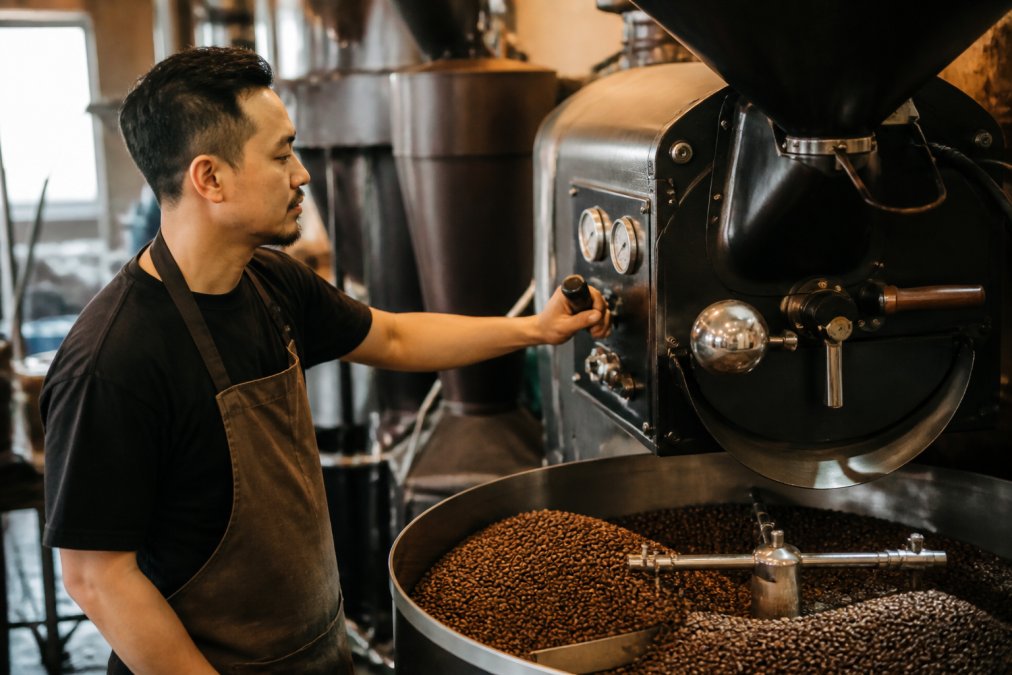
Drum roasters are the industry standard for most commercial operations. A rotating cylindrical drum, typically heated to 350-450°F on the outside, tumbles beans as hot air circulates around them. Heat transfers through conduction (beans touching the hot drum) and convection (hot air circulation).
Drum roasters excel at consistency. The mechanical agitation ensures even heat distribution across large batches. Batch sizes typically range from 25 to 150+ pounds, making them economical for high-volume production. The rotating drum also helps manage chaff collection and cooling.
Temperature control in drum roasters happens through adjusting burner intensity and airflow. Experienced operators develop a feel for how to modulate heat to achieve target roast profiles. Modern drum roasters often include thermocouples that feed data into roasting software, allowing operators to log roast profiles and replicate them batch after batch.
The trade-off: drum roasters require longer cooling times because the beans retain heat from the hot drum. Some operators argue this extended cooling slightly diminishes the brightness of light roasts compared to air-roasted beans.
Air Roasters
Air roasters suspend beans on a column of hot air, eliminating contact with a heated surface. Heat transfer occurs entirely through convection. Beans roast more quickly, typically 8-12 minutes total, and cool faster because there's no thermal mass from a drum.
Air roasters produce distinctly different flavor profiles. Light roasts tend to be brighter and more complex. The faster roast and rapid cooling preserve volatile compounds that might dissipate in longer drum roasts. This appeals to specialty coffee roasters focused on single-origin, high-quality beans.
The downside: air roasters typically handle smaller batches (5-50 pounds) and require more operator skill to maintain consistency. Uneven airflow can create hot and cold spots, leading to inconsistent roasts. They also demand more frequent cleaning because chaff can accumulate in the roasting chamber.
How Heat Transfer and Chemical Reactions Shape Your Coffee
Commercial coffee roasting relies on two heat transfer mechanisms: conduction and convection. Understanding how they work, and how they interact, is fundamental to controlling roast outcomes.
Conduction transfers heat through direct contact. In a drum roaster, beans touching the hot drum surface absorb heat directly.
Coffee Roast Profiles Explained: Light, Medium, and Dark
Roast level is determined by the bean's surface color and internal development at the moment cooling begins. Commercial roasters use visual cues and first/second crack timing to identify roast levels, then rely on roasting software to document and replicate them.
| Roast Level | Temperature Range | First Crack Timing | Flavor Profile | Best For |
|---|---|---|---|---|
| Light | 350-380°F | 8-10 minutes | Bright, acidic, origin-forward | Single-origin specialty coffees |
| Medium | 380-410°F | 10-12 minutes | Balanced, sweet, complex | Blends, everyday coffee |
| Dark | 410-430°F+ | 12-14+ minutes | Bold, full-bodied, caramelized | French roast, espresso blends |
Temperature Control, Cooling, and Roasting Software
Precise temperature control separates quality commercial roasting from amateur attempts. Modern roasters use thermocouples positioned inside the drum or roasting chamber to measure bean temperature in real time. This bean temperature, not the air temperature or drum temperature, is what actually matters.
Safety Standards and Maintenance in Commercial Operations
Commercial coffee roasting facilities must comply with food safety regulations established by the FDA. All roasting equipment must be food-grade and designed for commercial use. Facilities require proper ventilation systems to manage smoke and chaff particulates released during roasting.
Maintenance schedules vary by equipment but typically include:
- Weekly: chaff removal, visual inspection, cleaning collection systems
- Monthly: deep cleaning of roasting chamber, drum inspection
- Quarterly: thermometer calibration, bearing lubrication, burner inspection
- Annually: professional service, seal replacement, thermal imaging inspection
Why Fresh-Roasted Coffee Tastes Different
The flavor difference between fresh-roasted coffee and coffee roasted weeks ago is dramatic and measurable. Immediately after roasting, volatile compounds, the aromatic molecules that create coffee's complex flavor, are at peak concentration. These compounds begin oxidizing the moment the beans cool.
Frequently Asked Questions
What are the five stages of coffee roasting?
Commercial coffee roasting typically involves three main stages: drying (removing moisture from green coffee beans), browning (where the Maillard reaction begins and beans develop color), and development (where flavor compounds form and roast character emerges). First crack occurs late in browning, signaling the transition to development. Second crack marks the boundary between medium and dark roasts. Each stage requires precise temperature control and timing to achieve the desired roast profile.
How do commercial coffee roaster types differ in their approach?
Drum roasters use conduction and convection heat, rotating beans inside a heated chamber for even roasting and larger batch sizes. Air roasters suspend beans in a heated airstream using convection alone, offering faster roasts and greater temperature precision. Drum roasters dominate commercial operations due to batch capacity and consistency, while air roasters appeal to specialty roasters prioritizing control. The choice affects roast profile flexibility, energy efficiency, and the final cup characteristics.
What is the Maillard reaction and why does it matter?
The Maillard reaction is a chemical process occurring when amino acids and sugars in green coffee beans are exposed to heat, creating hundreds of new flavor compounds and the brown color you see in roasted beans. This reaction begins around 300°F and is central to developing coffee's aroma, body, and taste complexity. Understanding when and how aggressively the Maillard reaction occurs helps roasters control whether beans develop nutty, caramel, or chocolate notes.
How does roast level affect flavor and caffeine content?
Light roasts preserve more origin flavors and retain slightly more caffeine, offering brighter acidity and floral notes. Medium roasts balance origin character with roasted flavors, developing caramel and cocoa notes. Dark roasts like our Italian Roast emphasize roasted character with bold, smoky flavors and lower acidity, with marginally less caffeine due to longer heat exposure. Roast level doesn't drastically change caffeine, but it dramatically changes taste, body, and how the coffee pairs with your brewing method.