

How to Brew Fresh Coffee for Beginners
Table of Contents
- What You'll Need to Brew Fresh Coffee
- Choosing the Right Coffee Beans
- Why Use a Burr Grinder for Coffee
- Coffee to Water Ratio for Beginners
- Water Temperature and Quality Matter
- How to Store Coffee Beans for Freshness
- Three Simple Brewing Methods to Start With
- Troubleshooting Flavor Problems
- Frequently Asked Questions
Last Updated: September 1, 2026
What You'll Need to Brew Fresh Coffee
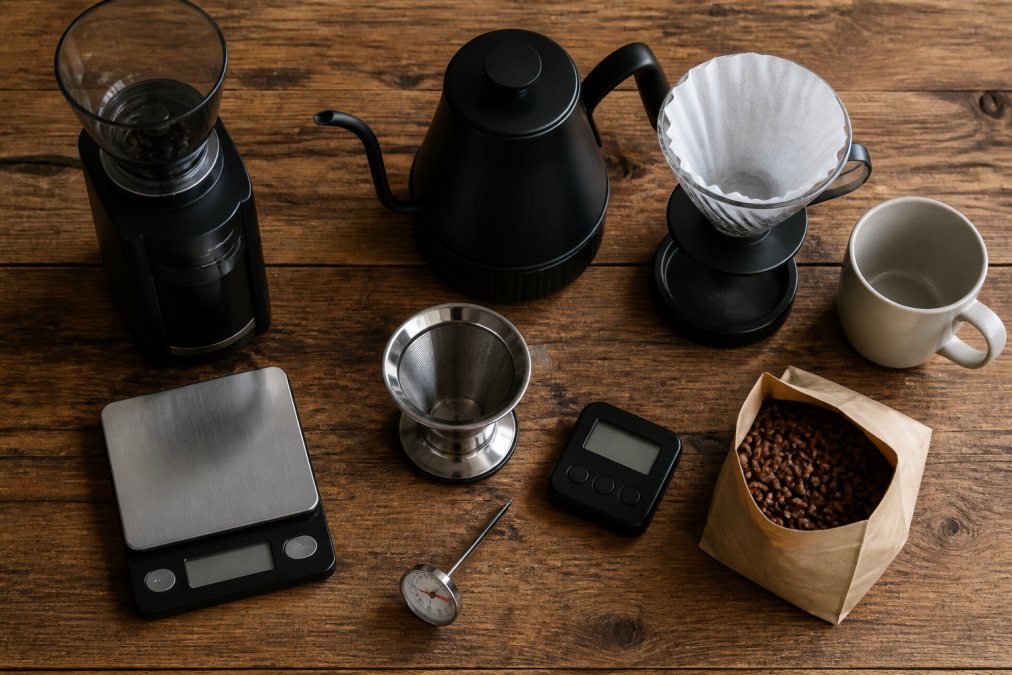
Before you start learning how to brew fresh coffee for beginners, gather the right equipment. You don't need an expensive setup, just the essentials that make a real difference in your cup.
A burr grinder is non-negotiable. Unlike blade grinders that chop beans unevenly, a burr grinder produces consistent particle size, which directly affects extraction. You'll want a kitchen scale too, measuring by weight, not scoops, removes the guesswork from your coffee-to-water ratio. A simple digital timer keeps you accountable during brewing. For pour-overs and French presses, you'll need a gooseneck kettle (or any kettle that gives you pouring control), and a thermometer helps you hit the right water temperature.
Filter paper matters. Paper filters remove oils and sediment, producing a cleaner cup. Metal filters let more oils through, creating a heavier body. Choose based on your preference, both work. A mug is obvious, but ceramic holds heat better than thin glass.
That's genuinely it. You can start brewing fresh coffee for beginners with under $100 in gear. Eager Beaver Roasters ships freshly roasted whole beans that work beautifully with any of these methods, so you're not limited by equipment choices.
Choosing the Right Coffee Beans
The beans you choose determine everything else. Stale beans make even perfect technique taste flat.
Look for a roast date on the bag. Coffee peaks between 5-14 days after roasting, then slowly declines (peer-reviewed research). If there's no roast date, the beans are likely weeks or months old. Whole beans stay fresher longer than pre-ground coffee, grinding releases oils and increases surface area, speeding up oxidation.
Light roasts highlight the bean's origin characteristics. You'll taste more acidity and brightness, often with fruit or floral notes. Medium roasts balance origin flavor with roast character, offering a smoother profile with nutty or chocolate notes. Dark roasts emphasize the roast itself, producing bold, smoky, sometimes bitter flavors.
For beginners, medium roasts are forgiving. They're less likely to taste sour (under-extracted) or bitter (over-extracted) if your technique isn't perfect yet. Eager Beaver Roasters roasts to order in all three profiles, their House Blend and Breakfast Blend are both medium roasts designed for consistency and approachability.

A single-origin bean comes from one farm or region. A blend combines beans from multiple origins. Blends offer consistency and balance; single-origins offer complexity and story. Neither is "better", it's personal preference.
Why Use a Burr Grinder for Coffee
The grind size controls how fast water extracts flavor from the grounds. Too coarse, and water rushes through without pulling enough flavor, your coffee tastes sour and weak. Too fine, and water gets stuck, over-extracting and creating bitterness.
A burr grinder produces uniform particle size. Two flat burrs (or a conical burr) crush beans between them at a consistent distance, so every particle is roughly the same. This uniform grind size means water flows through the coffee bed evenly, extracting at the same rate throughout.
A blade grinder chops randomly. You get a mix of powder, medium pieces, and chunks. Water moves through the powder instantly (over-extraction) while it struggles through the chunks (under-extraction). The result is muddy, inconsistent coffee.
Why use a burr grinder for coffee? Because consistency is everything. The difference between a $40 burr grinder and a $15 blade grinder is the difference between controllable brewing and guessing.
Burr grinders come in two types: flat burrs and conical burrs. Flat burrs are faster and produce slightly more uniform grinds. Conical burrs are slower and generate less heat (which can degrade flavor). For beginners, either works. Focus on getting a burr grinder at all.
Coffee to Water Ratio for Beginners
The coffee-to-water ratio determines strength and extraction. Most coffee experts recommend 1:16 or 1:17 (one part coffee to 16-17 parts water by weight) (peer-reviewed research). This is a starting point, not a law.
Here's how to calculate it: if you use 20 grams of coffee, multiply by 16 to get 320 grams of water. Brew that, taste it, then adjust. If it's too weak, use more coffee or less water next time. If it's too strong, reverse it.
For beginners, start at 1:16 and stay there for at least five brews. You need consistency to understand what's happening. Once you know what 1:16 tastes like from your beans, you can experiment.
A digital scale removes all doubt. Measuring by volume (scoops) introduces error because coffee settles differently in the bag, and different beans have different densities. Weight is objective.
| Brew Method | Recommended Ratio | Example (grams) | Notes |
|---|---|---|---|
| Pour-over | 1:16 to 1:17 | 25g coffee, 400g water | Adjust based on taste |
| French press | 1:15 to 1:16 | 30g coffee, 450g water | Coarser grind, longer steep |
| Drip machine | 1:16 to 1:18 | 20g coffee, 320-360g water | Varies by machine efficiency |
The coffee-to-water ratio for beginners should stay simple. Don't overthink it. Measure, brew, taste, adjust.
Water Temperature and Quality Matter
Water temperature controls extraction speed. Too hot, and you over-extract (bitter). Too cold, and you under-extract (sour). The sweet spot is 195-205°F (90-96°C) (peer-reviewed research).
If your kettle doesn't have a thermometer, boil water and wait 30 seconds. That's roughly 195°F. It's not precise, but it's close enough to start.
Water quality affects flavor more than most people realize. Tap water works, but if your tap water is heavily chlorinated or mineral-heavy, it changes the taste. Filtered water is a simple upgrade. You don't need expensive mineral water or distilled water, just something that tastes neutral when you drink it plain.
Hard water (high mineral content) can actually improve extraction in some cases, but it also builds scale inside kettles and equipment. Soft water extracts slower. Most tap water falls somewhere in between and works fine.
The water temperature matters because it affects how fast flavor compounds dissolve. Hotter water extracts faster. Cooler water extracts slower. This is why immersion brewing (like French press, where grounds steep in hot water) can use slightly cooler water and longer steeping time to achieve the same extraction as pour-over (where water flows through grounds quickly at higher temperature).
How to Store Coffee Beans for Freshness
Once you open a bag, oxygen starts degrading the beans. You can't stop it, but you can slow it down dramatically.
Keep beans in an airtight container away from light, heat, and moisture. A sealed jar in a cool cupboard is perfect. Avoid the refrigerator, condensation forms when cold beans warm up, introducing moisture that speeds staleness. The freezer works if you use an airtight container, but it's overkill for most home brewers.
Whole beans stay fresh for 2-4 weeks after opening. Ground coffee stays fresh for about a week. This is why grinding right before brewing matters, you're capturing the peak flavor window.
Buy smaller bags more often instead of large bags you'll slowly work through. A bag that lasts two weeks is better than a bag that lasts two months. Eager Beaver Roasters ships to order, so you can time deliveries to match your consumption and always have fresh beans arriving.
Oxygen is the enemy. Light is secondary. Temperature is tertiary. Moisture matters too, keep beans away from humid environments.
Three Simple Brewing Methods to Start With
You don't need to master all brewing methods. Pick one, practice it for two weeks, then try another. Each method produces different flavor because of how water contacts the grounds.
Pour-Over Brewing
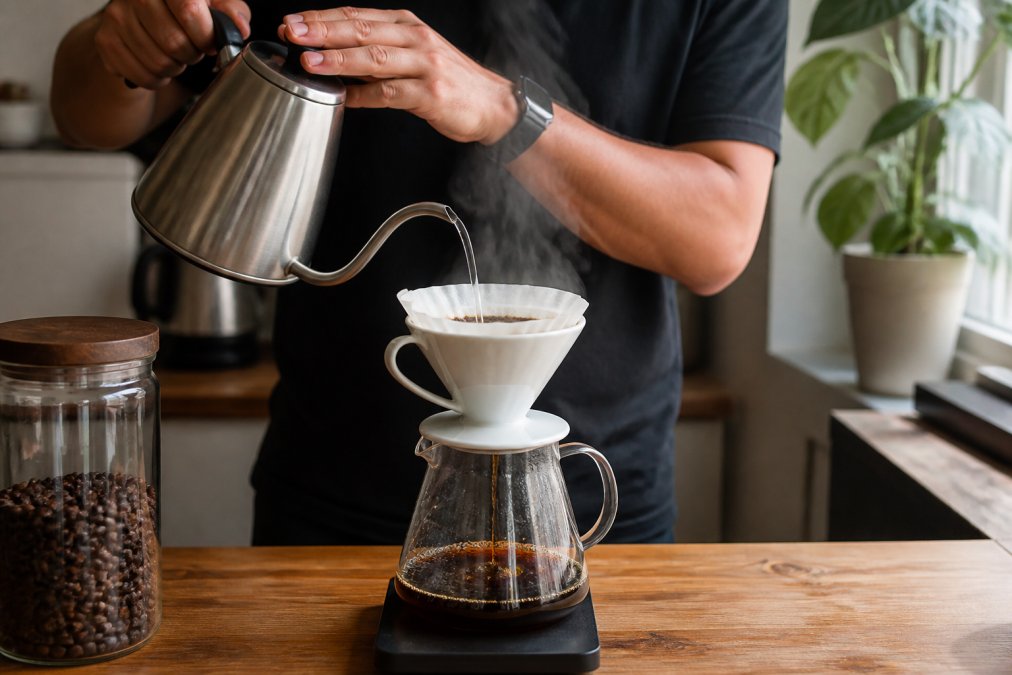
Pour-over is simple and forgiving. You pour hot water over grounds in a filter, and gravity does the work. It takes about 3-4 minutes.
Here's the process: Place a filter in your pour-over cone and rinse it with hot water to remove paper flavor and preheat the vessel. Add your ground coffee (use medium-fine grind for pour-over). Pour just enough hot water to wet the grounds, this is called the "bloom." Wait 30-45 seconds. The bloom lets CO2 escape, which improves extraction.
Pour the remaining water slowly in a circular motion, keeping the water level consistent. The total brew time should be 3-4 minutes. If it's faster, your grind is too coarse. If it's slower, your grind is too fine.
Pour-over produces a clean cup because paper filters remove oils. You taste the bean's origin characteristics clearly. It's an excellent method for learning how to brew fresh coffee for beginners because you control everything, water temperature, pour rate, grind size.
French Press Instructions
A French press steeps grounds directly in hot water for 4 minutes, then you press down a metal filter to separate grounds from liquid. It's tactile and produces a full-bodied cup because metal filters let oils through.
Add coarsely ground coffee to the empty press (use a 1:15 ratio). Pour hot water over the grounds, saturating them completely. Put the lid on but don't press down, just let it sit. After 4 minutes, press the plunger down slowly. Pour immediately into your cup.
French press is foolproof for beginners because timing is forgiving. If you steep for 3.5 minutes or 4.5 minutes, the difference is subtle. The main variable is grind size, too fine and you'll get sediment in your cup; too coarse and it'll taste weak.
The downside: French press produces more sediment than pour-over because metal filters don't catch fine particles. Some people love this, it adds texture and mouthfeel. Others find it gritty. Try it and decide.
Drip Coffee Maker Basics
An automatic drip machine heats water and pours it over grounds automatically. It's convenient and consistent because the machine controls temperature and pour rate.
Fill the water reservoir, add a filter and ground coffee (use medium grind), and press start. The machine handles the rest. Brew time is typically 5-10 minutes depending on the machine.
The trade-off: you lose control. You can't adjust temperature or pour rate mid-brew. Some machines brew hotter than others, which affects extraction. If your drip coffee tastes consistently bitter, the machine might be brewing too hot, try slightly coarser grounds to slow extraction.
Drip machines are great for beginners because they're simple. You're not learning technique; you're learning how beans and grind size affect flavor. Once you understand those variables, you can move to manual methods and apply that knowledge.
Troubleshooting Flavor Problems
Bad-tasting coffee usually comes down to three things: stale beans, wrong grind size, or incorrect water temperature.
Sour coffee tastes sharp and acidic in an unpleasant way. This is under-extraction, water didn't pull enough flavor from the grounds. Solutions: use finer grounds (slows water flow), use hotter water (speeds extraction), or brew longer (give water more time). Start with finer grounds.
Bitter coffee tastes harsh and dry. This is over-extraction, water pulled too much from the grounds, including unpleasant compounds. Solutions: use coarser grounds (speeds water flow), use cooler water (slows extraction), or brew shorter. Start with coarser grounds.
Weak coffee tastes thin and flavorless. You're under-extracting, but not enough to taste sour. Use more coffee, finer grounds, hotter water, or longer brew time. Most commonly, people use too little coffee, check your coffee-to-water ratio.
Muddy or flat coffee tastes dull even if it's not bitter. This usually means stale beans. Check your roast date. Beans older than 4 weeks will taste flat no matter what you do. Switch to fresher beans and the problem usually disappears.
Harsh or chemical taste suggests your water quality is the problem. Try filtered water and see if it improves.
Keep a simple log: date, beans (roast date and type), grind size, water temperature, brew time, and how it tasted. After 10 brews, patterns emerge. You'll see exactly which variables affect your results.
Frequently Asked Questions
How much coffee grounds should I use per cup?
Use a 1:16 coffee-to-water ratio as your starting point. For one 8-ounce cup, use 0.5 ounces (about 14 grams) of ground coffee. A digital scale makes this precise. If you prefer stronger coffee, adjust to 1:15. Weaker? Try 1:17. This ratio ensures proper extraction and balanced flavor, preventing sourness or bitterness.
Why use a burr grinder for coffee instead of a blade grinder?
Burr grinders produce uniform grind size, which ensures consistent extraction across all grounds. Blade grinders create uneven particles, some too fine, some too coarse, leading to over-extraction in small pieces and under-extraction in larger ones. This inconsistency causes sourness and bitterness in the same cup. Burr grinders are essential for brewing fresh coffee that tastes clean and balanced.
How do I store coffee beans for freshness after they arrive?
Store whole beans in an airtight container away from light, heat, and moisture. A sealed jar in a cool, dark cabinet works well. Beans stay fresh for 2-4 weeks after roasting when stored properly. Avoid the freezer unless storing for months. Grind only what you need right before brewing. Eager Beaver Roasters roasts to order, so your beans arrive at peak freshness, check the roast date on your bag.
Does water temperature affect coffee flavor?
Yes. Water between 195-205°F extracts the right balance of flavor compounds. Too cold (below 190°F) and you get sour, under-extracted coffee. Too hot (above 210°F) and you extract too much, creating bitterness. If your kettle doesn't have a thermometer, let boiled water cool for 30 seconds before pouring. Temperature control is one of the easiest ways to improve your cup immediately.
Learning how to brew fresh coffee for beginners is about understanding variables, not memorizing rules. Start with fresh beans from a roaster like Eager Beaver Roasters that roasts to order, use a burr grinder and scale, and pick one brewing method. Practice that method for two weeks. Taste what you make. Adjust one variable at a time. The coffee gets better because you're learning, not because you bought expensive gear. That's the real skill.
This article was written using GrandRanker