

How to Store Coffee Beans for Freshness
Table of Contents
- The Four Enemies of Coffee Freshness
- How Long Does Coffee Stay Fresh
- Best Coffee Storage Containers and Materials
- Freezing Coffee Beans for Long-Term Storage
- Whole Bean vs. Ground Coffee Storage
- Climate-Specific and Travel Storage Solutions
- Signs Your Coffee Has Gone Stale
- Conclusion
Last Updated: August 28, 2026
The Four Enemies of Coffee Freshness
Coffee deteriorates the moment it's roasted. The four primary culprits are heat, light, moisture, and air exposure. Heat speeds up oxidation and degrades oils. Light triggers photodegradation, breaking down the complex molecules that create taste. Moisture invites mold and damages cellular structure. Air exposure, particularly oxygen, oxidizes the coffee's surface and allows trapped carbon dioxide to escape.
The real problem is that most storage methods fail to block all four simultaneously. A clear jar on your kitchen counter might be airtight but allows light damage. A bag in a dark pantry might protect against light but suffers temperature fluctuations. Effective storage requires a system that addresses all four enemies at once.
How Long Does Coffee Stay Fresh
Peak freshness for whole bean coffee typically lasts 2-4 weeks after the roast date (peer-reviewed research). Ground coffee deteriorates faster, usually within 1-2 weeks, because grinding exponentially increases surface area exposed to oxygen (peer-reviewed research).
The roast date, not the purchase date, determines freshness. When you buy from Eager Beaver Roasters, we roast to order and ship immediately, so beans arrive at peak freshness. Grocery store coffee may have been roasted weeks or months before purchase, losing volatile compounds long before reaching your cup.
After four weeks, coffee doesn't become unsafe but loses complexity and brightness. Oils oxidize, creating a stale, flat flavor. For serious coffee drinkers, this degradation is unacceptable. For casual drinkers, properly stored coffee remains drinkable for several months, though quality declines steadily.
Freezing changes the timeline dramatically. Properly sealed and frozen whole beans can maintain reasonable freshness for 3-6 months (usda.gov). Ground coffee frozen lasts 1-2 months. Cold slows oxidation and prevents volatile compounds from escaping. However, freezing introduces a new risk: condensation when beans warm up.
Best Coffee Storage Containers and Materials
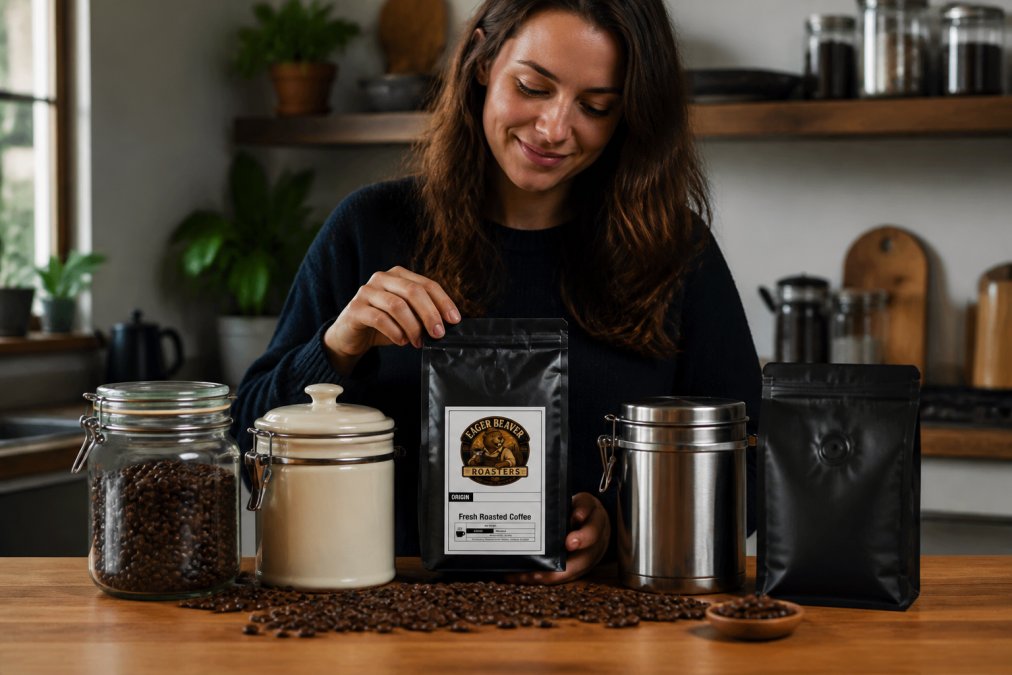
Not all containers are created equal. Glass, ceramic, and stainless steel are the top choices for serious storage.
Glass containers offer visibility and are chemically inert. The downside: most glass is transparent, allowing light exposure. Mirrored or opaque glass solves this but costs more. Ensure the seal is genuinely airtight.
Ceramic canisters with rubber gaskets provide excellent light protection and good seals. They're durable and won't absorb odors. Verify the gasket creates a true airtight seal by listening for a pop when you open it.
Stainless steel containers are the most durable and provide complete light blocking. They're ideal for travel or commuter storage because they're lightweight and nearly indestructible. Label the roast date clearly on the outside since you can't see the beans inside.
Avoid plastic, especially for long-term storage. Plastic absorbs odors and oils from coffee, degrading both the container and future batches. Some plastics also leach chemicals when exposed to coffee oils.
Why the Original Bag Works
The original bag from Eager Beaver Roasters or any quality roaster is engineered specifically for coffee storage. Most premium bags feature a multi-layer design: outer kraft paper, middle foil barrier, and inner lining that protects against moisture and oxygen.
The one-way degassing valve allows CO2 to escape during the first 24-48 hours after roasting while preventing oxygen from entering. This is why the original sealed bag often outperforms hastily chosen storage containers.
However, this only works if the bag stays sealed. Once opened, the valve becomes irrelevant and oxygen enters freely. This is the critical mistake: people buy excellent coffee in excellent bags, then store it with a clothespin or rubber band holding it closed. That's not airtight. Transfer to an airtight container immediately after opening.
One-Way Degassing Valves Explained
A one-way degassing valve is a small check valve built into coffee bags. CO2 pressure from inside pushes the valve open, allowing gas to escape. When external air pressure exceeds internal pressure, the valve closes, preventing oxygen from entering.
The valve works for about 2-3 weeks after roasting, until most degassing is complete. After that, it provides minimal benefit. Quality bags rely on their material to block light and resist oxygen permeation for the remaining storage time.
Freezing Coffee Beans for Long-Term Storage
Freezing works, but only if executed correctly. The goal is to slow oxidation and prevent volatile compounds from evaporating. The risk is condensation when frozen beans warm up.
Divide beans into small portions (enough for 1-2 weeks of brewing). Seal each in an airtight container or vacuum-sealed bag, removing as much air as possible. Label with the roast date. When needed, remove one portion and let it come to room temperature while still sealed. Open only after the beans have warmed completely to prevent condensation.
Frozen whole beans maintain quality for roughly 3-6 months. Ground coffee frozen lasts 1-2 months. Many enthusiasts freeze half their beans and keep the other half in an airtight container at room temperature, extending supply while keeping some beans at peak freshness.
Whole Bean vs. Ground Coffee Storage
Whole beans stay fresh significantly longer than ground coffee because they have far less surface area exposed to oxygen. Whole beans maintain peak freshness for 2-4 weeks. Ground coffee maintains peak freshness for 3-7 days.
The implication is clear: grind immediately before brewing. If you grind a week's worth of coffee on Sunday, by Friday you're brewing stale grounds.
If you must grind ahead, store ground coffee in the coldest part of your refrigerator in an airtight container. Expect a noticeable quality drop after one week. Freezing ground coffee extends this slightly, about 10-14 days, but thawing introduces condensation.
For serious coffee drinkers, a burr grinder is essential. It's the only way to grind consistently and immediately before brewing. Blade grinders create uneven particle sizes and generate heat from friction, both accelerating oxidation.
Climate-Specific and Travel Storage Solutions
Your climate determines which storage method works best. High humidity requires extra protection against moisture. Hot climates accelerate oxidation. Cold, dry climates are ideal.
In humid climates, airtight containers are non-negotiable. Glass or ceramic with rubber gaskets work well. Store in the coolest part of your home, never near windows or exterior walls where humidity fluctuates.
In hot climates, prioritize temperature control. A cool, dark closet is better than any counter-stored container. Consider a small wine cooler for significant quantities.
For travel or commute storage, stainless steel containers excel. They're lightweight, durable, and provide complete protection. Label with the roast date.
For office storage, keep beans in an opaque, airtight container at your desk. Avoid direct sunlight near windows. Bring fresh beans from home in smaller quantities rather than storing large amounts at work.
Signs Your Coffee Has Gone Stale
Stale coffee shows clear visual and olfactory signs.
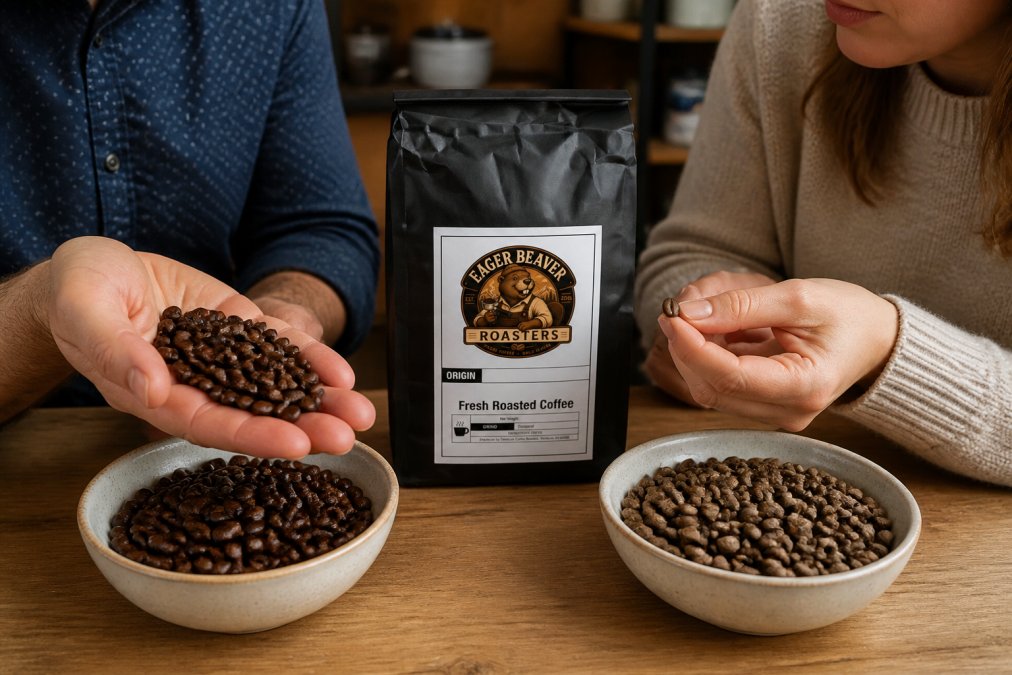
Appearance changes first. Fresh beans have a glossy, vibrant appearance with visible oils on the surface. As beans age, the surface becomes dull and matte. The color fades slightly.
Aroma diminishes noticeably. Open a bag of fresh beans and smell the powerful, complex aroma. Open a bag that's been sitting for two months and smell something flat and unremarkable. The volatile compounds that create aroma have evaporated.
Flavor becomes flat. Stale coffee tastes muted. The brightness and complexity disappear, leaving a one-dimensional, bitter taste without nuance.
Extraction behaves differently. Stale beans don't extract as efficiently. They require longer brewing times or finer grinds to achieve proper extraction. You might notice weak or sour coffee, signs that extraction is off.
Storing coffee properly isn't complicated, but it does require intentionality. The difference between excellent coffee and mediocre coffee often comes down to freshness. When you order from Eager Beaver Roasters, we roast to order and ship immediately, ensuring your beans arrive at peak freshness. The next step is on you: store them in an airtight, opaque container in a cool location, grind immediately before brewing, and use them within 2-4 weeks. Follow this system and you'll taste the difference every morning. Find Your Perfect Roast and start with beans that are genuinely fresh.
Frequently Asked Questions
How long does coffee stay fresh after roasting?
Whole bean coffee stays at peak freshness for 2-4 weeks after the roast date, though it remains drinkable for up to 2 months if stored properly in an airtight container away from heat and light. Ground coffee degrades faster, usually within 1-2 weeks, because grinding increases surface area exposed to oxygen and accelerates oxidation and rancidity. Check your roast date on the bag; Eager Beaver Roasters stamps every order with this information so you know exactly how fresh your beans are when they arrive.
Is it okay to store coffee beans in a Ziploc bag?
Standard Ziploc bags are not ideal for long-term storage because they are not completely airtight and allow moisture and air to enter over time. However, they work for short-term storage (1-2 weeks) if sealed carefully and kept in a cool, dark place. For better freshness, transfer beans to an opaque, airtight container with a one-way degassing valve, or use the original bag they shipped in if it has a valve and resealable closure. Vacuum-sealed bags offer superior protection but require a sealer.
Should you freeze coffee beans to keep them fresh longer?
Freezing coffee beans can extend shelf life to 3-6 months when done correctly, but it requires careful technique to avoid freezer burn and condensation damage. Store beans in an airtight, opaque container or vacuum-sealed bag, and thaw them completely before opening to prevent moisture from entering. Freezing works best for backup supplies you plan to use later; for your daily rotation, keep beans in the pantry at room temperature in an airtight container. Most specialty roasters recommend consuming frozen beans within 4 months for optimal flavor.
What are the best containers for storing coffee beans?
The best coffee storage containers are opaque, airtight, and made from glass, ceramic, or food-grade plastic. Look for containers with one-way degassing valves that allow carbon dioxide (released during the roasting process) to escape without letting oxygen back in. Vacuum-sealed containers offer maximum protection against oxidation. Many roasters, including Eager Beaver Roasters, package beans in bags designed with one-way valves and resealable closures, these original bags are often the best option because they're optimized for coffee storage. Keep any container in a cool, dark place away from direct sunlight and temperature fluctuations.
This article was written using GrandRanker