

7 Ways Water Hardness Changes Your Coffee Extraction
Last Updated: October 25, 2026
Quick Summary
Water hardness is the measure of dissolved calcium and magnesium in your brewing water, and it changes how much coffee flavor ends up in your cup. Hard water pulls more compounds out of the grounds, but too much hardness mutes acidity and clogs your machine. Aim for roughly 150 ppm hardness while keeping alkalinity in its own separate target range.
- Magnesium pulls out fruity and acidic notes, while calcium adds body but can push toward chalky or bitter flavors.
- Hardness counts calcium and magnesium; alkalinity counts bicarbonate and carbonate, and they are reported in the same unit.
- The best water hardness for coffee sits in the 75 to 250 ppm range, with roughly 150 ppm as the target.
- When water above roughly 250 ppm heats up, calcium carbonate drops out of solution and coats every surface it touches.
- Carbon filtration removes chlorine and some sediment but leaves minerals in place, so it is useless against hardness.
Table of Contents
- What Water Hardness Actually Means for Brewing
- How Hard Water and Coffee Taste Interact
- Hardness vs. Alkalinity: Two Numbers, Two Jobs
- The Best Water Hardness for Coffee, by the Numbers
- How to Test Water Hardness for Coffee at Home
- Coffee Machine Limescale from Hard Water
- Adjusting Your Brew Water: Recipes and Trade-offs
- Find Your Perfect Roast for Your Water
- Frequently Asked Questions
What Water Hardness Actually Means for Brewing
Water hardness is the measure of dissolved calcium and magnesium in your brewing water, and it changes how much coffee flavor ends up in your cup. Roughly 98% of a brewed cup is water, so the mineral content matters as much as the beans.
The short answer: hard water pulls more compounds out of the grounds, but too much hardness mutes acidity and clogs your machine. A 2026 study in PubMed's research on water composition and coffee sensory properties tested how hardness and alkalinity separately affect brewed Colombian coffee, which confirms what roasters have suspected for years.
Calcium, Magnesium and the Minerals That Do the Work
Calcium and magnesium are the two minerals that define hardness. Both bind to flavor compounds during brewing, but they behave differently.
- Magnesium pulls out fruity and acidic notes. It makes coffee taste brighter.
- Calcium adds body but can push toward chalky or bitter flavors at high levels.
- Bicarbonate buffers acidity. Too much and your coffee goes flat.
The balance between them decides whether your cup tastes lively or lifeless.
How Hard Water and Coffee Taste Interact
Hard water and coffee taste interact in ways that defy the simple "hard water is bad" rule. According to Java City's guide to water quality and coffee, hard water can actually enhance certain flavor notes, while excessive hardness causes bitterness and equipment buildup. Achieving the ideal balance requires a nuanced understanding of how mineral content influences extraction, a subject explored in depth through the water quality impact on home brewed coffee.
That nuance matters. A moderately hard brew water can round out a thin cup. Push past the upper limit and you get:
- Dull, muted acidity
- A dry, chalky finish
- Scale that ruins your kettle and machine
The real problem is not hardness itself. It is hardness you never measured.
Hardness vs. Alkalinity: Two Numbers, Two Jobs
Hardness and alkalinity are different measurements, and confusing them is the most common mistake we see. Hardness counts calcium and magnesium, the minerals that bind flavor compounds and pull them into your cup.
A water can be hard and low in alkalinity, or soft and high in alkalinity. Each combination brews a different cup, and the difference is large enough to taste side by side.
A Measurement-Based Comparison
| Property | What It Measures | Typical Brewing Target | What It Changes in the Cup |
|---|---|---|---|
| Hardness | Calcium and magnesium | About 50 to 150 ppm | Extraction strength, body, and how much flavor is pulled from the grounds |
| Alkalinity | Bicarbonate and carbonate | About 40 to 80 ppm | Perceived acidity, brightness, and whether the cup tastes flat or sharp |
Read the two rows together. Hardness without enough alkalinity can leave a cup sharp and thin because there is little buffering to round off the acids. Alkalinity without enough hardness can leave a cup flat and muted because there are few minerals pulling flavor out of the grounds. The target window is not a single number; it is a pair.
Why the Two Numbers Diverge
Hardness and alkalinity come from different sources in the water. Calcium and magnesium enter from limestone and mineral deposits. Bicarbonate enters from dissolved carbon dioxide and carbonate rock, and it shifts with water treatment and aeration. A municipal utility may soften water to reduce hardness while leaving alkalinity high, or blend sources in a way that changes one number without the other.
Carbonate Hardness, Temporary Hardness and TDS
Carbonate hardness, also called temporary hardness, is the part of hardness tied to bicarbonates. It drops out as scale when you boil water. Permanent hardness stays dissolved.
Total dissolved solids (TDS) measures everything dissolved in the water, not just calcium, magnesium, bicarbonate, or carbonate. A high TDS reading tells you something is in the water. It does not tell you what.
This is where most home brewers get stuck, and it is the gap our testing workflow is built to close. Once you have both numbers, the adjustment section below shows which treatment moves which value.
The Best Water Hardness for Coffee, by the Numbers
The best water hardness for coffee sits in the 75 to 250 ppm range, with roughly 150 ppm as the target. That guidance comes from Climpson & Sons' summary of SCA water recommendations, and it gives you a real window to aim for.
Here is how the ranges break down in practice:
| Hardness Level | ppm Range | Effect on the Cup |
|---|---|---|
| Soft | Under 75 | Thin body, sharp acidity |
| Target | Around 150 | Balanced extraction, clear flavor |
| Hard | 150-250 | Full body, watch for muted acidity |
| Very hard | Over 250 | Chalky, bitter, heavy scale risk |
Soft water is not automatically better. De'Longhi's water hardness guidance notes that soft water adds too much acidity and recommends keeping mineral content under 250 ppm. Aim for the middle, not either extreme.
How to Test Water Hardness for Coffee at Home
Testing water hardness for coffee at home takes about five minutes with a test strip or a TDS pen, but the reading only helps if you know what it is telling you. Most home brewers stop at a single number and miss the two measurements that actually predict how a cup will taste: hardness (calcium and magnesium) and alkalinity (bicarbonate and carbonate). A practical workflow captures both, then retests after any treatment so you can confirm the change instead of assuming it.
Step 1: Collect a Representative Sample
Fill a clean glass with the water you actually brew with, not water from a different tap or a bottle you keep for guests. Let the tap run for about 10 seconds first so you are not testing water that sat in the pipes overnight. If you use a filter pitcher or under-sink filter, collect a sample from the filtered side as well so you can compare before and after.
Step 2: Run a Hardness Test Strip or Drop Test
Dip a hardness test strip for one second, shake off the excess, and wait the time printed on the strip's instructions, usually 15 to 60 seconds. Match the color to the chart and record the result in ppm (or grains per gallon; 1 grain per gallon equals about 17.1 ppm). Drop-count test kits work the same way but count drops until the color changes, which is slower and more precise.
Step 3: Measure Alkalinity Separately
Hardness strips do not measure alkalinity, and a TDS pen measures neither. To capture alkalinity, use a separate alkalinity test strip or a KH (carbonate hardness) drop kit, both sold for aquarium and brewing use. Record that number next to the hardness reading. A water can read 150 ppm hardness and 40 ppm alkalinity, or 150 ppm hardness and 200 ppm alkalinity, and those two waters brew very different cups.
Step 4: Interpret the Pair of Numbers
Read the two results together rather than in isolation:
- Hardness around 50 to 150 ppm, alkalinity around 40 to 80 ppm: a workable brewing range for most methods. Expect clear acidity and balanced body.
- Hardness high, alkalinity low: plenty of calcium and magnesium to pull flavor, but little buffering. Cups can taste sharp or overly bright.
- Hardness low, alkalinity high: few extraction minerals but strong buffering. Cups often taste flat or muted even when the coffee is fresh.
A TDS pen is still useful, but only as a cross-check. It measures everything dissolved, so a high reading tells you something is in the water without telling you whether it is hardness, alkalinity, or sodium. Use TDS to confirm that a filter or dilution step changed the water, not to diagnose the cause.
Step 5: Retest After Treatment
After installing a filter, switching to bottled water, or mixing mineral packets into distilled water, wait until the new water has fully flushed through the system, then repeat steps 2 and 3. Compare the before and after numbers. A carbon filter should leave hardness and alkalinity largely unchanged; if the numbers moved, you are probably seeing a different water source or a filter that also softens.
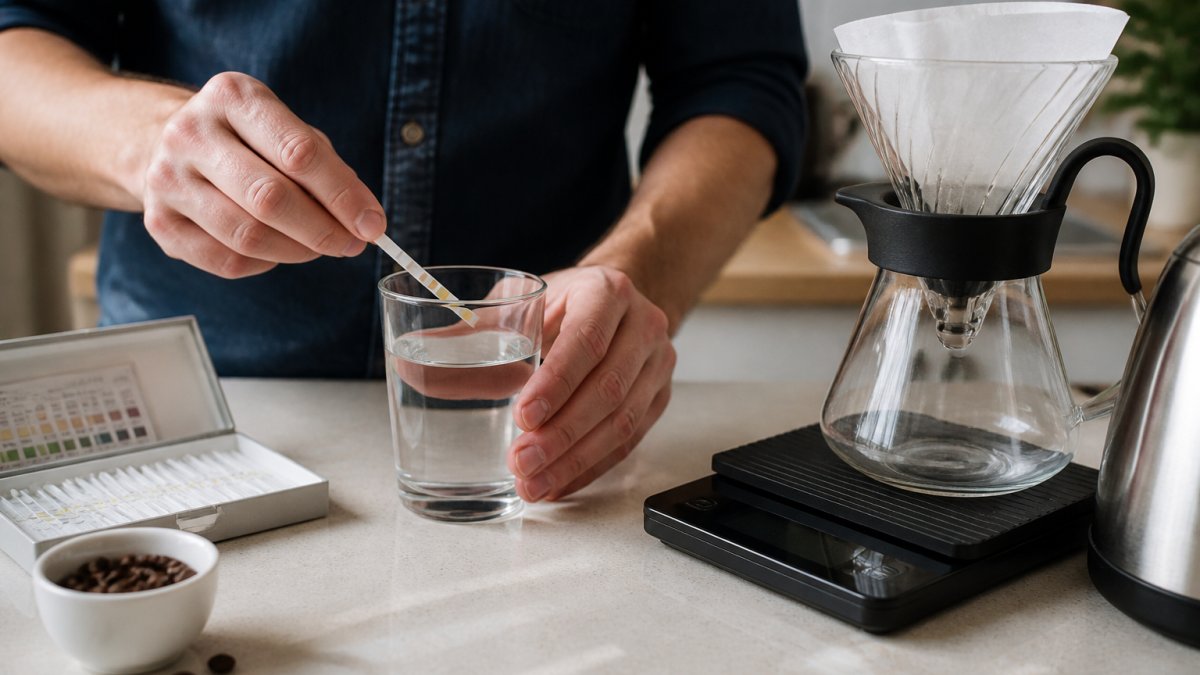
If your strip shows hard water, the next question is whether a filter is the practical fix. Our guide on whether water filters really improve coffee taste walks through what filtration does and does not remove.
Coffee Machine Limescale from Hard Water
Coffee machine limescale from hard water is the expensive part of this story. When water above roughly 250 ppm heats up, calcium carbonate drops out of solution and coats every surface it touches.
The damage builds slowly:
- Heating elements work harder and use more energy
- Flow rates drop and shots pull unevenly
- Bitter, metallic flavors creep into the cup
Descaling helps, but it is maintenance, not a cure. Our guide to the best coffee roasts for espresso machines pairs well with a water fix, since a well-matched roast shows off the difference immediately.
Adjusting Your Brew Water: Recipes and Trade-offs
Adjusting brew water means choosing between three approaches, each with a real trade-off.
Bottled water is the simplest option. Pick a brand with a published mineral analysis and stick with it.
Carbon filtration removes chlorine and some sediment but leaves minerals in place.
Mineral packets or concentrates let you build water from scratch, usually starting with distilled water and adding a measured blend.
| Method | Controls Hardness | Effort | Best For |
|---|---|---|---|
| Bottled water | Yes, if analyzed | Low | Simple setups |
| Carbon filter | No | Low | Chlorine removal only |
| Mineral packets | Yes, fully | High | Precise tuning |
Whichever route you take, apply it through a brewing method that lets you taste the change. Our guide to medium roast brewing methods covers the techniques that respond most clearly to water adjustments.
Find Your Perfect Roast for Your Water
Finding your perfect roast for your water is the last step, and it is where the impact of water hardness on coffee extraction becomes personal. Harder water mutes acidity, so a bright, fruit-forward coffee can taste flat.
Match your roast to your water:
- Hard water: lean toward fuller, chocolatey profiles that hold up
- Soft water: choose brighter coffees with clear fruit notes
- Balanced water: almost anything works, so experiment
Our Ethiopia Natural brings milk chocolate, fruity notes and caramel, and it rewards water in the target range. The Brazil Santos offers a smooth cup with cocoa notes, a clean single-origin baseline for testing how your water interacts with a nutty Brazilian profile.


Frequently Asked Questions
What happens if water hardness is too high?
Excess hardness pulls more compounds out of the grounds, and not all of them are welcome. Java City notes that hard water can enhance certain flavor notes, but excessive hardness may cause bitterness and equipment buildup. De'Longhi's guidance caps the mineral component under 250 ppm. Above that range, you risk chalky texture, muted acidity and faster scale formation inside kettles and machines. The fix is usually dilution with filtered or distilled water rather than abandoning your tap supply entirely.
Is hard or soft water better for brewing coffee?
Neither extreme wins. Soft water is not automatically better: De'Longhi's guidance says soft water adds too much acidity, which reads as sharp and thin in the cup. Hard water beyond roughly 250 ppm swings the other way toward bitterness and scale. Climpson & Sons reports the SCA-recommended range of 75-250 ppm with an ideal near 150 ppm. Aim for the middle of that band and you get sweetness, body and clarity without the downsides of either end.
How does water hardness affect coffee extraction?
Calcium and magnesium bind to flavor compounds in the grounds and carry them into the cup, so mineral content directly shapes extraction yield. Too little mineral and the water under-extracts, leaving the cup flat and dull. Too much and it over-extracts, pulling bitter and chalky notes alongside the good ones. A 2026 study in PubMed examined how hardness and alkalinity separately affect the sensory properties of brewed Colombian Kachalu coffee using duo-trio screening, which underlines that both variables deserve their own measurement.
Does hard water cause scale buildup in coffee machines?
Yes. Calcium and magnesium precipitate out as limescale when water is heated, coating heating elements, shower screens and valves. The higher your total hardness, the faster that layer forms. De'Longhi's guidance keeps minerals under 250 ppm to limit it, but even mid-range water needs regular descaling. If your espresso machine or kettle shows white crust, test your water and consider filtered or diluted brew water. Scale insulates heating elements, which raises running costs and shortens machine life.
Most brewers chase better coffee through gear and grind size while ignoring the water doing 98% of the work. Test your water, aim for that 150 ppm target, and taste what changes. Eager Beaver Roasters roasts every bag to order in light, medium and dark profiles, with no fillers and no shortcuts, so the coffee you brew is fresh enough to show you exactly what your water is doing. Find your perfect roast and start tasting the difference.
