

Why Coffee Loses Flavor After Grinding and How to Stop It
Last Updated: October 28, 2026
Quick Summary
Coffee loses flavor after grinding because grinding exposes far more surface area to air, which speeds up oxidation of the aromatic oils and volatile compounds that give coffee its taste. The biggest drop happens in the first day, and aroma can fade within minutes to hours.
- Aroma of ground coffee can be noticeably muted within 15 to 30 minutes if left open on the counter.
- The biggest flavor loss happens during the first day after grinding.
- In an airtight container, ground coffee holds acceptable flavor for about two weeks.
- Store ground coffee in an airtight, opaque container in a cool, dark cabinet.
- Grind only what you will brew in the next few days and keep whole beans for the rest.
Table of Contents
- Why Ground Coffee Loses Its Flavor So Fast
- How Oxygen and Surface Area Drive Oxidation
- How Long Does Ground Coffee Stay Fresh?
- Fresh-Ground Coffee vs. Pre-Ground Coffee
- How to Store Ground Coffee to Slow Staling
- How to Make Coffee Taste Like It Smells
- Test It Yourself and Start Brewing Fresher Coffee
- Frequently Asked Questions
Why Ground Coffee Loses Its Flavor So Fast
Coffee starts losing flavor the moment it's ground. That's not a myth or a marketing line. Grinding breaks the beans into thousands of small particles, and each new surface exposes aromatic oils to the air.
Here's the part most people miss: the flavor doesn't vanish all at once. It fades in stages, and the first day does the most damage.
So why does coffee lose flavor after grinding in the first place? Mostly because of air, surface area, and the aromatic compounds that make coffee smell and taste the way it does.
How Oxygen and Surface Area Drive Oxidation
Whole beans hold up well because their sealed outer layer protects the flavorful oils inside. Grinding removes that protection. A whole bean has a relatively small surface area, but a ground dose has far more exposed surface. More surface means more contact with oxygen.
Oxygen reacts with coffee oils and aromatic compounds. This process is called oxidation, and it breaks down the molecules that give coffee its flavor. The result is a flatter, duller cup.
The math explains the speed. A finely ground dose exposes much more surface than the same weight of whole beans, so it oxidizes faster. Finer grinds, often used for espresso, can stale even quicker.
- Whole beans: less exposed surface, slower staling
- Ground coffee: much more exposed surface, faster staling
- Fine grinds: the most exposed surface, the fastest loss
The Role of Volatile Aromatic Compounds
Much of what you taste starts with what you smell. Coffee contains volatile aromatic compounds, which are molecules that evaporate easily and reach your nose. These compounds carry the fruity, nutty, and chocolatey notes that make a cup interesting.
How Long Does Ground Coffee Stay Fresh?
Minutes to a few hours: aroma first. The volatile aromatic compounds that carry fruity, floral, nutty, and chocolatey notes are the most mobile molecules in the bag. Once the bean is broken open, they evaporate and react with oxygen quickly. A common pattern is that the smell of freshly ground coffee is noticeably muted within 15 to 30 minutes if the grounds sit open on the counter. The cup can still taste good at this stage; it just tastes less vivid.
Days 2 through 7: oils oxidize and the cup goes flat. Oxidation continues working on the coffee oils. The bright acidity softens, sweetness flattens, and the finish shortens. Many people describe the result as 'woody' or 'papery.' This is a flavor change, not a safety issue. Ground coffee at this stage is still fine to brew; it simply tastes less like itself.
One to two weeks: past its best for most palates. In an airtight container, ground coffee can hold acceptable flavor for a couple of weeks, but the gap versus fresh-ground becomes obvious in a side-by-side taste. Beyond that window, the cup is drinkable but the aromatics that made it interesting are largely gone.
A quick way to place your own bag on this timeline: smell the grounds right after opening the container. If the aroma is weak and the surface looks dry and matte, the coffee is well into the oxidation stage regardless of the roast date on the bag.
The article breaks freshness into stages, so a quick reference makes the timeline easy to scan.
| Stage | Timing | What changes |
|---|---|---|
| Aroma fades | Minutes to a few hours | Volatile aromatics evaporate and react with oxygen |
| Oils oxidize | Days 2 through 7 | Acidity softens, sweetness flattens, finish shortens |
| Past its best | One to two weeks | Aromatics largely gone in airtight storage |
Fresh-Ground Coffee vs. Pre-Ground Coffee
A few differences add up:
- Pre-ground coffee: packed early, often stale before you open it
- Freshly ground coffee: aroma and oils intact, more vivid flavor
- Pre-ground coffee: convenient, but the trade-off is taste
For help choosing fresher beans, see Fresh Roasted Vs Store Bought Coffee, Fresh Coffee Vs Instant Coffee Taste Difference, and How to Choose Fresh Coffee Beans at the Grocery Store.
How to Store Ground Coffee to Slow Staling
Storage will not stop staling, but the method you choose changes how much flavor you keep. The four enemies are oxygen, moisture, heat, and light, and each storage option handles them differently. Here is how the common approaches compare.
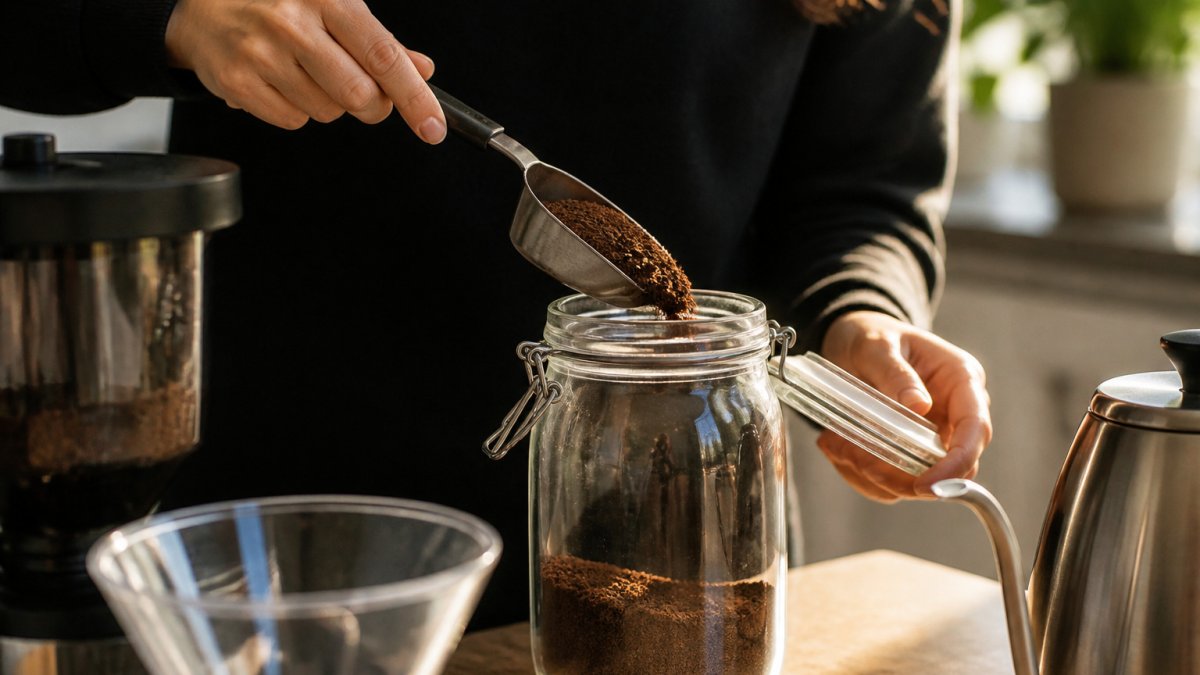
Airtight, opaque container at room temperature. This is the default for ground coffee you will finish within a couple of weeks. A sealed canister with a one-way valve or a tight gasket limits oxygen exchange, and an opaque body blocks light. Keep it in a cool, dark cabinet away from the stove, the sink, and any sunny counter. The trade-off is that every time you open the lid, fresh oxygen enters, so a smaller container you refill from a larger one reduces how often the whole batch is exposed.
The original bag, rolled and clipped. Better than an open jar, worse than a real airtight container. Most coffee bags have a one-way degassing valve that lets carbon dioxide out without letting much oxygen in, which is useful in the first days after roasting. Once the bag is opened repeatedly, the seal weakens. If you use the bag, press out as much air as possible before clipping and keep it in a dark cabinet.
Clear glass or plastic jar on the counter. Convenient and attractive, but the weakest common choice. Light accelerates the breakdown of aromatic compounds, and a clear jar on a warm counter combines two enemies at once. If you like the look, use an opaque jar or store the clear one inside a cabinet.
The refrigerator. Generally not recommended for ground coffee. Fridge interiors are humid, and every time you take the container out, condensation can form on the grounds. Moisture is the one enemy that can push coffee from stale toward spoiled. If you must refrigerate, use a truly airtight container and let it come to room temperature before opening.
The freezer for long-term storage. A reasonable option if you bought more ground coffee than you can finish in two weeks. Freeze it in small, airtight portions so you thaw only what you will use, and let each portion come to room temperature sealed before opening to avoid condensation. Do not refreeze the same grounds repeatedly; each thaw cycle adds moisture exposure.
Practical habits that matter more than the container:
- Grind only what you will brew in the next few days, and keep whole beans for the rest.
- Buy in amounts you can finish within two to three weeks of opening.
- Write the grind date on the container so you are not guessing.
- Keep the lid closed between scoops rather than leaving it open while you set up the brewer.
A simple decision rule: if you will finish the grounds within two weeks, an airtight opaque container in a dark cabinet is enough. If you will not, portion and freeze. If you are unsure, buy whole beans and grind per brew; that single change removes most of the storage problem.
How to Make Coffee Taste Like It Smells
Start with a few steps:
- Grind right before brewing so the aroma stays intact.
- Match grind size to your brew method. Fine grinds suit espresso, coarse grinds suit French press and cold brew.
- Weigh your dose and water with a scale so each cup tastes consistent.
- Use water heated to a proper brewing temperature, not boiling straight off the kettle.
Our Cold Brew Coffee is a dark French roast with very coarse grounds. For a fresh-roast option, our Cold Brew Coffee (medium roast, $23.99) is a smooth blend with chocolate, toffee, and floral tones, and it works for cold brew or nitro.
Test It Yourself and Start Brewing Fresher Coffee
A few more tips to try this week:
- Buy whole beans and grind as you go
- Write down the roast date and use the beans within a few weeks
- Store your coffee in a sealed, dark container
- Brew with a scale to remove guesswork
We roast to order. If you're ready to try the difference, explore our coffee and pick the right gear for precise brewing to get the most from every bean.
Frequently Asked Questions
Does fresh ground coffee actually taste better?
Yes, in most cases. Grinding exposes far more coffee surface area to oxygen, and volatile aromatic compounds begin to escape and oxidize within minutes. Research on coffee aroma has found that roughly half of the initial flavor can be lost during the first 24 hours after grinding, with different aroma notes degrading at different rates. Grinding just before brewing keeps the most aroma in the cup, which is the main reason freshly ground coffee tends to taste brighter and more complex.
How quickly does ground coffee lose its flavor?
Noticeable loss begins quickly. Published aroma research indicates that about half of the initial flavor can disappear within the first 24 hours after grinding, and the decline continues over the following days and weeks. Whole beans hold their flavor much longer because the intact cell structure limits oxygen contact. For the best cup, plan to use ground coffee within a day or two of grinding, and treat anything older than a couple of weeks as past its peak.
Should I grind coffee right before brewing?
Yes, if you want the most flavor. Grinding right before brewing minimizes the time oxygen has to attack the exposed grounds. Use a burr grinder for a consistent grind size, since uneven particles extract unevenly and can taste flat or bitter. Even if you only grind a few spoonfuls at a time, the difference in aroma is usually obvious in the first sip.
How should I store ground coffee to keep it fresh?
Keep ground coffee in an airtight container, away from heat, light, and moisture. Limit how often you open the container, and avoid storing it near the stove or on a sunny windowsill. Storing coffee in the freezer is an option for small amounts you won't use soon, but portion it into single-use bags so you never repeatedly expose the same grounds to air and condensation.
