

Are Manual Coffee Grinders Worth It for Home Brewing in 2026?
Last Updated: October 30, 2026
Quick Summary
A manual coffee grinder is worth it for many home brewers who want control over grind size and value for money. Choose one with durable burrs, a stepped adjustment with a wide range, and a sturdy build that matches your main brew method.
- Consistency matters more than size or brand, because uneven grounds make sour and bitter cups.
- Conical burrs give fewer fines, which many prefer for pour-over and French press.
- Hardened steel burrs hold their edge longer than softer alloys.
- Choose a stepped, clickable adjustment so you can return to settings you liked.
- Confirm the coarse end of the range before buying, or French press will suffer.
Table of Contents
- What Makes a Manual Coffee Grinder Good for Home Brewing
- Manual Coffee Grinder for Beginners: What to Buy First
- Matching a Manual Coffee Grinder to Your Brew Method
- Manual Coffee Grinder for Espresso: Can It Keep Up?
- Manual Coffee Grinder for French Press and Drip Coffee
- Manual Coffee Grinder vs Electric: Effort, Speed and Consistency
- Choosing Your Grinder and Your Next Cup at Home
- Frequently Asked Questions
What Makes a Manual Coffee Grinder Good for Home Brewing
A good manual coffee grinder does one job well: it turns whole beans into evenly sized particles that extract cleanly in your brewer. This guide is for home brewers who want to know whether a hand grinder is worth buying, and what to look for when they do.
Consistency is the core test. Uneven grounds produce a cup that tastes sour in some spots and bitter in others, no matter how good the beans are. That is why the burr set and the adjustment range matter more than size, color, or brand reputation.
Burr Type and Material
Most manual grinders use either conical or flat burrs. Conical burrs tend to produce a wider range of particle sizes with fewer fines, which many brewers prefer for pour-over and French press. Flat burrs can deliver a more uniform cut, which helps with espresso-style grinds.
Material matters too. Hardened steel burrs hold their edge longer than softer alloys, so they stay consistent after months of daily use. Ceramic burrs are durable but can chip if a stone or hard bean gets through.
Grind Adjustment Range and Precision
Look for a stepped adjustment with clear, repeatable clicks. Each click should move the grind setting by a consistent amount, so you can return to a setting you liked yesterday. A wide range matters if you brew several ways. A grinder that only goes fine or only goes coarse will limit what you can make.
Manual Coffee Grinder for Beginners: What to Buy First
If you are new to home brewing, start with a grinder that covers pour-over and French press well. These two methods teach you the most about grind size, and a mid-range manual grinder handles both without much fuss.
Skip the cheapest models with thin plastic bodies and loose burrs. They tend to wobble, drift out of alignment, and grind unevenly within a few weeks.
A practical starter checklist:
- Stepped, clickable grind adjustment
- Burrs made of steel or another durable material
- Stable base or crank that does not slip
- Capacity that fits your daily cup count
- Replaceable or serviceable burrs
Watch out: buying a grinder that only covers fine espresso settings will frustrate you when you try to brew a French press. Confirm the coarse end of the range before you buy.
Matching a Manual Coffee Grinder to Your Brew Method
Most guides tell you a hand grinder is 'compatible' with every method and stop there. That is not useful when you are standing at the counter at 6 a.m. trying to decide which click to use. This section maps grinders to specific brew methods with practical starting points, so you can dial in rather than guess. Treat the settings below as starting points to adjust one click at a time, every grinder's click scale is different, and bean density, roast level, and dose all shift the result.
French press
French press is the most forgiving method for a manual grinder because it needs a coarse, even grind and tolerates some fines. What it does not tolerate is a grinder that cannot go coarse enough, a common failure on espresso-focused hand grinders whose range tops out at medium. Achieving that necessary range becomes even more critical when transitioning to manual espresso presses, where the precision of the burr alignment dictates the success of the entire extraction.
- Starting point: coarse, roughly the texture of sea salt, near the coarsest third of the grinder's range.
- What to adjust: if the cup is muddy or silty, go one click coarser. If it tastes thin and sour, go one click finer.
- Grinder feature that matters: a clear, repeatable coarse setting and a catch cup that does not spill when you transfer a large dose.
Pour-over and drip
Pour-over rewards particle uniformity more than any other method here, because uneven grounds channel water through the bed and produce sour-and-bitter cups at the same time. This is where burr quality and adjustment precision pay off most.
- Starting point: medium, roughly the texture of table salt, near the middle of the range.
- Dose: a common starting ratio is about 1:16, for a 12 oz (350 mL) brew, roughly 20-22 g of coffee.
- What to adjust: if the drawdown stalls and the cup is bitter, go coarser. If it drains fast and tastes weak or sour, go finer.
- Grinder feature that matters: minimal fines and a repeatable mid-range setting. A grinder that produces a lot of fines will clog the filter regardless of setting.
AeroPress
AeroPress is the most flexible method for a manual grinder because it works across a wide grind range, fine for espresso-style concentrates, medium for standard brews, and coarse for longer steeps. That flexibility makes it a good match for a single hand grinder that covers the whole range.
- Starting point: medium-fine for standard recipes, toward the finer half of the range; coarser for longer steep-and-press recipes.
- Dose: a common starting point is 15-18 g for a standard 8-10 oz (240-300 mL) brew.
- What to adjust: if the press is hard to push, go coarser; if the cup is weak, go finer.
- Grinder feature that matters: a wide adjustment range, since AeroPress recipes span from fine to coarse.
Espresso
Espresso is the hardest method for a manual grinder and the one where grinder choice matters most. It needs a very fine, uniform grind, and small changes in particle size shift shot time dramatically. A hand grinder can do it, but the grinder needs a fine end that holds alignment without the burrs rubbing.
- Starting point: espresso-fine, near the finest usable setting, fine enough that the grounds clump slightly when pinched.
- Dose: a common starting point is 18 g in a double basket, adjusted to the basket size.
- What to adjust: dial in by shot time and taste, moving one click at a time. A shot that runs too fast and tastes sour needs a finer setting; one that runs slow and bitter needs coarser.
- Grinder feature that matters: stepless or fine-stepped adjustment and a rigid burr carrier. Espresso exposes alignment problems that other methods hide.
Choosing when you brew several methods
If you brew mostly one method, pick a grinder that does that method well and covers the neighboring settings. If you switch between methods, prioritize a wide adjustment range over peak performance at one extreme, a grinder that is excellent at espresso but cannot go coarse will frustrate you at French press, and vice versa. Decide your main brew method first, then choose the grinder.
Coffee roast also affects which grind works best. Learning your beans is part of the process.
The article maps each brew method to a grind starting point and dose, so you can scan the settings at a glance.
| Brew method | Starting grind | Key adjustment note |
|---|---|---|
| French press | Coarse, near the coarsest third of the range | Muddy or silty: go coarser; thin or sour: go finer |
| Pour-over and drip | Medium, near the middle of the range | Bitter or stalled drawdown: coarser; fast, weak or sour: finer |
| AeroPress | Medium-fine for standard recipes | Hard to press: coarser; weak cup: finer |
| Espresso | Espresso-fine, clumps slightly when pinched | Fast and sour: finer; slow and bitter: coarser |
Manual Coffee Grinder for Espresso: Can It Keep Up?
Manual grinders can produce espresso-fine grounds, but expect more effort and slower output. A single espresso dose takes time to crank through, and consistency depends heavily on your technique and the burr quality.
Look for a grinder with flat or high-quality conical burrs that hold a fine setting without clogging. Grinding speed is the main trade-off.
Keep the dose consistent from shot to shot. Small changes in how much coffee you grind can throw off your extraction time more than tiny adjustments to the grind setting.
Manual Coffee Grinder for French Press and Drip Coffee
French press is one of the most forgiving brews for manual grinders because it needs a coarse, even grind. Find out which light roast coffee for French press suits this method best. A stepped grinder with a clear coarse setting produces consistent results here, and it is easy to dial in.
Drip coffee sits between coarse and medium. Set the grinder to a medium-coarse grind and adjust one click at a time if the brew tastes weak or harsh. A consistent grinder with minimal fines gives the cleanest cup for both methods.
Manual Coffee Grinder vs Electric: Effort, Speed and Consistency
Electric grinders win on speed and convenience. A good electric model grinds a full dose in seconds with little effort.
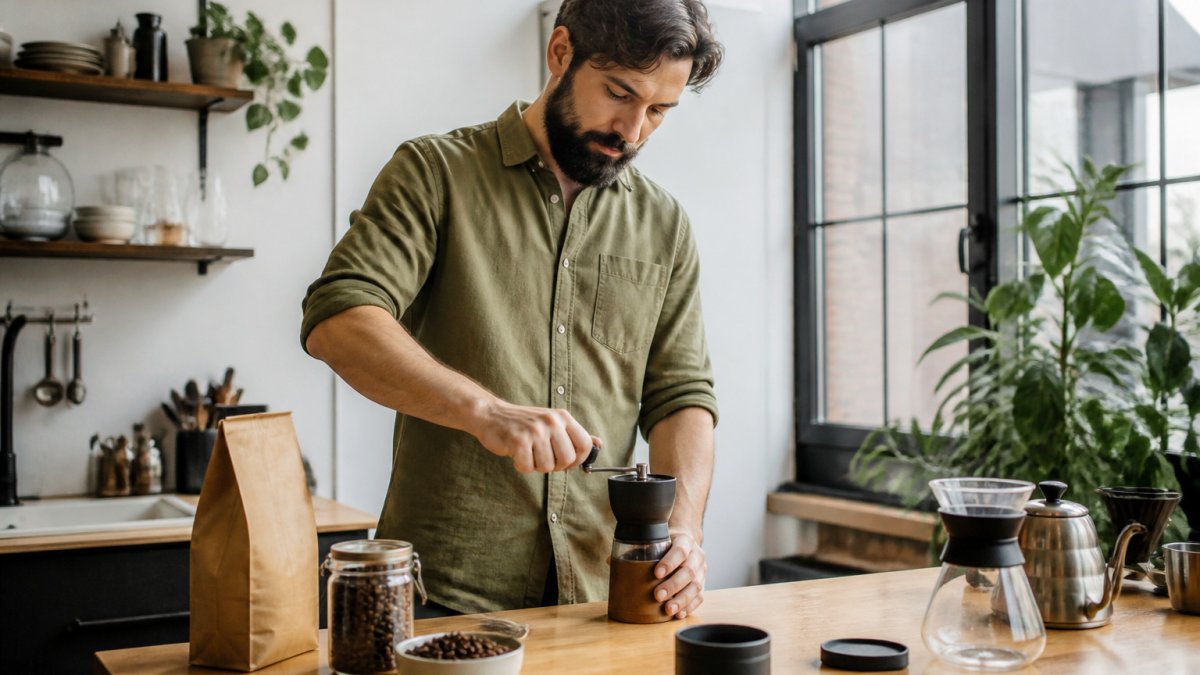
Consistency is closer than many people expect. A well-built manual grinder with quality burrs can match a mid-range electric grinder on particle uniformity.
Grinding fresh is the main reason to bother either way. Read why coffee loses flavor after grinding and how to prevent it.
Eager Beaver Roasters roasts to order in light, medium, and dark profiles, so you can pair a fresh roast with whichever grinder fits your routine.
Choosing Your Grinder and Your Next Cup at Home
A manual coffee grinder is worth it for home brewing when you want control over grind size, value for money, and a quiet, hands-on routine. Focus on burr quality, a stepped adjustment with a wide range, and a sturdy build. Use this guide to choose the right roast for your taste and method.
Start with the grinder that fits your main brew, then experiment one click at a time. Follow this step-by-step guide to brew fresh coffee for beginners. Pair it with freshly roasted beans and you will taste the difference.
Frequently Asked Questions
Are manual coffee grinders any good?
Yes, for home brewing they can be very good. A well-built manual grinder with steel burrs produces a grind that is consistent enough for pour-over, French press and drip. Quality varies widely, so the burr design, the adjustment range and the build matter more than the brand name. Cheap models with thin burrs or wobbly shafts give uneven grounds. A solid model costs more but lasts for years and needs no electricity or counter space for a motor.
Can a manual coffee grinder grind coffee fine enough for espresso?
Some can, but it depends on the burr set and the adjustment range. Espresso needs a very fine, uniform grind, and not every hand grinder reaches that setting with consistent results. Look for a grinder that lists a fine setting suitable for espresso and check reviews from people who pulled shots with it. Expect the process to take longer than with an electric grinder, and plan for a few minutes of effort per dose.
How long does it take to grind coffee by hand?
Grinding time depends on the dose, the burr size and the grind setting. For a typical home dose of about 15 to 20 grams for a single cup, most hand grinders take roughly one to three minutes. Finer settings take longer because the beans must pass through a narrower gap. Larger burrs and a comfortable crank handle reduce the effort. Coffee that is ground by hand is often made just before brewing, which helps flavor.
What should I look for in a manual coffee grinder for home brewing?
Focus on burr material and size, the range and clarity of the grind adjustment, build quality, and how comfortable the handle feels over several minutes. Steel burrs are durable and common, while ceramic burrs stay sharp for a long time. Check whether the adjustment clicks reliably between settings so you can repeat a grind. Capacity matters too: a small hopper suits one or two cups, while a larger one is more practical for a household.
