

Why Is My Espresso Sour? Fix It With This Guide
Table of Contents
- Sour Espresso Means Under-Extraction: What That Actually Means
- The Espresso Grind Size Guide for Fixing Sour Shots
- Ideal Espresso Brew Time: Dialing In Your Shot Duration
- Espresso Water Temperature Settings That Prevent Sourness
- Other Causes of Sour Espresso: Dose, Tamping, and Channeling
- How to Troubleshoot Sour Espresso Step by Step
- Common Mistakes to Avoid When Fixing Sour Espresso
- Final Thoughts on Fixing Sour Espresso at Home
- Frequently Asked Questions
Sour Espresso Means Under-Extraction: What That Actually Means
Sour espresso is the most common failure at home, and it almost always traces back to under-extraction: water pulls too few soluble compounds from the grounds, leaving behind the sugars and oils that balance acidity. What reaches your cup is a sharp, tart shot dominated by organic acids rather than sweetness.
Sour espresso is a diagnostic signal, not a flaw in the beans. The fix lives in your brewing variables. At Eager Beaver Roasters, we roast to order precisely because freshness changes how those variables behave, and we want you tasting the intended flavor profile, not fighting your equipment.
The good news: sour shots are the easiest to fix. Unlike bitterness, which can involve roast defects, sourness is almost purely a mechanics problem. Adjust grind size, brew time, water temperature, or dose, and you will land on a balanced shot within a few attempts.
The Espresso Grind Size Guide for Fixing Sour Shots
Grind size is the first lever to pull. If your espresso tastes sour, the grind is likely too coarse, letting water rush through the puck in seconds rather than slowly dissolving flavor compounds. A finer grind increases surface area and resistance, which raises extraction yield.
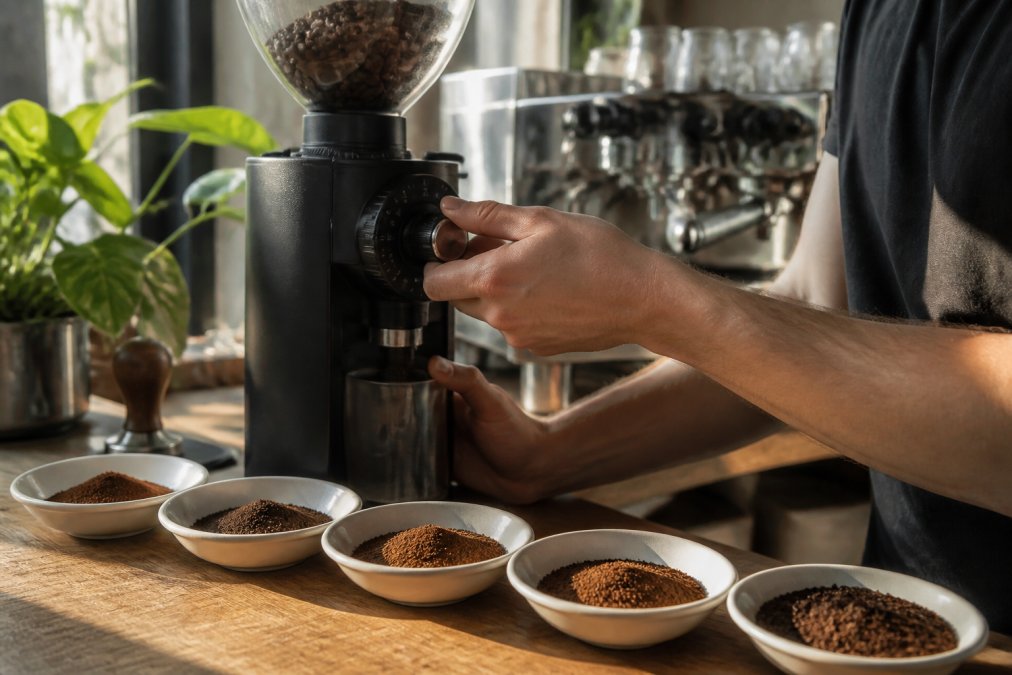
An espresso grind size guide starts with this rule: dial finer until the shot runs slow enough to taste balanced. Make small changes. A full number on most grinders is a massive jump; move in quarter increments.
Expect to pull a few shots while adjusting. Each shot should take roughly 25 to 30 seconds from pump start to stop (peer-reviewed research). If your shot finishes in 18 seconds and tastes sour, grind finer, then taste again.
Ideal Espresso Brew Time: Dialing In Your Shot Duration
The ideal espresso brew time for a standard double shot is 25 to 30 seconds. This window gives water enough contact with the coffee to extract sugars and oils while avoiding the harsh, dry compounds that appear later. Shots finishing faster than 25 seconds typically taste sour because extraction stopped too early.
Start timing the moment you engage the pump, not when coffee first appears. The first drops should fall around 8 to 10 seconds. If coffee gushes out immediately, your grind is too coarse or your dose is too low.
Shot volume matters alongside time. A standard double shot targets 36 to 40 grams of liquid out, based on an 18 gram dose. That is a brew ratio of roughly 1:2. If you hit 40 grams out in 20 seconds, you pulled a sour shot, even though the volume looks correct.
Espresso Water Temperature Settings That Prevent Sourness
Espresso water temperature settings sit lower than most home brewers assume, but sour shots often mean the water is too cool. Extraction is temperature-dependent: cooler water dissolves fewer soluble compounds, producing the same under-extraction as a coarse grind. Target 195 to 205 degrees Fahrenheit at the group head (sca.coffee).
Many home machines run cool despite their gauges reading correctly. The thermostat measures the boiler, not the water hitting the coffee. If your machine lacks a PID controller, flush a few ounces through the group before locking in the portafilter. This warms the group head and stabilizes temperature.
Light roast coffee needs the hotter end of that range. Light roasts are denser and less soluble, so they require more thermal energy to extract properly. Dark roasts tolerate cooler water, but they rarely cause sourness in the first place.
The Water Chemistry Factor That Changes Everything
Temperature is only half the story. The water itself, specifically its mineral content, directly controls how acids in the coffee are extracted and perceived. Most home baristas never consider this, yet it is often the hidden reason a shot tastes sour even when grind, dose, time, and temperature are all correct.
The key metric is alkalinity (bicarbonate content), not hardness (pubs.acs.org). Hardness (calcium and magnesium) helps extraction by providing ions that bind with coffee compounds. Alkalinity buffers against acidity, it neutralizes acids. If your water has very low alkalinity, the water cannot buffer the natural acids in coffee, and those acids hit your palate as sharp, sour flavors, regardless of how well you extracted the shot.
The practical problem: Most municipal tap water in the United States is either too hard (high in both calcium and bicarbonate) or too soft (low in both). Both extremes cause problems:
- Hard water (common in the Midwest and Southwest): High bicarbonate levels over-buffer acidity, producing flat, dull, sometimes salty shots. But the bigger issue is scale buildup inside your boiler, which throws off temperature stability over time.
- Soft water (common in the Pacific Northwest and New England): Low alkalinity means acids are not buffered at all. Your espresso will taste sour and sharp even when every other variable is perfect.
What to do about it:
- Check your water. If your tap water is noticeably hard (white scale on your kettle) or noticeably soft (soap doesn't lather easily), your water is likely a factor.
- Use bottled spring water as a baseline test. Spring water typically has moderate hardness and alkalinity (around 50-100 ppm total dissolved solids). Pull a shot with it. If the sourness disappears, your tap water is the culprit.
- Consider a simple recipe. Many home baristas use a blend of distilled water and a small amount of tap water or a commercial mineral concentrate (e.g., Third Wave Water's Espresso Profile) to hit the ideal range of roughly 50-80 ppm alkalinity and 100-150 ppm hardness. You do not need a lab; you need to test one bottle of spring water against your tap water to isolate the variable.
A quick sensory check: If your shot tastes sour but also feels thin or "sharp" on the tongue, suspect water chemistry. If it tastes sour but has a heavy, coating mouthfeel, suspect under-extraction from grind or dose. Water issues produce a distinct, clean sharpness that does not resolve with grind adjustments.
Temperature and water chemistry work together. A machine running at 198 degrees with low-alkalinity water will produce a doubly sour shot. Fix temperature first, then test water. Water chemistry is often the last 10% of dialing in, but it is the difference between a good shot and a great one.
Other Causes of Sour Espresso: Dose, Tamping, and Channeling
Grind, time, and temperature cover most sour shots, but three other variables can sabotage an otherwise correct setup. Dose weight is the quiet culprit. If your basket holds 18 grams and you load 15, water finds less resistance and flows too fast. Weigh your dose and confirm the basket is actually sized for that weight.
Tamping consistency matters more than tamping pressure. A level, uniform tamp seals the puck evenly. An uneven tamp creates weak spots where water channels through, extracting only part of the coffee. That channeling produces a sour, thin shot alongside a bitter edge from the over-extracted areas.
Channeling is the hidden killer. Even with correct grind and dose, a cracked or uneven puck lets water bypass most of the coffee. Knock the portafilter gently after tamping to settle the puck, and always distribute grounds before tamping so density is uniform.
The Equipment Variable Most Guides Miss: Pressurized vs. Non-Pressurized Baskets
Here is where most troubleshooting articles stop, and where your specific machine setup starts to matter more than any single grind setting. The basket in your portafilter determines how much control you actually have over extraction, and it changes how you should interpret a sour shot.
Non-pressurized (single-wall) baskets are what specialty coffee shops use. They have a flat, perforated bottom that relies entirely on the coffee puck's own resistance to build pressure. If you own a machine with a non-pressurized basket, the grind size advice in this article applies directly: a coarse grind means water rushes through, under-extracts, and you get sourness. You have full control, and full responsibility, for the puck's integrity.
Pressurized (double-wall) baskets are common on entry-level home machines (e.g., many models from Breville, De'Longhi, and Mr. Coffee). These baskets have a single small hole on the bottom that artificially builds pressure regardless of grind size. They are designed to forgive inconsistent grinding and stale coffee. If you are using a pressurized basket and your espresso tastes sour, the cause is rarely your grind setting. In fact, grinding finer on a pressurized basket can choke the machine or produce a bitter, over-extracted shot because the pressure is already fixed by the basket's design.
Instead, with a pressurized basket, sourness usually points to one of two issues:
- Dose is too low. The basket needs enough coffee to create a proper seal against the rubber gasket. Under-dosing by even 2 grams can cause water to pool above the puck and extract unevenly, producing a thin, sour shot.
- The basket is dirty or clogged. The single hole is tiny, about 0.5 mm across. Old coffee oils and residue can partially block it, reducing flow to a trickle and causing the water to overheat or stall, which produces a sour, under-developed flavor.
How to tell which basket you have: Look at the bottom. If you see many small holes across the entire surface, it is non-pressurized. If you see a single hole in the center (sometimes hidden behind a small cap), it is pressurized. Many machines ship with both; check your accessory box.
This distinction matters because it changes the entire troubleshooting path. A guide that tells you to "grind finer" without checking your basket type may make your sour shot worse. Check your basket before you touch the grinder.
How to Troubleshoot Sour Espresso Step by Step
Work through this sequence in order, changing one variable at a time. Pull a shot after each adjustment and taste before moving on.
- Confirm your dose matches the basket. Weigh 18 grams for a standard double basket.
- Grind finer by one small increment on your grinder.
- Pull a shot and time it from pump start. Aim for 25 to 30 seconds.
- Verify the yield: 36 to 40 grams of liquid for an 18 gram dose.
- If the shot still runs fast, grind finer again and repeat.
- If timing is correct but the shot tastes sour, raise water temperature by 2 to 3 degrees.
- Check your puck after the shot. A dry, solid puck means even extraction. A muddy or cratered puck indicates channeling.
| Symptom | Likely Cause | Fix |
|---|---|---|
| Shot finishes under 20 seconds, sour | Grind too coarse | Grind finer, retest |
| Shot times correctly, still sour | Water too cool | Increase temperature 2-3 degrees |
| Uneven extraction, sour plus bitter | Channeling from uneven tamp | Distribute grounds, tamp level |
| Fast flow, thin body | Dose too low for basket | Weigh dose, add coffee |
Common Mistakes to Avoid When Fixing Sour Espresso
The most common mistake is changing too many variables at once. Adjust grind, then taste. If you also change dose and temperature in the same shot, you cannot identify which fix worked. That turns dialing in into guesswork.
Another frequent error is ignoring freshness. Coffee that sits for weeks after roasting degasses and extracts differently, often producing dull, sour cups. Freshly roasted beans within a few weeks of their roast date behave predictably. Stale beans do not. If your beans lack a roast date on the bag, you are flying blind.
Skipping the purge between grind settings also wastes shots. Residual grounds from a coarser setting mix with your new dose and throw off extraction. And do not chase sourness by pulling longer shots; extending time past 35 seconds adds bitterness without fixing the sourness. The problem is extraction rate, not total time.
Final Thoughts on Fixing Sour Espresso at Home
Sour espresso frustrates every home barista at some point, but the diagnosis is straightforward: water is not extracting enough from your coffee. Work through grind size, brew time, and water temperature in that order, and you will find balance within a few shots.
The variable most people overlook is the beans themselves. Coffee roasted to order, with a visible roast date, extracts predictably because it has not lost its volatile compounds to time. At Eager Beaver Roasters, we roast in small batches and ship fast so your dialing-in process starts from a consistent baseline. Our African Espresso blend sourced from Kenya, Tanzania, and Ethiopia offers a medium-dark profile that handles home espresso machines well, while the Blonde blend from Central America and Africa suits those chasing sweet,明亮 shots.

Get the mechanics right, start with fresh beans, and sour espresso becomes a solved problem rather than a daily mystery.
Frequently Asked Questions
Why does my espresso taste sour even though I brew it correctly?
If your espresso tastes sour, the shot is almost always under-extracted. That means water pulled too few soluble compounds from the coffee grounds. The most common culprits are a grind that is too coarse, a brew time under 25 seconds, or water that is not hot enough. Try grinding finer and see if the shot time increases toward the 25-30 second range. Also check that your water is between 195-205°F before you lock in the portafilter.
Does grind size affect espresso sourness?
Yes, grind size is the first thing to adjust when your espresso tastes sour. A coarse grind exposes less surface area to water, so extraction happens too quickly and the shot runs fast. This leaves acidic compounds dominant. Grind finer to slow the flow and increase extraction. Make small adjustments, one step at a time, and pull another shot to taste the difference.
How does water temperature impact espresso flavor?
Water temperature directly controls how quickly coffee solubles dissolve. If your water is below 195°F, extraction slows down and you will likely taste sour, acidic notes. Most home machines brew best between 195-205°F. If your machine runs cool, try flushing the group head for a few seconds before locking in the portafilter to warm it up. Light roasts often need the higher end of that range to extract properly.
What is the ideal espresso brew time for a balanced shot?
For a standard double shot, aim for a brew time between 25 and 30 seconds from the moment you start the pump. If your shot finishes in under 25 seconds, it is running too fast and will likely taste sour. That usually means your grind is too coarse or your dose is too low. Increase the dose or grind finer to slow the flow. Keep your yield consistent and adjust only one variable at a time.
Mastering extraction takes practice, and every bag of coffee behaves slightly differently. That is why we roast to order and print the roast date on every bag, so you know exactly what you are dialing in. Explore our light, medium, and dark roast options to find the profile that rewards your technique. Find Your Perfect Roast with Eager Beaver Roasters and pull shots worth savoring.
This article was written using GrandRanker